Home Page

|
|
|
Get on our news & bulletins mailing list
Yesterday, today and tomorrow
NEWS BULLETIN ARCHIVES
Also see NevadaLabor.com's Statewide U-News Roundup[[EDITOR'S NOTE: Unless otherwise noted, historical items appear courtesy of longtime Nevada reporter Dennis Myers' Poor Denny's Almanac. [PDA] Items highlighted in blue are of particular interest to labor. Copyright © 2006 Dennis Myers.]]
Update: Tuesday, Oct. 31, 2006, 3:35 p.m. PST — On Oct. 31, 1984, Indian Prime Minister Indira Gandhi was assassinated near her residence by two Sikh security guards. [New York Times/AP e-headlines]
On this date in 1517, Martin Luther posted his 95 theses on the door of the church in Wittenberg; in 1864, Nevada became the 36th state (see below); in 1882, the Nevada State Journal observed "Last evening was Hollow Eve, and yet the people were so absorbed in political and other matters that few were aware of the fact."; in 1903, a Reno constable arrested Señor Enrique Robles, "toreador from Madrid", apparently for bullfighting — "For unlawfully having a living creature, to-wit a bull, in an enclosure and by tormenting and arousing his savage instincts by waving a red flag in his face."; in 1922, in admission day remarks to Sparks high school students, former governor Emmet Boyle said that turning the Spanish Springs Valley into an irrigation reservoir and building the Boulder dam project would build up the state; in 1931, when Governor Fred Balzar returned to Nevada from a hunting trip he found a letter that Acting Governor Morley Griswold had neglected to answer "a request from Assemblymember Lindley Branson of White Pine County for a special session of the legislature, apparently to abolish the senate; in 1937, Groucho and Chico Marx were convicted of violating copyright laws by allegedly using a script submitted to them by two writers without paying for it (Harpo was not included in the action because he never spoke during skits and so could not be said to have performed the script); in 1938, after many in the United States were panicked by the Mercury Theatre's radio play of H.G. Wells' The War of the Worlds that was dramatized in the form of news reports, H.G. Wells said in London that in his agreement selling the rights to the story, he gave no permission for alterations such as the news reports; in 1949, a collection of musical and jewelry memorabilia that once belonged to Carson City jeweler and amateur weatherman Charles Friend was put on display for an admission day exhibit in the state capital (the collection had been purchased at auction by Republican Party figure and Home Means Nevada composer Bertha Raffetto); in 1953, the Nevada Day Committee sponsored as part of the admission day entertainment in Carson City Dat So La Lee/An Indian Legend with a cast of 200 Native Americans, plus the mysterious and beautiful Puberty Dance and Battle of the River of the Washoe-Paiute War; in 1953, some Reno folks found a way to make children hate admission day — the usual Saturday morning programs at movie theatres and the county library were cancelled; in 1956, two days after Israel launched an unprovoked attack on Egypt, Britain and France — over the objection of the U.S. — joined the attack (the Eisenhower administration said it stood by its 1950 declaration pledging assistance to any Middle East victim of aggression, but it failed to come to Egypt's aid); in 1959, Idaho Representative Joseph Garry, a Native American and president of the National Congress of American Indians, announced his candidacy for the United States Senate; in 1959, former Nevada District Judge Clark Guild was the grand marshal of the Nevada Day parade in Carson City; in 1964, Baby Love by the Supremes, their biggest hit and the second of five straight hits, went to number one on the Billboard magazine chart (the song was used as a protest against police brutality in Purple Haze aka More American Graffiti) and this was the first week's top 100 chart not to feature a Beatles song since January; in 1965, the New York Times published a story on a peculiar slice of the dark underside of life — a profile of Daniel Burros, a Jewish Nazi and Klansman who killed himself the day the story appeared; in 1965, the only Sunday Nevada Day parade was held, never repeated because of objections from Christians; in 1970, Richard Nixon campaigned in Las Vegas for Republican U.S. Senate candidate William Raggio; in 1970, Nevada Appeal editor Zane Miles resigned in protest against newspaper chain owner Donald Reynolds' enforcing an editorial endorsement of U.S. Senator Howard Cannon's reelection onto the newspaper; in 1992, after thirteen years of study, and 359 years after the event itself, a Vatican panel recommended that the heresy conviction of scientist Galileo Galilei (for arguing that the earth revolves around the sun instead of the other way around) be lifted, a recommendation John Paul II accepts, saying "One day we may find ourselves in a similar situation..." — but the church failed to apologize; in 2000, Russia offered intercontinental ballistic missiles for sale.
From the Davenport [Iowa] Daily Gazette/October 31, 1864
BY THE PRESIDENT OF THE UNITED STATES OF AMERICA:
A PROCLAMATION
WHEREAS, The Congress of the United States passed an Act, which was approved on the 21st day of March last, entitled "An Act to enable the people of Nevada to form a Constitution and State Government, and for the admission of such State into the Union on an equal footing with the original States;
And whereas, the said Constitution and State Government have been formed, pursuant to the conditions prescribed by the fifth section of the Act of Congress aforesaid, and the certificate required by the said Act, and also a copy of the Constitution and ordinances, have been submitted to the President of the United States;
Now, therefore, be it known, that I, ABRAHAM LINCOLN, President of the United States, in accordance with the duty imposed on me by the Act of Congress aforesaid, do hereby declare and proclaim that the said State of Nevada is admitted into the Union on an equal footing with the original States. In witness whereof, I have hereunto set my hand, and caused the seal of the United States to be affixed.
Done at the city of Washington this thirty-first day of October, in the year of our Lord one thousand eight hundred and sixty-four, and of the independence of the United States the eighty-ninth.
(signed) ABRAHAM LINCOLN
By the President:
WILLIAM H. SEWARD, Secretary of State.
Update: Monday, Oct. 30, 2006, 2:24 a.m. PST — On Oct. 30, 1974, Muhammad Ali knocked out George Foreman in the eighth round of a 15-round bout in Kinshasa, Zaire, to regain his world heavyweight title. [New York Times/AP e-headlines]On this date in 1872, the New York Herald carried a report from Salt Lake City that the George Wheeler expedition had split into several parties, with Wheeler leading one of them to the Colorado River and northern Arizona, and one of the other parties traveling into southeastern Nevada; in 1874, the Pacific Coast Pioneers held third anniversary balls and celebrations of Nevada statehood in the Odd Fellows' Building in Virginia City and the Gold Hill Miners' Union Hall; in 1878, the Nevada State Journal reported that "Very few Indians now make the Pyramid Lake Reservation their home. There are not over fifty there. Generally the reservation is the home for nearly three hundred; but nearly all are now away pinenutting, so as to lay in their Winter's supply."; in 1938, the Mercury Theatre's radio dramatization on CBS of H.G. Wells' The War of the Worlds created a panic among listeners who tuned in late and thought they were hearing a news broadcast; in 1950, columnist Earl Wilson reported that the U.S. House Un-American Activities Committee would soon turn its attention to the assassination of Leon Trotsky; in 1952, the Las Vegas Sun, which had earlier endorsed Dwight Eisenhower for the presidency, switched its endorsement to Adlai Stevenson in reaction to Eisenhower's willingness to accommodate McCarthyites, with publisher Hank Greenspun writing that "Right thinking people cannot condone the embracement of McCarthy in Wisconsin and Jenner in Indiana, no matter what the end result may be."; in 1953, the Nevada sagebrush chapter of the Daughters of the American Revolution gave U.S. Senator Patrick McCarran an award for his "fight against communist subversive infiltration" and his sponsorship of an immigration law designed to exclude non-Aryan races from the U.S.; in 1953, columnist Erskine Johnson reported that Martin and Lewis rejected an offer to appear in Las Vegas for $50,000 a week; in 1956, the McGill Civic Organization, the new town board, voted unanimously to support a proposal by TV Pix Inc. to provide three television channels in town; in 1959, French colonial occupation troops captured 76 Algerian patriot rebels in a cave east of Algiers; in 1959, Washoe County commissioners were snarling about the commission's appointment of Ray Crosby to a Democratic seat in the Nevada Assembly, with Democratic commissioner J.S. McKenzie saying that the two Republican commissioners had appointed Crosby because he was really a Republican who had only recently switched parties [EDITOR'S NOTE: The appointment cost Crosby his livelihood. KOLO Radio, then owned by Donald W. Reynolds' Donrey Media Group, served Crosby notice to show up for work as an ad salesman, which he could not do after the 1960 legislative session had begun. The ultimatum appeared shortly after Crosby introduced a bill calling for an investigation into all aspects of the operation of Sierra Pacific Power Company, in effect a utility consumer advocate bill two decades ahead of its time. Nevada ratepayers finally got a consumer advocate in 1981]; in 1961, Elvis' version of the 1911 song Come Back to Sorrento, with new lyrics and a different title, Surrender, hit number one on the Billboard chart; in 1974, Muhammad Ali became the second fighter in boxing history to regain the heavyweight championship, seven years after it was stripped from him; in 1975, a day after President Ford's secretary of the treasury, William Simon, told a congressional committee "I would urge that the financial terms of assistance be made so punitive, the overall experience so painful, that no city, no political subdivision would ever be tempted to go down the same road" and Ford himself promised a veto of assistance to New York City, the New York Daily News ran one of the most famous headlines of the century: "FORD TO CITY: DROP DEAD"; in 1978, an unforgettable episode of WKRP in Cincinatti, Turkeys Away, was first broadcast, implanting a memorable sentence in the minds of a generation of viewers — "As God is my witness, I thought turkeys could fly."; in 2000, Steve Allen died; in 2004, John Lukac of Las Vegas died near Fallujah, Iraq.
Update: Sunday, Oct. 29, 2006, 9:54 a.m. PST — On Oct. 29, 1929, stock prices collapsed on the New York Stock Exchange amid panic selling. Thousands of investors were wiped out. [New York Times/AP e-headlines]
On this date in 1861, the New York Times reported that Creek tribe Chief Opothleyaholo (properly Hupuehelth Yahólo) was leading a force of 1,700 warriors against the Confederacy (most of his tribe had entered into a treaty with the Confederacy and he withdrew from the Creek nation with about a third of the population to support the Union); in 1873, a convicted murderer named Matheny in Eureka County was planning to ask Governor Lewis Bradley for a commutation and the Nevada State Journal called it "an excellent opportunity to his Excellency to show his moral courage‚" (however, Nevada governors did not have the power of commutation); in 1892, the Nevada State Journal questioned why former U.S. representative William Woodburn supported Francis Newlands for the Silver Party nomination but was now running against him as the candidate of the Republican Party; in 1898, the Nevada State Journal called the editors of the Territorial Enterprise and the Carson City News coprophagists; in 1895, the Nevada Equal Suffrage Association began its first state convention in Reno; in 1901, Leon Czolgosz [chawl-gosh], alleged assassin of President McKinley, was put to death, just 54 days after the assassination; in 1904, Democratic-Silver candidate for state senator Patrick McCarran spoke at Wadsworth — Wadsworth and Olinghouse precincts were reported to be strongly in favor of Democratic candidates; in 1923, Returning from Washington where governors met with President Coolidge, Nevada Governor James Scrugham announced in Elko that he was calling a November 12 law enforcement conference at which a strategy would be mapped to make alcohol prohibition work; in 1923, Scrugham also said he met with U.S. Secretary of Agriculture Henry Wallace and that Nevada was going to have to become more aggressive in its efforts to get Congress to support plans to turn the Spanish Springs Valley into an irrigation reservoir; in 1929, after several days of stock market crashes, the biggest one of all hit (see below); in 1941, President Franklin Roosevelt signed executive order 8927, withdrawing Nevada public lands from public use for National Defense Purposes; in 1947, in New Hampshire, General Electric produced rain by cloud seeding; in 1953, a day after Frank Sinatra left a Sands Hotel engagement in Las Vegas to make a final reconciliation attempt with his wife Ava Gardner in California, her studio released a statement from them announcing a divorce; in 1953, a lecturer named John Morley told a civic meeting in Los Angeles that the Kinsey report was more demoralizing to U.S. troops in Korea than communist propaganda because it reported that one out of every four U.S. wives had been unfaithful; in 1955, U.S. bankruptcy referee John Mowbray recommended that creditors of Las Vegas' bankrupt Moulin Rouge hold a creditors meeting to select a receiver; in 1956, without provocation and using Egypt's regaining of the Suez canal as a pretext, Israel launched an invasion of the Sinai, heading toward Egypt; in 1959, the Nevada board of examiners asked state agencies to start unloading "outdated and worthless" records, but not to dispose of those with historic or legal value (no hints were offered on how to tell the difference); in 1967, Hair opened in Greenwich Village; in 1993, the Dunes casino/hotel in Las Vegas was imploded.
From the New York Times/October 30, 1929:
STOCKS COLLAPSE IN 16,410,030-SHARE DAY, BUT RALLY AT CLOSE CHEERS BROKERS;
BANKERS OPTIMISTIC, TO CONTINUE AID
CLOSING RALLY VIGOROUS
Leading Issues Regain From 4 to 14 Points in 15 Minutes
INVESTMENT TRUSTS BUY
Large Blocks Thrown on Market at Opening Start Third Break of Week.
BIG TRADERS HARDEST HIT
Bankers Believe Liquidation Now Has Run Its Course and Advise PurchasesTwo Extra Dividends Declared
Change Is Expected Today
Third Day of Collapse
Three Factors in Market
Update: Saturday, Oct. 28, 2006, 1:30 a.m. PDT — On Oct. 28, 1886, the Statue of Liberty, a gift from the people of France, was dedicated in New York Harbor by President Grover Cleveland. [New York Times/AP e-headlines]
On this date in 1646, John Eliot provided the first Christian religious service in the English colonies for Native Americans in their own language; in 1862, at the battle of Island Mound a detachment of African-Americans in Kansas, drawn from the ranks of fugitives who fled slave states, became the first black soldiers to see combat in the U.S. Civil War; in 1870, the first child was admitted to the Nevada Orphans‚ Home in Carson City; in 1897, eight-time Academy Award winning designer Edith Head, who spent part of her girlhood in Searchlight, Nevada, was born in San Bernardino; in 1908, after eliciting a health warning from the city health board during a period of anti-Chinese sentiment, city leaders burned Reno's Chinatown to the ground with no warning to residents (to prevent them from getting a court order stopping the action), who were left homeless in the snow and with a labor group promising to drive the refugees out of town; in 1912, with just a few days before election, Vice-President James Sherman, President Taft's re-election running mate and the first vice-presidential candidate to be nominated twice in a row, was believed to be on his deathbed, prompting speculation on whether he would be replaced on the ticket (Sherman did die before the election and his name remained on the ballot but he was replaced after the election for electoral vote purposes by the anti-Semitic president of Columbia University, Nicholas Murray Butler, not that it mattered — Republicans Taft and Sherman came in third behind the Democratic and Progressive tickets); in 1912, negotiations between the Western Federation of Miners and Samuel Belford resulted in a strike by the Lane miners union and the Steptoe mill and smeltermen's union in White Pine county being declared off [See below] (Meanwhile, PT&T announced it would construct a $100,000 building in Reno); in 1912, the application of Sierra Telephone and Telegraph to open telephone systems in Sparks and Reno to compete with Pacific States T&T was postponed by the city councils, whereupon Sierra withdrew the applications; in 1912, President Taft reserved an additional 89.70 acres for the Moapa River Indian Reservation; in 1933, there were news reports that brown shirts had replaced the normal costumes in the famed "passion play" at Oberammergau and that Nazi salutes greeted visitors attending the famous performance in Bavaria; in 1933, the University of Nevada football team lost to St. Mary's College in Moraga, 60 to 0; in 1942, Nevada council of defense director Hugh Shamberger spoke to a public meeting of civil defense workers on "the block plan of organization for civilian war services"; in 1953, in Las Vegas there was a court hearing on a stockholders lawsuit against RKO Pictures managing director Howard Hughes; in 1953, Felix Manley was installed as the new pastor of Reno's Federated Church, a church that was merged from a Presbyterian and a Congregational Church; in 1958, Cardinal Angelo Roncalli of Venice was elected pope, supposedly as a caretaker-- but he became the greatest pope of the century (he startled the college of cardinals by selecting the name John XXIII, which had been the name of the last Pope John, an antipope); in 1959, with a court action by motel owners to seize the receipts of a new room tax pending, the Washoe County Fair and Recreation Board — in what appeared to be a carefully orchestrated action — spent all the money from the first quarter before the court acted; in 1959, in an effort to keep Nevada's first annual session of the legislature short, Governor Grant Sawyer sent a message to all state agencies asking them to restrict their legislative requests to one year instead of planning for a biennium as in the past; in 1959, the Interfraternity Council of the University of Nevada claimed it had abolished hazing and hell week; in 1963, the Reno City Council voted to replace the Reno arch with a new arch; in 1965, the phased shut down of Stead Air Force Base north of Reno began; in 1971, John and Yoko began two days of work during which they recorded Happy Xmas (War Is Over); in 2000, Nevada's admission day was celebrated on the 28th instead of the 31st for the first time under a new state law moving the holiday to the weekend.
DENNIS MYERS CLARIFIES: "a strike by" modifies both unions. It was a joint action by the two unions. I had to write it carefully because the newspaper report on which I was relying — in the Nevada State Journal — was really poorly written (nothing changes). It did not make clear whether the strike had already started or not, so I was uncertain if the agreement halted a strike in progress or averted one that was impending.
Update: Friday, Oct. 27, 2006, 12:01 a.m. PDT — October 27, 1949: In a speech to the United Nations general assembly, Soviet Foreign Minister Andrei Vishinsky scoffed at U.S. criticism of Soviet human rights policies, pointing to the convictions of 11 U.S. communists and the Peekskill riots (in which people attending a civil rights concert in upstate New York were attacked with baseball bats and rocks); in 1949, Hawaii Territory Governor Ingram Stainback gave his approval to legislation creating a state un-American activities commission; in 1949, Republican plans to make statism an issue in the 1950 election hit a snag when a Gallup survey indicated that 68 percent of those surveyed didn't know what the word meant; in 1949, President Truman, who unsuccessfully vetoed the Taft-Hartley Act, said he was prepared to use it to deal with steel and coal strikes; in 1949, a hearing at the State Building in Reno on whether the city should end rent control drew 1,500 people, most of them opposed; in 1954, shots were fired at Egyptian President Gamal Abdul Nasser at a nighttime rally in Alexandria, coming so close that a floodlight above him was shot out and leaving the hysterical crowd in doubt about whether he was still dead or alive, until his voice called out "I am still alive...Let them kill Nasser! He is one among many. You are all Gamal Abdul Nassers."; in 1956, U.S. Senator William Knowland of California, the GOP floor leader, campaigned for Republican candidates in his wife's home town of Ely, Nevada, where Democratic floor leader Lyndon Johnson had visited on October 13; in 1975, the Washoe County grand jury, after hearing several witnesses on the hazing death of University of Nevada-Reno student John Davies, adjourned its investigation until November 5; in 2002, the New York Times report on an antiwar march in Washington said that "thousands of protesters marched through Washington's streets — Fewer people attended than organizers had said they hoped for," followed three days later by a second Times report on the very same march that said it "drew 100,000 by police estimates and 200,000 by organizers," forming a two-mile wall of marchers around the White House. The turnout startled even organizers, who had taken out permits for 20,000 marchers.
On this date in 625, Honorius succeeded Boniface V as pope, eventually espousing the Monothelite heresy and thus raising questions about the later doctrine of papal infallibility; in 1553, anti-trinitarian Christian reformer Michael Servetus was burned at the stake after being convicted of heresy charges brought against him by John Calvin, with death taking three hours because Servetus was burned over green wood; in 1787, the first of the Federalist papers appeared in New York's Independent Journal under the name "Publius", written by Alexander Hamilton: "Vigour of government is essential to the security of liberty."; in 1879, Ulysses S. Grant visited Virginia City and spoke to the public from the second floor balcony of the Savage building [EDITOR'S NOTE: The building was owned by Leonard Coates Savage, whose son, Frank Charles Savage, established Genesy and Savage Plumbers and Tinners, eventually moving the business to Reno where it survives and thrives today as Savage and Son Heating and Plumbing, sporting Nevada Contractor's License No. 10 and union signatory, of course]; in 1914, in San Francisco, Ella Sterling Mighels wrote to Nevada Historical Society official Jeanne Weir acknowledging an invitation to the half century celebration in Reno of Nevada's admission to the union; in 1914, Nevada Governor Tasker Oddie signed a proclamation declaring a holiday on the half century of Nevada's admission to statehood; in 1925, a contract was awarded to Varney Air Lines to carry mail between Elko, Nevada, and Pasco, Washington, with a stop in Boise, Idaho (the storied route was featured in the Christopher Reeve/Rosanna Arquette movie The Aviator); in 1928, Perry Smith, one of the alleged killers profiled in Truman Capote's In Cold Blood, was born in Elko County, Nevada; in 1930, North Las Vegas deputy city attorney, Las Vegas city councilman, Clark County commissioner, Nevada lieutenant governor, state district court judge and Nevada supreme court justice Myron Leavitt was born in Las Vegas; in 1935, a consultant to state governments on how to implement alcohol prohibition repeal said the number of alcohol-related deaths had declined since people started drinking again from 3.44 to 2.75 per 100,000; in 1942, U.S. Secretary of Commerce Jesse Jones announced last night that Anaconda Copper had gained control of Basic Magnesium, Inc., operators and builders of what was expected to be the be the world's largest magnesium plant near Las Vegas, Nevada; in 1947, You Bet Your Life, hosted by Groucho Marx, debuted on radio.
Sebastian Castellio, criticizing Calvin for the burning of Servetus: "To burn a man is not to prove a doctrine. It is to burn a man."
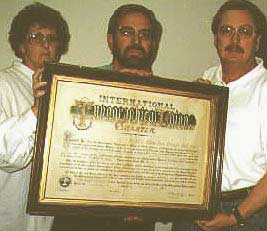
Update: Thursday, Oct. 26, 2006, 2:24 a.m. PDT — On this date, the Great Fire of 1875 destroyed most of Virginia City's business district (including the original Washoe Typographical Union charter).
CWA LOCAL 9413 OFFICERS WITH THE WASHOE TYPOGRAPHICAL UNION'S 1876 CHARTER. It replaced the 1863 original which was lost in the Great Virginia City Fire of 1875. See Nevada Labor History.From left to right, Vice-President Rose Wolcott, President Craig B. Hansen and Immediate Past-President John Doran. (2001 photo)
On Oct. 26, 1529, Thomas More, who defended religious freedom in the abstract (in his book Utopia) but was critical of the Reformation and Martin Luther (in Henry VIII's Defence of the Seven Sacraments, which More helped write), became lord chancellor of England; in 1825, the Erie Canal opened; in 1861, the first news dispatch was sent from the east to San Francisco by telegraph; in 1861, the San Francisco office of Wells Fargo received instructions to shut down the short-lived Pony Express (though it kept running until November 20); in 1881, after Virgil, Morgan, and Wyatt Earp pistol whipped Ike Clanton and Tom McLaury in separate incidents, the gunfight near the O.K. Corral (which U.S. Senator William Stewart of Nevada claimed to have witnessed) occurred, shifting power in the town's political battle from the cowboy faction to the law and order faction (Tombstone Epitaph headline: "Three Men Hurled into Eternity in the Duration of a Moment"); in 1909, with university varsity games at an end for the rest of the year (possibly because of the shortage of men during wartime), Reno high school and university first year students were planning a rugby game; in 1919, Persian despot Reza Pahlavi was born; in 1920, electronics, math, and information theory pioneer Ralph Hartley (birthplace Spruce, Nevada) received a patent for the Hartley oscillator; in 1925, Reno Mayor Edwin Roberts received a wire informing him that Governor George Dern of Utah had appointed a committee to plan that state's participation in the Transcontinental Highway Exposition in Nevada and that the committee had recommended a $25,000 expenditure for a Utah building and exhibits; in 1927, Jewish anarchist Samuel Schwartzbard, who assassinated vicious anti-Semite Ukrainian cossack commander Simon Petliura (Petliura had conducted 998 major and 349 minor pogroms in 372 cities and towns resulting in about 70,000 murdered), was found innocent by a sympathetic French jury; in 1936, electric generation began at Boulder Dam; in 1950, the Confederated Indian Tribes of Nevada sent a letter to U.S. Senator Patrick McCarran — who kept trying to strip land from the Pyramid reservation — asking him to publicly state his position on acquisition of additional lands by Nevada tribes, return of land on the Pyramid reservation held for decades by white squatters, and water rights for tribes (McCarran's Republican opponent in the '50 election, George Marshall, had already said he opposed white settlers on tribal land); in 1965, at Buckingham Palace, the government of Prime Minister Harold Wilson made John, Paul, George, and Ringo MBE's — "Members of the Most Excellent Order of the British Empire" (which they received after getting high in a palace restroom) for their "services to the export industry", causing several earlier recipients to return their MBE's (Lennon later returned his MBE as a protest against British policies on Vietnam and Biafra); in 1966, Sparrowhawk, the episode of I Spy that debuted on this date, was set in Las Vegas (it was directed by Walter Koenig, aka Chekov); in 1972, twelve days before the election, Nixon national security advisor Henry Kissinger launched the last dirty trick of the campaign, declaring of the Vietnam war "Peace is at hand" (the supposed agreement evaporated after the election); in 1996, Richard Jewell was belatedly cleared as a suspect in the Atlanta olympic bombing; in 2002, Gabbs and McDermitt high schools played a six-man game of football in Gabbs, believed to be the first six-man prep game played in 40 years.
October 27, 1875
Territorial Enterprise
Virginia City Rocked by Fire.
NIL DESPERANDUM.
The Enterprise is not quite full size this morning. Only by the courtesy of some kind friends are we permitted to put in any appearance at all to day. There was a convulsion in Virginia City yesterday. A breath of hell melted the main portion of the town to ruins. Our eyes are still dazed by the lurid glare; our ears are still ringing with the chaos of sounds of a great city passing away on the whirlwind of a storm of fire. As the sun arose yesterday morning it turned to purple and gold the smiling features of the most prosperous city on earth. Before the sun set, last night, the greater portion of that city had disappeared; and men and women and little children, by hundreds and thousands, knew not where to get a morsel of food, or where to lay their heads. The catastrophe is appalling. Men give and receive cheerful salutations as they meet, and brave women smile out of countenance the hard fate that has overtaken them; but the heartaches are sore, nevertheless. We know our people will rally from this blow; that, though houses have disappeared and vaults have been rent open by the fire, away down under the ruins there is a treasure safe which will rebuild our city more staunch and fair than it was before. But that promise of the future does not make lighter the suffering of the awful present, and we beseech from this generous coast a full measure of their sympathy for our poor. Those who yesterday would have gladly helped them are poor themselves to-day. An inclement winter is close upon us; there are many hundreds here who have neither houses nor food. They are a strong, brave race, and if California can furnish work for them, they will give a better return for their wages than any other people on earth. Meanwhile, for our people generally there is nothing to do but to go to work. The calamity looks at its worst to-day. Millions of dollars above ground will back the millions below. The shafts to the great mines are uninjured; many of the wrecked engines can be wakened, and in a few weeks the old harmonious clamor will again be heard, and prosperity will come back to us. The whole coast will be more or less affected by this catastrophe. Our mine owners understand this, and will strain every nerve to as swiftly as possible bridge this chasm which has opened at our feet. There is nothing to despair about, and we have not been in this desert for years without learning something of the virtue which suffers without complaining. The winds and the flame conspired against our city yesterday, but neither tempests nor fire can prevail against steadfast souls, and all the scars of yesterday can be erased.
Update: Wednesday, Oct. 25, 2006, 1:21 a.m. PDT — On Oct. 25, 1971, the United Nations General Assembly voted to admit mainland China and expel Taiwan. [New York Times/AP e-headlines]On this date in 1846, after five days of rest in the Truckee Meadows, the Donner party resumed its trek toward the Sierra and history; in 1877, Garfield and Arthur supporters from Carson City traveled to Reno for a torchlight parade with supporters there, with torchlights, transparencies projected, oratory and singing; in 1881, Pablo Ruiz Picasso was born in Malaga, Spain; in 1887, "The Austin Reveille thinks if the railroad company would put on two trains daily, one might accidentally get in on time."; in 1909, the City of Reno, which owned a single share in the Orr Ditch Company, owed an assessment of fifteen cents on its share; in 1909, the Reno city council upheld Mayor Richard Kirman's veto of a saloon ordinance (Kirman vetoed because the council had not given the measure both required readings); in 1917, Nevada had collected $2,647,000 for the second wartime liberty loan campaign with some collections not yet counted; in 1925, the Reno Evening Gazette reported that "KLAN FIERY CROSS BURNS ABOUT TOWN Four fiery crosses of the Ku Klux Klan burned in four sections about Reno last night, one near the big N northeast of the university, one at Sparks, one on the Virginia road and the principal one on a raft in the Truckee river near Wingfield Park. According to several connected with the organization, there was no significance in the demonstration other than a desire to remind everyone that the klan was 'very much alive and active.'"; in 1937, in a letter to a conference on state labor laws, President Roosevelt said he called Congress into special session to enact wage and hour laws; in 1937, maritime union organizer Joseph Curran called for the ouster of Joseph Kennedy as chair of the National Maritime Commission because of the jailing of 14 sailors aboard the government owned SS Algic who struck for union recognition (the ship was docked, not at sea); in 1937, former first lady Lou Hoover was the guest at a tea at the home of Mrs. Tasker Oddie and several other social functions in Reno; in 1950, in Boulder City, Republican candidate for governor Charles Russell declared he was opposed to any additional taxes, a pledge that bound him when he took office and caused the state to lose four years in dealing with the impact of the baby boom on schools; in 1950, the U.S. Bureau of Indian Affairs in D.C., concerned about tribal attorneys, including the Pyramid Lake Paiute tribe's lawyer James Curry, was considering adopting a policy restricting the use of lawyers by tribes; in 1952, Las Vegas Sun publisher Hank Greenspun published an article claiming that U.S. Senator Joseph McCarthy of Wisconsin was gay; in 1958, fifty one cardinals, their number reduced by the death of a U.S. cardinal 70 minutes before the conclave was to begin, entered the Sistine Chapel to select a successor to Pius XII and were bricked up inside; in 1958, Henry Fonda, filming Warlock near Moab, denied a news report that he had nearly been hit by a rifle bullet while on location, calling it the product of a publicity man; in 1961, Las Vegas Hacienda Hotel president Warren Baxley purchased 25 Constellation airliners from Trans World Airlines, the largest known purchase of airliners by a private citizen; in 1962, John Steinbeck received the Nobel prize in literature; in 1965, after sitting on it for a while to make Nevada's U.S. Representative Walter Baring crazy, President Johnson signed legislation enacting the Southern Nevada Water Project; in 1968, John and Yoko announced they were expecting a baby (Yoko miscarried); in 1971, the Congress of African People announced that a political convention of African-Americans would be held in Las Vegas in November, the first state convention leading to a national meeting; in 1983, the United States of America (population 230,000,000) invaded Grenada (population less than 100,000); in 1986, the Mets won game six of the world series when a ground ball rolled between the legs of Red Sox first baseman Bill Buckner; in 2002, U.S. Senator Paul Wellstone of Minnesota was killed in a plane crash.
THE NEVADA DAY COMMITTEE
WISHES TO ADVISE ALL PERSONS THAT THE COMMITTEE
IS NOT SOLICITING OR ENDORSING ANY
ADVERTISING PROGRAM OR ANY SPECIAL EDITION
OF ANY NEWSPAPER OR PERIODICAL FOR NEVADA
DAY, OCTOBER 31st, 1950.
ROY M. WHITACRE, ChairmanUpdate: Tuesday, Oct. 24, 2006, 12:15 a.m. PDT — On Oct. 24, 1945, the United Nations charter took effect. [New York Times/AP e-headlines]
On this date in 1648, peace negotiations begun in 1640 were concluded with the Peace of Westphalia, ending the Thirty Years War, bringing the Holy Roman Empire to an effective end, extending political rights to both Catholics and Protestants, and starting secularization in society; in 1868, U.S. Minister (ambassador) to Uruguay and Argentina Henry Worthington of Nevada presented his credentials to the Uruguay government; in 1881, an editorial in the Tombstone Nugget two days before the gunfight near the O.K. Corral: "The arming of oneself in a peaceful community, as every well organized community is supposed to be, and walking about like a moving arsenal, is highly ridiculous and, as events demonstrate, exceedingly dangerous."; in 1902, William Jennings Bryan campaigned for Democratic candidates in Carson City, Virginia City and Reno; in 1940, U.S. workers got a forty hour work week under a new federal law; in 1950, the Mills family, final owners of the Virginia and Truckee Railroad (which was being dismantled), donated Foley's Forest — 51 acres of forest on the east side of Carson City — to the city and Engine 27 and a coach to the State of Nevada; in 1956, news reports said Nevada's first application for power from the Glen Canyon Dam was filed by U.S. Senator Alan Bible for the Pahrump/Ash Meadows Improvement Association; in 1973, former Nevada Assemblymember Flora Dungan, who transformed Nevada politics with her lawsuit to restore Nevada's original population-based legislative apportionment system and overturn the "little federal" plan that gave each county one senator, died; in 1975, American Indian Movement leader John Trudell, in federal district court in Reno on a weapons charge, objected to his case being handled by the federal court instead of a tribal court.
On Oct. 24, 2006, on The Countdown with Keith Olbermann on MSNBC, Rep. Jim Gibbons, R-Nev, was named "worst person in the world" over Fox News blowhaha Bill O'Reilly. [BARBWIRE]
Update: Monday, Oct. 23, 2006, 2:21 a.m. PDT — On Oct. 23, 1983, a suicide truck-bombing at Beirut International Airport in Lebanon killed 241 U.S. Marines and sailors; a near-simultaneous attack on French forces killed 58 paratroopers. [New York Times/AP e-headlines]
George Bush/Des Moines/October 23, 2000: I want to have a ballistic defense system so that we can make the world more peaceful and at the same time I want to reduce our own nuclear capacities to the level commiserate with keeping the peace.
On this date in 1880, the Nevada Central Railway sold its locomotive "Battle Mountain" to the Utah Eastern Railroad; in 1901, as part of the U.S. conquest of the Phillippines, Brigadier General Jacob Smith ordered that all males over the age of ten on Samar be killed; in 1902, the annual convention of the Women's Christian Temperance Union of Nevada began in Reno; in 1909, Mackay Stadium was dedicated during the game between Nevada and the Barbarians with Clarence Mackay in attendance; in 1915, twenty five thousand women marched in New York City demanding women's suffrage, including 12 marchers wearing banners with the names of 12 states (Nevada among them) that had already given women their right to vote; in 1930, Clarence Mackay arrived in Reno for ceremonies the next day dedicating the Mackay School of Mines at the University of Nevada; in 1931, while law enforcement officers across the southwest and in California searched for "trunk murderer" Winnie Ruth Judd (she was accused of shipping trunks containing her two roommates from Phoenix to Los Angeles' Union Station), the sheriff of White Pine County, Nevada, received a report that Judd rented a cabin at a tourist camp on Emigrant Pass on October 22; in 1944, Republican presidential nominee Wendell Willkie was hit by an egg thrown by a crowd member at the LaSalle Street station in Chicago and a photograph of the incident appeared in the Chicago Times with the headline "It Shouldn‚t Happen Here" (photographer Borrie Kanter later wrote "You set your shutter at 1/50th and your lens opening right — and be there!"); in 1948, longshoremen's union leader Harry Bridges responded to a request by the Alaska Chamber of Commerce for an investigation by a congressional subcommittee of whether Bridges was a communist by saying that "since three trials and a U. S. Supreme Court decision has held me not a Communist," chamber members should resume negotiating with striking longshoremen; in 1948, a U.S. Senate elections subcommittee asked Texas election officials to preserve and safeguard ballots in the narrow Coke Stevenson/Lyndon Johnson Democratic senate primary election that Johnson won by 37 votes; in 1948, a day after California Governor Earl Warren said he would retain daylight savings time in his state, Nevada Governor Vail Pittman said he had no such power and would do nothing to influence local communities on whether to (keep) daylight saving to deal with postwar power shortages, but did call it "heartening" that PG&E was construction additional power generating facilities; in 1956, after Nevada Democratic chair C.D. Baker claimed the state Republican Party had hired as many as 30 people at $150 a week to spread streetcorner gossip smearing Democratic U.S. senate candidate Alan Bible in his race against Republican Cliff Young, GOP chair Emery Graunke denied the charge on the grounds that "We don't have the money anyway. We're broke."; in 1965, Pete Seeger's Turn! Turn! Turn! by the Byrds was released on Columbia; in 1966, two days after one of the strangest bouts in boxing history, in which referee Billy Conn stopped a fight in Mexico City between Carlos Ortiz of Puerto Rico and Sugar Ramos of Cuba and Mexico because of Ramos' injuries and a World Boxing Association official awarded the bout to Ramos, four thousand Puerto Ricans besieged a New York City theatre where Mexican singers were performing and the World Boxing Association changed its mind; in 1968, Ice Station Zebra was released, later gaining a peculiar niche in Nevada history — recluse billionaire Howard Hughes watched it obsessively atop a Las Vegas hotel; in 1998, Dr. Barnet Slepian, brother of a Reno high school principal, was assassinated in his kitchen in Buffalo, New York, by a sniper firing from ambush.
Update: Sunday, Oct. 22, 2006, 10:58 a.m. PDT — On Oct. 22, 1685, Louis XIV issued the Revocation of the Edict of Nantes, causing the destruction of Huguenot churches and shutdown of Protestant schools and provoking the emigration from France of hundreds of thousands of Protestants and a subsequent economic decline because of the loss of craft workers; in 1836, Texas, having escaped a ban on slavery under new Mexican law by fighting a war of independence to become a republic, inaugurated Sam Houston as its president; in 1887, journalist John Reed, who would marry fellow journalist Louise Bryant of Nevada, was born in Portland (Reed and Bryant were portrayed by Warren Beatty and Diane Keaton in Reds); in 1915, a five ton electric locomotive for use by the quarrying company at the Nevada marble boom camp of Carrara arrived on the Las Vegas and Tonopah Railroad; in 1922, Vladivostok, reportedly the last outpost held by the White Guards, fell to Soviet troops, effectively ending resistance to the Russian revolution; in 1922, AFL President Samuel Gompers called U.S. Attorney General Harry Daugherty an "irresponsible agitator"; in 1922, United Comstock Mines held an open house on American Flats to show off their new town of Comstock and 2,000 people were in attendance; in 1933, the Nevada State Journal carried a front page story on the "comeback of the Comstock", a story that ran regularly in Nevada newspapers in the years after the Comstock Lode's decline without ever actually being true until the onset of major tourism; in 1934, Charles "Choc" Floyd (called "Pretty Boy" by reporters) was killed by FBI officers near Wellsville, Oklahoma; in 1934, the Nevada office of the Emergency Relief Administration (one of the New Deal "alphabet agencies" created to deal with the Depression) reported that of 712 drought relief projects (well drilling, spring development, etc.) launched in the state, 596 had been completed; in 1935, cowboy actor Tom Mix brought his wild west show to Las Vegas; in 1947, actor Robert Taylor protected his own career by naming names at a hearing of the House UnAmerican Activities Committee, providing damaging testimony that did not actually incriminate his targets: "Well, the one chap I am thinking of currently is Mr. Howard DeSilva — that always has something to say at the wrong time. Karen Morley also usually appears at the guild meetings."; in 1956, U.S. Senator Alan Bible, introducing Senator John Kennedy of Massachusetts at Reno's Twentieth Century Club, said he thought Kennedy might one day be president or vice president; in 1962, President Kennedy announced that nuclear missiles were being installed in Cuba and that he had ordered a blockade of the island nation (he called it a "quarantine" in order to try to get around the fact that under international law, it was an act of war-- and illegal); in 1963, President Kennedy called New York Times publisher Arthur Sulzberger to the White House for lunch and pressured him to call Times reporter David Halberstam home from Saigon, which instead prompted the Times to keep Halberstam (who had been on thin ice with his editors) in place and even cancel his scheduled vacation to avoid letting Kennedy think his pressure had worked; in 1972, Nixon advisor Henry Kissinger met twice with Saigon dictator Nguyen Van Thieu to plead that Thieu not block a cease fire that would allow Nixon to claim a peace agreement before the election; in 1972, Lake Tahoe realtors gave first prize in a "dirty photo" contest to a shot of the shuttered and ramshackle Bal Tabarin Casino in Crystal Bay; in 1979, the Carter administration admitted Reza Pahlavi to the United States for medical treatment easily available in several other nations that did not have a history of interference with Iranian affairs, precipitating the hostage crisis; in 1990, President Bush the Elder vetoed Senate Bill 2104, the Civil Rights Act of 1990.
Update: Saturday, Oct. 21, 2006, 1:41 p.m. PDT — On this date in 1864, with only ten days to go until his great achievement (signing Nevada's statehood papers) and two weeks from his reelection, President Lincoln and his son Tad watched a torchlight parade (see below); in 1873, John Muir visited Mount Whitney; in 1874, in an essay on "Quack journalism", the Nevada State Journal editorialized that "no name has yet been invented to express the utter degradation the miserable slimy foulness into which a certain class of fellows who have attached themselves to the newspapers of this country, have fallen."; in 1882, Chief Winnemucca died; in 1887, when the Western Union telegraph line in Esmeralda County was sold on a tax judgment, the county bought it; in 1913, reformer William Sulzer, impeached and convicted as New York's governor by supporters of Tammany Hall, arrived in New York City from the state capital to welcoming crowds who lined the streets (he was elected to the legislature in November and later refused a third party presidential nomination); in 1913, Chicago postal officials were dealing with cases of germ-laden letters; in 1918, Charles Ellis Beuhanon, a U.S. soldier of Wells, Nevada, died at base hospital no. 55 in France; in 1922, during the half-time show of a USC/Nevada game, what was reportedly the first card stunt was staged with the letters T-R-O-J-A-N-S; in 1931, acting on a suggestion by President Hoover, electric utilities across the nation, including the Elko Lamoille Power Company, shut off all city lights in their communities for one minute at 7 in the evening; in 1933, the U.S. Public Works Administration, a depression relief agency, separated Nevada and Utah and made them distinct administrative units (the Nevada State Journal reported that the change had been sought for three years, though the PWA was not created until June 16, 1933); in 1947, in testimony before the U.S. House Unamerican Activities Committee, Adolphe Menjou named names, including AFL union leader Herbert Sorrell (who had been beaten earlier in the year by mobsters) and actors Edward G. Robinson, Paul Henried, Hume Cronyn and Alexander Knox and "anyone who attended any meetings to hear Paul Robeson and applauded" (he said a jurisdictional strike by set directors, painters, and carpenters was an example of communist influence in Hollywood); in 1950, in a nicely loaded story lead, the Nevada State Journal claimed "While the Indians around Pyramid Lake continue to battle to retain their tribal lands against infringement by white settlers, the Bureau of Indian Affairs is preparing to sell a large amount of Indian land in California and nobody is objecting" (U.S. Senator Patrick McCarran, D-Nev., was trying to get Congress to give title to Pyramid tribal land to white squatters); in 1957, Jailhouse Rock was released into theatres, the same day the song of the same name hit number one on the Billboard magazine chart; in 1967. the National Mobilization Committee to End the War in Vietnam (the Mobe), a coalition of 150 groups, held its first Washington protest and the largest protest of the Johnson administration, chronicled in Norman Mailer's The Armies of the Night: History As a Novel/the Novel As History (Abbie Hoffman tried to levitate the Pentagon but was not entirely successful); in 1970, the U.S. House Armed Services Committee disclosed that six soldiers in Vietnam had charged that they were ordered to invent fictitious heroism for Brigadier General E.P. Forrester so he could receive the Silver Star and the Distinguished Flying Cross; in 1985, Ringo Starr, George Harrison, Eric Clapton, Roseanne Cash, and members of the Stray Cats participated in the taping of a television program about Carl Perkins at Limehouse studio in London; in 1988, former Philippine President Ferdinand E. Marcos and his wife Imelda were indicted by a U.S. grand jury for racketeering and fraud; in 2004, Jesse M. Samek of Rogers, Arkansas, based at Nellis Air Force Base in Nevada, was killed in a helicopter accident in western Afghanistan.
Washington Daily Morning Chronicle/October 22, 1864: [A torchlight parade] passed through the grounds in front of the Presidential Mansion, where a large crowd had gathered, and kept up a continual blaze of light with rockets, bluelights, Roman-candles, &c., lighting up the upper windows under the portico, at which stood the President and "little Thad,"...After the procession had left the grounds, the crowd called loudly for the President, and he responded as follows: FELLOW-CITIZENS: I was promised not to be called upon for a speech to-night, nor do I propose to make one. But, as we have been hearing some very good news for a day or two, I propose that you give three hearty cheers for Sheridan. While we are at it we may as well consider how fortunate it was for the Secesh* that Sheridan was a very little man. If he had been a large man, there is no knowing what he would have done with them. I propose three cheers for General Grant, who knew to what use to put Sheridan; three cheers for all our noble commanders and the soldiers and sailors; three cheers for all people everywhere who cheer the soldiers and sailors of the Union-- and now, good night.
* Dennis Myers elaborates: The word meant secessionists. I was taken by surprise to see it, because the term was a really nasty one and Lincoln has this great reputation for gentility. See this entry in the Random House Dictionary.
Update: Friday, Oct. 20, 2006, 12:23 a.m. PDT — On Oct. 20, 1846, the Donner Party reached the Truckee Meadows (Reno) [Nevada Magazine calendar]; on this date in 1973, in the so-called Saturday Night Massacre, President Nixon abolished the office of special Watergate prosecutor Archibald Cox, accepted the resignation of Attorney General Elliot L. Richardson and fired Deputy Attorney General William B. Ruckelshaus [New York Times/AP e-headlines].
George Washington/October 20, 1792: Of all the animosities which have existed among mankind, those which are caused by a difference of sentiments in religion appear to be the most inveterate and distressing, and ought most to be deprecated. I was in hopes that the enlightened and liberal policy, which has marked the present age, would at least have reconciled Christians of every denomination so far that we should never again see their religious disputes carried to such a pitch as to endanger the peace of society.
On this date in 1890, Indian agent Daniel Royer at the Pine Ridge Agency, feeling threatened by the ghost dance that had spread from Nevada across the nation, requested six to seven hundred troops, setting in motion the tragedy at Wounded Knee Creek; in 1921, Nevada Attorney General Leonard Fowler issued a formal opinion in response to an inquiry from Assemblymember J.H. Hart saying that hiring a courthouse janitor who was a citizen of another nation violated state law; in 1931, a 27-year court case came to an end with a final court decree adjudicating Humboldt River rights in the court of Judge George Bartlett in Reno; in 1931, Lou Gehrig would accept the role of Tarzan in the movies "if they kick through with enough dough", said his man; in 1934, western states AFL organizer Leo Flynn, speaking in Ely, called for a six hour work day as a Depression measure to combat joblessness; in 1934, two hundred African-American workers at the Basic Magnesium plant near Las Vegas struck the plant with a demand that separate white and black restrooms be abolished (management blamed it all on labor organizers); in 1947, Ayn Rand appeared as a "friendly witness" before the House Unamerican Activities Committee to denounce the film Song of Russia under an agreement that she would later be recalled to also denounce The Best Years of Our Lives (best picture 1946) but after she gave the testimony the committee wanted in this first hearing, she was never invited back; in 1951, in a game between Drake and Oklahoma A&M, Oklahoma players — particularly defensive tackle Wilbanks Smith — kept going after Drake's African-American halfback John Bright (the nation's leading ground gainer) after Bright had already passed or handed off, battering him and breaking his jaw, a pattern of brutality revealed the next day in a series of Pulitzer Prize-winning photographs taken from overhead by Don Ultang and John Robinson and published in the Des Moines Register (Bright played most of the game injured, recovered from his injuries, and later passed up a draft into the NFL in favor of the Canadian Football League, where he spent a great career); in 1956, Republican U.S. senate candidate Cliff Young's campaign raised the issue of Democratic vice-presidential nominee Estes Kefauver — who had investigated the organized crime ties of Las Vegas casinos — against Democratic U.S. senate candidate Alan Bible; in 1967, three years after the murder of civil rights workers James Chaney, Mickey Schwerner and Andrew Goodman in Mississippi and two years after their killers were acquitted, seven men (law officers and Klan members) were convicted on federal civil rights charges in the murders (which were chronicled in William Bradford Huie's book Three Lives For Mississippi and the sleazy movie Mississippi Burning that lionized the FBI which actually dragged its feet in protecting the men and then in solving their murders); in 1969, George Harrison attended a Ravi Shankar concert in London; in 1970, Pat Nixon campaigned in Reno for Republican U.S. Senate candidate William Raggio, whose mother Clara told a reporter "Just think, the first lady came clear out here for my boy."; in 1973, President Nixon ordered Attorney General Elliot Richardson to fire Special Prosecutor Archibald Cox, fired Richardson when he refused, then fired Richardson's deputy William Ruckelshaus when he refused, provoking 22 impeachment measures in Congress the following Monday; in 2004, the New York Yankees became the owners of the biggest choke in sports history (on Google the next day, a search for the combined terms "Yankees" and "choke" produced 12,700 hits, and the sports blogosphere went nuts: "the biggest choke team money can buy", "I hope the over-paid chokers burn in hell for having the greatest collapse in sports history. Against the Red Sox, no less.", "This morning someone got to my blog via Google by searching for 'Yankee choke pictures'."Update: Thursday, Oct. 19, 2006, 6:57 a.m. PDT — On this date in 1720, Quaker leader John Woolman, whose journal became a significant spiritual document, was born in New Jersey; in 1893, the Student Record, the University of Nevada's first student newspaper which later changed its name to Sagebrush, began anonymous publication in defiance of campus administrators (see below); in 1909, the Portola Festival, named for the white "discoverer" of San Francisco Bay, Don Gaspar de Portolá, was held to celebrate San Francisco's recovery from the great earthquake of '06; in 1917, the Army named its new airstrip in Dallas "Love Field" (the name had no relevance to Texas or Dallas — it was named for a lieutenant who died in a San Diego plane crash and had been stationed for five months in Texas City); On Oct. 19, 1918, twenty four days before combat ended in the world war, Army Private John Sayer of Elko, Nevada, was killed south of Champigneulle in France (no relatives or friends could be found to inform of his death); in 1921, Nevada Attorney General Leonard Fowler advised the Churchill County District Attorney that "any person who suffers damage by reason of a defective bridge, which is under the control of the county" is legally out of luck; in 1923, verbal arguments were held in the United States Supreme Court in Jay Burns Baking Company vs. Bryan, over whether government can regulate the weight of bread (a footnote in the court's April 14, 1924, decision read "Washington changed from a law permitting the sale of any weight bread, provided that it is properly labeled, to a law fixing a standard weight loaf with an excess tolerance... West Virginia, Utah, Nevada, Detroit, and Milwaukee desire to do likewise."); in 1931, news reports said U.S. Senator Tasker Oddie had switched from dry to wet and would vote to modify the Volstead Act; in 1934, Nevada education supporters laid plans to ask the 1935 legislature for a two percent sale tax and a personal/corporate income tax to support state schools; in 1936, James Bevel, who organized the 1963 protest marches by Birmingham children that stymied police commissioner Bull Connor's fire hoses and police dogs and finally produced victory in the long Birmingham campaign, and who was the Labor Party candidate for vice president in 1992, was born in Itta Bena, Mississippi; in 1938, Pauline Frederick, then known as the greatest U.S. dramatic actress, died in Beverly Hills; in 1940, the Works Progress Administration, a New Deal agency, allocated $20,864 for planting of trees, construction of sidewalks and landscaping in Las Vegas, $1,902 for a tennis court at Mineral County's high school and $8,096 for a telephone system and rifle ranges in Washoe County; in 1951, six years after combat ended, Congress enacted Public Law 181 formally ending the war between the U.S. and Germany; in 1954, Las Vegas and Reno leaders were engaged in talks with U.S. Bureau of Land Management officials about the prospects for small tract lessees on federal land purchasing their homesites; in 1956, a day after the Supreme Court of Nevada refused to remove a sales tax referendum from the ballot at the request of attorney David Zenoff representing pro-education groups (the tax was used for schools), Washoe County Senator Forest Lovelock told a service club that repeal of the tax would "wreck the economy of the state"; in 1965, the will of Desert Inn casino owner Wilbur Clark, filed at the county clerk's office in San Diego, left half his estate to his widow Toni Clark, smaller bequests to several friends and relatives, and the remainder of the estate to be administered by Clark's mother Lulu Clark; in 1967, I Second That Emotion by Smokey Robinson and the Miracles was released; in 1969, Vice-President Spiro Agnew contended in New Orleans that "a spirit of national masochism prevails", encouraged by "an effete corps of impudent snobs who characterize themselves as intellectuals"; in 1987, the stock market crashed, losing nearly a fourth of its value, the largest losses in stock market history; in 1997, the Broadway revival of Annie at the Martin Beck Theatre closed; in 1997, the Nevada Boxing Commission, which had revoked Mike Tyson's state license for an indefinite period 11 days after he bit Evander Holyfield on each ear in their rematch of June 28, 1997, retreated from that stance and restored Tyson's license on a four-to-one vote.
The Student Record/October 19, 1893: We trust that the appearance of the Record will be a glad surprise to the public and especially to the friends and patrons of our State University. No apology is needed for the publication of such a journal, as it enters a field unoccupied by any other of its class. Our primary object is to create in the minds of the young men and women of Nevada, and adjacent territory, a conviction of the need of a higher education and inspire them with a determination to obtain it. We will also aim to promote the college spirit among the students of the State University and to elevate athletics in that institution, to the important place that it occupied in the leading colleges of our country. The Record will be independent in politics and reserve the right to criticize all parties and measures. It will, however, advocate the enactment of such laws as will restore silver to the place it occupied previous to its demonetization. The petition presented to the Board of Regents, at its last meeting, by the students of the State University, asking the privilege to publish a college paper, not having been granted has, in some measure, made necessary the publication of the Record. While our columns are freely offered to the public they are especially tendered the University students as the medium through which they may voice their sentiments on all matters that affect their interests.
Update: Wednesday, Oct. 18, 2006, 12:23 a.m. PDT — On Oct. 18, 1864, construction began on the Sutro Tunnel, the huge project to drain water from Comstock Lode mines [Nevada Magazine calendar]; in 1968, the United States Olympic Committee suspended two black athletes, track and field medalists Tommie Smith and John Carlos, for giving a "black power" salute as a protest during a victory ceremony in Mexico City [New York Times/AP e-headlines]; in 2006, former members of the Black Panther Party are celebrating their founding in Oakland, Calif.
George Bush/LaCrosse, Wisconsin/October 18 2000: "Families is where our nation finds hope, where wings take dream." (PDA)
On this date in 1805, at a point on the Columbia River near present day Kennewick, Washington, the Lewis and Clark expedition sighted Mount Hood; in 1867, a shift in the International Date Line and a simultaneous change from the Julian to the Gregorian calendar resulted in the loss of a week for residents of Alaska — October 6 was followed by October 18; in 1923, the American Legion, competing with the Ku Klux Klan for membership and struggling with how to oppose the increasingly powerful Klan without alienating its following, adopted a national convention resolution only mildly critical of the Klan; in 1925, Babe Ruth's record of 59 home runs in one season, set in 1921, was broken by a minor league player — Salt Lake City second baseman Tony Lazzeri, who hit an inside-the-park homer in a 12 to 10 victory over Sacramento for a season record of 60; in 1926, Chuck Berry was born in St. Louis; in 1938, actress and Miss Nevada Dawn Wells was born in Reno; in 1942, U.S. Senator Berkeley Bunker of Nevada spoke at the Mormon Church in Annapolis, Maryland; in 1952, Joseph Stacher, refused a gambling license in Nevada and wanted in New York for forgery and a gambling offense at Saratoga Springs spa and race track, was arraigned in Las Vegas with Harry Claiborne as his lawyer (Nevada Governor Charles Russell signed an extradition to New York on November 21st, and ten minutes later Claiborne obtained a writ of habeas corpus and freed Stacher); in 1956, a few days after President Eisenhower described U.S. Senator George Malone of Nevada as one of three Republican senators he could not count on (the other two were Joseph McCarthy and William Jenner) and that the three had "little place" in the GOP, U.S. Representative Cliff Young of Nevada denied making a comment attributed to him in the Mineral County Independent that "It is a fact Senator George Malone has opposed and voted against many policies of the Eisenhower administration — even more so than Senator Joseph McCarthy" (the Independent stood by the quote); in 1961, in a letter to his Random House editor's wife, Nevada novelist Walter Van Tilburg Clark (The Ox Bow Incident) wrote "I have turned nearly deaf."; in 1964, the pilot of an airliner carrying 85 people collapsed after its takeoff from Las Vegas and was pronounced dead after the copilot returned the plan to Las Vegas; in 1967, How I Won The War, the antiwar film directed by Richard Lester and starring Michael Crawford as "Goodbody" and John Lennon as "Gripweed", premiered; in 1968, the U.S. Olympic Committee, unwilling to refuse the demand of the International Olympic Committee, suspended the great African-American athletes Tommie Smith and John Carlos (who had trained at Lake Tahoe) from the Mexico City games for giving the black power salute on the victory stand after winning their events (their fellow U.S. African-American Olympians Bob Beamon, Ralph Boston, Lee Evans, Larry James and Ron Freeman nevertheless subsequently found additional ways to protest during the games); also in 1968, U.S. journalists used words like "plague" and "mar" to portray Carlos and Smith's gesture at the Mexico City Olympics as a flaw — "Black Fists‚ Mar Olympics."; in 1971, crews climbing over difficult terrain reached a wrecked plane from Scenic Airways of Las Vegas that crashed on an Arizona mountaintop in a winter storm during a sightseeing flight to the Grand Canyon, killing all aboard, including former U.S. commissioner of education James Allen.
Update: Tuesday, Oct. 17, 2006, 1:15 a.m. PDT — On this date in 1872, the mail steamship Nevada arrived in Auckland from Honolulu with 6 in steerage (a year earlier, on October 15, 1871, the Nevada had a collision with the A.H. Badger, also in New Zealand waters) [PDA]; on Oct. 17, 1931. mobster Al Capone was convicted of income tax evasion and sentenced to 11 years in prison. He was released in 1939. [New York Times/AP e-headlines]
Red State Redeye Review
GUBERNATORIAL DEBATE POST-MORTEMS: Join the editor of NevadaLabor.com on the northern Nevada CBS affiliate, KTVN TV-2, bushy-eyed and bright-tailed at 6:00 a.m. PDT Wednesday, Oct. 18, for a bit of political CSI after tonight's gubernatorial debate between State. Sen. Dina Titus, D-Las Vegas, and U.S. Rep. Jim Gibbons, R-Nev. CD2. The two major party nominees will go at it for a third time this election season and the agenda promises to be much more interesting than the round two rematch produced by the Gomorrah South Vestal Virgins League of Vague Politics wherein the participants got the questions in advance. (That's not a debate, that's a TV commercial videotaping session.)
Most of my fellow pundits missed the fact that Titus wiped the floor with Gibbons in their first fist fight at UNR. (See Fred Flintstone for Governor.) Much the same will happen tonight, as Gibbons follows in a long tradition of statewide congressional seat holders unable to think on their feet (Barbara Vucanovich, R, David Towell, R, Walter Baring, D) and thus somehow susceptible to being swept off their feet by foreign mining companies. Perhaps all that gold dust-covered money boggles the brain.
Most Nevada network TV stations will carry the debate live on Tuesday, Oct. 17, from 7:00 to 8:00 p.m. PDT. On Wednesday morning's Red State Redeye Review, I'll join Channel 2 morning news anchor Erin Breen and former Nevada State Treasurer Patty Cafferata, R, former Rep. Vucanovich's daughter.
I understand we'll do a couple of segments between 6:00 and 7:00 a.m. As that wise, worldly, internally combusting philosopher Jay Leno once wisely opined, "sleep is for wimps."
Titus and Gibbons may well put everyone to sleep by constant repetition of well-polished clichés, but I guarantee you that we certainly won't.
Be well. Raise hell.
Albert Camus, in the second of his Letters to a German Friend in the French resistance newspaper Liberation during the Nazi occupation/December 1943: This is what separated us from you; we made demands. You were satisfied to serve the power of your nation and we dreamed of giving ours her truth.
On this date in 1872, the mail steamship Nevada arrived in Auckland from Honolulu with 6 in steerage (a year earlier, on October 15 1871, the Nevada had a collision with the A.H. Badger, also in New Zealand waters); in 1876, F.E. Mills of Virginia City, Nevada, received a patent for an "improvement in ore-concentrators"; in 1887, in a letter to President Cleveland, Nevada Governor Charles Stevenson requested reimbursement for the costs of Nevada volunteers in fighting various Indian wars since 1860; in 1906, playwright Rachel Crother's' first theatrical success, The Three of Us, debuted at Madison Square Theatre in New York, the first of many Crother productions to explore the role of women in society (the play is about a sister and her two brothers who own a Nevada silver mine); in 1926, in a pattern repeated many times around the U.S., the New Orleans Morning Tribune, joined shortly by the New Orleans Item, began an inflammatory anti-marijuana campaign (the drug was then legal) filled with alarmist and irresponsible reporting that caused the 1927 Louisiana Legislature to enact marijuana prohibition; in 1926, the Republican nominee for Nevada treasurer, Clara Cunningham, was killed in a car wreck (because the election was so near, the state GOP agreed not to replace Cunningham on the ballot, throwing the election uncontested to incumbent Democrat Ed Malley, who was removed from office the next year after he embezzled state funds and invested them in oil stocks); in 1931, the Elko Business and Professional Women held an International Tea at which 15 nations were represented; in 1933, less than three weeks before the Nazis took power in Germany, Albert Einstein arrived in the United States as a refugee over the objections of the U.S. Department of State and U.S. right wingers (the FBI quickly began tapping his phone and opening his mail); in 1934, Forbes magazine editor in chief B.C. Forbes, on his way to California by train to join the business community's campaign against Democratic nominee Upton Sinclair's candidacy for governor, stopped in Ogden and gave an interview to the Standard-Examiner claiming that President Roosevelt had changed his attitude toward the business community and was moving toward business; in 1934, Harry Pierpont, often described as the leader of the Dillinger gang, was executed at the Ohio State Penitentiary at Columbus; in 1935, William Pechart, described in the newspapers as a "vice lord" and former Las Vegas casino owner, was arrested when a fashionable resort, Rancho San Pablo near El Cerrito, was raided for running a casino; in 1938, United Press carried a story claiming that the formation of Lake Mead behind Hoover Dam made development of "vast, richly mineralized areas" of Nevada and Arizona possible because transportation on the lake would be possible in canyons that were previously impassable because the terrain did not permit road building; in 1938, U.S. Secretary of the Interior Harold Ickes, who failed to show up at a scheduled October 15 appearance in Boulder City, issued a statement saying he would appear for his California speaking engagements, but "I did not go to Boulder City from Reno simply and solely because I preferred a few days in California to long automobile rides in a hot climate (California papers please take notice)."; in 1956, the Nevada Drought Committee approved extension of drought relief for Lincoln County and drought relief for Clark County ranchers; in 1957, Albert Camus received the Nobel prize for literature; in 1970, Carson City was buzzing when F. Lee Bailey, who recently made the headlines by winning the release of Dr. Sam Shepard, showed up in town (he was there to look into the incorporation of a company in Nevada); in 1973, Arab oil producing nations responded to the Yom Kippur war by imposing an embargo on oil shipments against nations that supported Israel in the war, sparking the first high oil prices in U.S. history, gas lines, the 55 mile an hour speed limit, and substantial damage to the U.S. economy; in 1987, George Harrison joined Bob Dylan on stage at the end of a concert at Wembley Arena in London; in 1989, a major earthquake hit northern California, collapsing highways, one of the levels of the Bay Bridge, and many buildings in the bay area, particularly those built on fill land; in 1997, Che Guevara was buried in Cuba 30 years after his death in custody in Bolivia; in 2006, Democrat Dina Titus and Republican Jim Gibbons will hold their third debate in the Nevada governor's race; in 2006 the population of the United States will go over 300 billion.Update: Monday, Oct. 16, 2006, 3:15 a.m. PDT — On Oct. 16, 1964, China detonated its first atomic bomb. [New York Times/AP e-headlines]
Hugh Latimer, about to be burned at the stake, to Nicholas Ridley, October 16, 1555: Be of good cheer, brother. We shall this day kindle such a torch in England as, I trust in God, shall never be extinguished.
On this date in 1555, Protestant reformers Nicholas Ridley and Hugh Latimer were burned at the stake at Oxford; in 1701, the Congregationalist Church started the Collegiate School in Killingworth, Connecticut (now Yale in New Haven); in 1859, John Brown led 21 men in capturing a federal arsenal of 100,000 weapons at Harper's Ferry and other strategic locations, hoping to use weapons and the Blue Ridge Mountains for guerrilla warfare against slavery, but the U.S. Marines halted the effort and Brown was captured the next day and eventually convicted of treason and executed; in 1874, Thomas Fitch, a former member of the U.S. House from Nevada, began a speaking tour in Elko to talk about the Sutro tunnel, with subsequent appearances in Winnemucca, Carson City, Reno, Silver City, Gold Hill, Virginia City, Austin, Eureka, Hamilton and Pioche; in 1887, the Nevada State Journal reprinted an article on Nevada from the New York Morning Journal (see below); in 1888, Nobel and Pulitzer prize winning playwright Eugene O'Neill was born in the Barrett House hotel on Broadway and 43d in New York City; in 1903, George Beldam, later movie star and Nevada lieutenant governor Rex Bell, was born in Chicago; in 1915, the Carrara Obelisk observed "It's a peculiar thing that in all the newspaper accounts of the strike at Clifton, we have yet to see one embodying the cause of the trouble" (Carrara was a Nye County mining boom camp where, instead of precious metals like silver or gold, marble was quarried); in 1915, the Obelisk also reprinted from the New Republic a poem about Mary Phagan, the victim of a murder that was pinned, probably incorrectly, on an Atlanta Jew named Leo Frank who was lynched on August 17, 1915 (the poem portrayed Phagan as a victim of sweat shops supported by those who framed Frank, who was posthumously pardoned); in 1916, Margaret Sanger opened the first U.S. birth control clinic, in New York City; in 1931, the assistant director of the University of Nevada agricultural extension service urged PTAs and relief organizations to see to it that every Nevada child received a cup of milk a day; in 1938, the Las Vegas Review-Journal editorialized that Republican U.S. senate candidate Tasker Oddie of Nevada would have to achieve another of his chameleon-like changes — this time from conservative to liberal Republican — in order to beat "liberal Senator Pat McCarran"; in 1939, a Parent Teacher Association chapter in Las Vegas, the Hebrew Ladies of Las Vegas, and the American Legion Auxiliary were planning a hot lunch program for needy children at the grammar school; in 1940, Las Vegas Schools Superintendent Maude Frazier was elected president and Winnemucca Superintendent Roger Corbett vice-president of the Nevada State Education Association; in 1954, Elvis appeared on the Louisiana Hayride; in 1957, You Send Me by Sam Cooke was released on the Keen label; in 1963, the New York Mirror was published for the last time; in 1965, sixty five protests were held around the United States and the world against the Vietnam war (two weeks later one pro-war counterprotest was held in Washington); in 1969, the supposedly hapless New York Mets won the world series in the fifth game, setting off hysterical citywide celebrations, an event that New York Mayor John Lindsay, running on a third party line after losing renomination in the GOP primary, credited with his reelection; in 1973, Le Duc Tho (Phan Dinh Khai), negotiator for Vietnam, declined the Nobel prize for peace, noting that there was no peace in his nation since it was occupied by a foreign power (Henry Kissinger, representative of the foreign power who was also named a recipient of the prize, accepted it; the prize was announced on the same front pages that carried reports of renewed U.S. bombings of Vietnam); in 2002, George Bush signed a congressional resolution authorizing war against Iraq; in 2002, the White House claimed that North Korea had announced it had a nuclear weapons program, an account that most of the press in the U.S. parroted (what actually happened was that Korea withdrew from the 1994 Agreed Framework because the U.S. had failed to comply with the agreement by providing the light-water [LWR] power plants to replace the Korean graphite-moderated reactors, a requirement of the AF, thus freeing the Koreans to develop nuclear weapons).
Special Correspondence of the New York Morning Journal — Reno, Nevada, Sept. 19, 1887: To one who has had an opportunity to investigate the various resources of Western Nevada, it becomes a surprise to find this section ignored by the present tide of immigration to the far West. Everybody apears [sic] to be bound for Southern California without permitting the bare thought of something meritorious existing in Nevada to enter his head. Nevada, to most people, and very intelligent people at that, exists in their mind only as the Comstock Mine, and the Comstock mine to them is Nevada. But the time is near at hand when the fickleness of mining will make room for the certainty of agricultural success, and when the millions of acres of land now considered barren waste will team with well cultivated farms and sleek cattle. Although Virginia City is perhaps more generally known or heard of in the East, the city which will become the important commercial and agricultural centre of this unjustly neglected State, by virtue of its geographical location, is Reno, the county seat of Washoe county. Reno is prettily situated in a charming valley at the foothills of the Sierra de Nevada, with a swift mountain stream, the Truckee river, piercing its widths. Its population at present numbers 4,500 people, and the business streets have the appearance of a thriving, bustling town, calculated to double its population in a very few years. The stores are substantial buildings, mostly brick, and the heavy stocks carried by the merchants will astonish an Eastern man if disposed to class Reno among the country towns.
Update: Sunday, Oct. 15, 2006, 8:33 a.m. PDT — On Oct. 15, 1964, it was announced that Soviet leader Nikita S. Khrushchev had been removed from office. He was succeeded as premier by Alexei N. Kosygin and as Communist Party secretary by Leonid I. Brezhnev. [New York Times/AP e-headlines]
On this date in 1858, the play Our American Cousin debuted at Laura Keene's Theatre in New York City; in 1858, heavyweight champion John L. Sullivan, who visited Nevada for the 1897 Fitzsimmons/Corbett fight and again to support "great white hope" Jim Jefferies in 1910, was born in Roxbury, Massachusetts (his claim to the title — and that of several other "champions" — is tainted because he refused to fight African-Americans like Peter Jackson); in 1868, Oregon rescinded its previous ratification of the Fourteenth Amendment to the U.S. Constitution (a post-Civil War amendment guaranteeing citizens due process and equal protection of the laws and extending the protection of the Bill of Rights — previously a protection only against the federal government — to actions by the states), an action which was probably invalid; in 1895, Erwin W. Harris of Palisade, Nevada, received a patent for a furnace door; in 1903, William "Wild Bill" Elliott, 1940s movie star and 1950s Clark County rancher, was born in Pattonsburg, Missouri; in 1917, Mata Hari (Margaretha Geertruida Zelle) of the Netherlands was executed by firing squad in Paris after being brutalized into confession and a show trial; in 1934, Democratic nominee for governor of Nevada Richard Kirman spoke in the party stronghold of Ruth, pledging his support to Franklin Roosevelt's programs; in 1934, in a strike that captured world wide attention, more than a thousand Hungarian miners who stayed in several dangerous mines for more than a hundred hours as officials tried to lure them out, prevailed when they were offered bonuses and better treatment (the sit-in technique was used three years later in the General Motors strike); in 1934, state teachers meeting in Reno discussed the possibility of a sales tax to pay for state education costs; in 1937, United Artists was filming The Adventures of Marco Polo starring Gary Cooper and Alan Hale at Mono Lake; in 1938, U.S. Secretary of the Interior Harold Ickes failed to appear for a scheduled appearance at the Boulder City theatre a day after appearing in Reno, and did not send an explanation; in 1943, the U.S. War Department announced that Ronald C. Hutchison, son of William Hutchison of Las Vegas, was a prisoner of the Japanese; in 1943, Emile Gezelin was appointed a deputy state superintendent of schools; in 1956, it was announced that United States Treasurer Ivy Baker Priest would come to Nevada at the end of the month to campaign for President Eisenhower and be honorary marshall of the Nevada Day parade; in 1962, film that had been shot by Air Force planes flying over Cuba (illegally, under international law) was developed and showed nuclear missile sites being built (legally, under international law); in 1965, Catholic Worker volunteer David Miller burned his draft card to protest the Vietnam war, the first known instance of that form of protest being used, and was sent to prison for two years; in 1967, Governor Paul Laxalt of Nevada was given an audience bow on the Ed Sullivan Show; in 1969, in the largest demonstration in human history, millions of people in the United States and around the world participated in Moratorium Day, protesting the U.S. government's war in Vietnam; in 1976, in Houston, Robert Dole and Walter Mondale participated in the first vice-presidential debate; in 1982, the Flyaway "indoor skydiving" amusement ride opened in Las Vegas; in 1993, it was announced that Nelson Mandela and F.W. de Klerk would receive the Nobel Prize for peace; in 1997, Richard Noble's Thrust SSC, driven by Andy Green on Nevada's Black Rock Desert, set the world's first supersonic land speed record; in 1999, it was announced that Doctors Without Borders would receive the Nobel Prize for peace; in 2005, William I. Salazar of Las Vegas was killed in Karabilah, Iraq.
Update: Saturday, Oct. 14, 2006, 1:04 p.m. PDT — On Oct. 14, 1964, civil rights leader Martin Luther King, Jr., was named winner of the Nobel Peace Prize. [New York Times/AP e-headlines]
Explorer Richard Burton/Smith Creek Pony Express station, Nevada Territory/October 14, 1860 2:45 PM: The station was sighted in a deep hollow. It had a good stone corral and the visual haystack, which fires on the hill tops seemed to menace. Amongst the station folks we found two New Yorkers, a Belfast man, and a tawny Mexican named Anton. The house was unusually neat, and displayed even signs of decoration in the adornment of the bunks with osier work taken from the neighboring creek. We are now in the lands of the Pa Yuta, and rarely fail to meet a party on the road: they at once propose shwop‚ and readily exchange pine-nuts for white grub‚ i.e., biscuits. I observed however, that none of the natives were allowed to enter the station house. After a warmer night than usual -- thanks to fire and lodging -- we awoke and found a genial south wind blowing.
On this date in 1644, William Penn, who would found Pennsylvania as a refuge for Quakers and become one of the few colonial leaders who treated with Native Americans as full partners, was born in London; in 1656, Quakerism was outlawed in Massachusetts, along with transporting Quakers into the colony; in 1657, Massachusetts added provisions to the 1656 law providing for male Quakers who returned to the colony to lose an ear — and a second ear on a second return — and female Quakers who returned to be whipped, and any Quaker returning a third time to have his tongue bored through with a hot iron (the same penalties applied to Puritans); in 1869, Nevada Controller William Parkinson died halfway through his term of office; in 1879, William Pillimer of Elko received a patent for an "improvement in gold-washers"; in 1880, Mimbres Apache guerrilla leader Victorio and his warriors were killed by Mexican troops; in 1882, Eamon de Valera, who would become president of Ireland at 77 (and serve until he was 91) was born in Brooklyn; in 1886, Marie (Mrs. John) Mackay had the body of her first husband, physician Edmund Gardiner Bryant, moved from Virginia City twenty years after his death to her plot in Laurel Hill cemetery in San Francisco; in 1887, the San Francisco Evening Bulletin reported that Charles Gray, making a transcontinental bicycle trip, "found [in Nevada] the worst roads met with on the trip, the sand in many places being so deep that for miles at a time he was obliged to dismount and push the bicycle before him."; in 1894, E.E. Cummings was born in Cambridge, Massachusetts; in 1902, the Tuscarora Miners Union No. 31 held its Fourth Anniversary Ball; in 1912, Progressive Party presidential candidate Theodore Roosevelt was shot while speaking in Milwaukee; in 1930, the musical Girl Crazy, which made a star of Ethel Agnes Zimmerman (later Merman) and was conducted by George Gershwin, premiered in New York's Alvin Theatre (the play was originally a tale of the black sheep of a New York family who settled in Custerville, Arizona; when it was restaged in 1992 as Crazy For You, it told the story of a banker who traveled to Deadrock, Nevada, to foreclose on a theatre); in 1931, a day after Louisiana Lieutenant Governor Paul Cyr was sworn in as governor, Huey Long (who claimed to be holding the offices both of governor and U.S. senator) ordered the state police to arrest Cyr; in 1932, Republican U.S. Senator Hiram Johnson of California replied to a demand from ten California newspapers that he support President Hoover's reelection by refusing and saying that Hoover ran a government for the privileged few; in 1932, in Elko, Nevada political boss George Wingfield said business was improving in the state; in 1932, exploitation flick actress Dyanne Thorne (The Erotic Adventures of Pinnochio, Ilsa/She-Wolf of the SS), now a marriage chapel owner in Las Vegas, was born in Greenwich, Connecticut; in 1934, the Nevada State Federation of Labor began its three day state convention in Ely; in 1935, a party headed by U.S. Representative James Scrugham and U.S. Senator Key Pittman left Las Vegas for Pittman's home town of Tonopah where a torchlight parade and mass meeting would be held to honor him; in 1938, the Las Vegas Review Journal reported that Boulder Lake's slowly rising waters were nearing the Lost City and would eventually engulf it; in 1938, Las Vegas City Attorney Harry Austin jolted a city commissioners meeting by declaring that the state's municipal courts had no jurisdiction over drunken driving cases and that all such charges would have to be filed in justice courts; in 1940, Las Vegas Age editor Charles Squires was interviewed in Reno and urged cooperation between the two cities: "Say, why this general impression that Las Vegas and Reno are deadly enemies, or rivals or something of that kind?"; in 1943, a meeting of the Washoe County library trustees was scheduled to discuss the purchase for $1,943 of a set of bound volumes of the New York Times being sold by British Type Investors Inc. (an investment group facing Securities and Exchange Commission charges) after the county auditor objected to the purchase, saying that because it exceeded $500 it must be put out to bid; in 1945, Nevadans were returning home from the war theatres, including Lyman Leavitt of Pioche aboard the SS Frederick Lykes docking in New York on this date, a day after Victor Peri of Dayton and Albert McGee of Reno arrived in New York on the NYU Victory and Frank Kornmayer of Reno on the SS Smith Victory and two days after the SS Gosper arrived in Seattle with Charles Brotherson of Las Vegas among the troops aboard; in 1944, Erwin Rommel, who refused to join the assassination plot against Adolf Hitler but did want him arrested and tried, was given a choice of suicide and protection for his family or trial for treason when his participation in conspiracy against Hitler was discovered, and he committed suicide; in 1949, police were investigating an incendiary bomb thrown into the newsroom of the Las Vegas Review-Journal during a strike; in 1956, Warner-Pathe shot footage in Nevada's Lehman Caves for an educational film to be distributed to schools around the nation; in 1956, the Los Angeles Times published a United Press report on oil fields in eastern Nevada; in 1964, it was announced that Martin Luther King would receive the Nobel Prize for peace; in 1970, syndicated columnist Jack Anderson accused Nevada gambling regulator Frank Johnson of telling Las Vegas casinos to promote the September 14 visit of Vice-President Spiro Agnew; in 1986, it was announced that author and Holocaust survivor Elie Wiesel would receive the Nobel Prize for peace; in 1991, it was announced that imprisoned Myanmar leader Aung San Suu Kyi would receive the Nobel Prize for peace; in 2004, John Kerry and George Bush both campaigned in Nevada.
Virginia Wolff/New Republic/October 14, 1940: To make ideas effective, we must be able to fire them off. We must put them into action — " I will not cease from mental fight," Blake wrote. Mental fight means thinking against the current, not with it. The current flows and furious. It issues a spate of words from the loudspeakers and the politicians. Every day they tell us that we are a free people fighting to defend freedom. That is the current that has whirled the young airman up into the sky and keeps him circulating there among the clouds. Down here, with a roof to cover us and a gas mask handy, it is our business to puncture gas bags and discover the seeds of truth.
Update: Friday, Oct. 13, 2006, 10:26 a.m. PDT — On Oct. 13, 1943, Italy declared war on Germany, its one-time Axis partner. [New York Times/AP e-headlines]
On this date in 1843, twelve German-Jewish immigrants gathered on New York's lower east side and founded B'nai B'rith; in 1903, Boston won over Pittsburg in the first World Series, a best-of-nine affair; in 1907, Ely Constable Edwin Gilbert was shot and killed during an incident with a prostitute and her pimp; in 1917, the last reported vision of a lady to Francisco and Jacinta Marto and Lucia de Santos occurred at Fatima; in 1917, Nevada Attorney General George Thatcher advised the Nevada Tax Commission that a widow who used the state's widow's thousand-dollar tax exemption to exempt $50 in taxes in one county could not then claim a $950 exemption in another county; in 1925, Lenny Bruce was born on Long Island; in 1934, national parks officials visting Ely announced that a contingent of about 50 from the Civilian Conservation Corps camp near Panaca would be sent to the Lehman Caves for the winter where they would clean the caverns, build a "comfort station", complete a water system, and create a camp ground; in 1934, U.S. Representative James Scrugham of Nevada was injured and hospitalized when a car carrying him and Democratic nominee for Nevada mines inspector nominee Matt Murphy hit a patch of rough road between Kingman and Las Vegas and Scrugham (who was driving) lost control of the vehicle; in 1935, a month after his reappointment by right wing Governor Frank Merriam, California state health officer Walter Dickie announced that he would have his officers study community health problems and whether they were fostered by "increasing trends of radicalism"; in 1935, enemies of Huey Long flocked to the Louisiana state fair to campaign to overthrow the murdered leader's machine; in 1938, the Las Vegas city commission voted to limit the number of taverns in the town to 16; in 1941, President Roosevelt approved two $45,000 appropriations for construction of recreation halls at Las Vegas and Hawthorne; in 1942, hopes that the Tonopah and Goldfield Railroad would be extended south to Las Vegas came to an end when it was announced at Philadelphia corporate headquarters of the Tonopah Mining Company that the 102-mile road running from Mina to Tonopah to Goldfield would be sold to Dulien Steel Products, Inc., which wanted to scrap it; in 1942, former University of Nevada Sagebrush editor Walker Matheson (BA, '25) entered a plea of innocent to a charge of being a Japanese agent after being accused of writing and publishing material of which the U.S. government disapproved while allegedly receiving a subsidy from the Japanese (Matheson was working in Nelson Rockefeller's Office of Inter-American Affairs writing short wave broadcast scripts at the time of his arrest); in 1956, speaking in Ely, U.S. Senator Lyndon Johnson of Texas, the Democratic floor leader, belittled Nevada Republican U.S. Representative Cliff Young, who was running for the U.S. senate, as "Little Boy Blue" and "this little phony named Young"; in 1956, U.S. Senator George Malone of Nevada, stung by a comment by President Eisenhower that Malone was one of three GOP senators he could not count on, said he would continue to campaign for other Republicans; in 1960, the third Nixon/Kennedy "debate" was held, with the candidates in different locations and the candidates often done by split screen; in 1970, Nevada District Court judge John Gabrielli ordered Secretary of State John Koontz to take independent candidate for governor Charles Springer's name off the ballot (the Gabrielli decision was later reversed by the Supreme Court of Nevada); in 1970, political activist Maya Miller's false arrest charge against the Reno Police Department for arresting her while she was picketing the census office (for not hiring minority workers) was being heard in Nevada district court; in 1971, Michael Lee Darrah of Reno, Nevada died in Vietnam (panel 2w/row 38 of the Vietnam wall); in 2006, the Reno plumbers union will celebrate a century-plus of service with a banquet at the Peppermill Hotel.
Update: Thursday, Oct. 12, 2006, 10:45 a.m. PDT — On Oct. 12, 1859, Emperor Norton I issued a proclamation dissolving the United States Congress; in 1872, Francis "Borax" Smith first arrived at Teel's Marsh, Nevada, where he found sodium borate and later launched the company that became U.S. Borax; in 1874, the University of Nevada opened in Elko, where it would remain for eleven years; in 1875, the cornerstone was laid in Reno for the new Masonic temple; in 1877, the Territorial Enterprise reported that "Several Paiute hunters came in yesterday morning from Humboldt Lake with game — ducks and snipe. One Indian had a great number of robin snipe, which bird he reports as being very plentiful at the lake."; in 1883, the Sacramento Bee wrote "The San Francisco Report says that "when John Mackay does talk for the benefit of the public, he speaks freely and plainly.‚ The idea of John Mackay speaking for the benefit of anybody but himself is one that that has never yet occurred to the public mind."; in 1918, a six week county-wide quarantine began in White Pine County during the worldwide pneumonia pandemic; in 1922, in a San Francisco appearance, Nevada Governor Emmet Boyle urged that city's Downtown Association to support the construction of the coast-to-coast Victory Highway, which was then one-fourth complete; in 1931, Al Capone found himself at his tax trial without his bodyguard, who was arrested for carrying a gun into the court room; in 1931, salt was being mined in Rhodes marsh near Mina (which had reportedly been mined for salt and borax during the Civil War) and shipped to a Kraft Paper plant in the Pacific northwest for use in the process of manufacturing paper from wood pulp; in 1933, in a nationally broadcast radio address, U.S. Attorney General Homer Cummings announced that federal prison officials had arranged to acquire from the War Department a military prison "located on a precipitous island in San Francisco Bay, more than a mile from shore" for use as a federal prison for the worst criminals (Al Capone was in the first shipment of prisoners); in 1933, outlaws Harry Pierpont, Charles Makley and Russell Clark repaid John Dillinger for engineering their escape from Indiana's Michigan City Prison by breaking him out of the Lima, Ohio jail; in 1934, parents in Nebraska's Lakeland district, unable to afford sending their children into town for school, revived the pioneer practice of building sod homes and built a sod school; in 1935, Washington Post columnist William Raspberry was born in Okolona, Mississippi; in 1938, G. L. "Red" Adams, one of the leaders of a contingent of Boca, California, workers who tried to support striking workers on a highway project at Verdi Glen, Nevada, reported to the Truckee sheriff's office that five shots had been fired at his car; in 1942, U.S. Attorney General Francis Biddle removed Italian Americans (but not Japanese Americans) from the status of enemy aliens; in 1946, U.S. Senator Patrick McCarran traveled to Ely to talk with a group of Las Vegans about housing; in 1951, after the prosecution rested its case against 13 Las Vegas heating and plumbing contractors on antitrust charges of creating a competition-free monopoly in the area, U.S. District Judge Roger Foley granted a defense motion to dismiss all charges on grounds of insufficient evidence; in 1951, attorneys for three Las Vegas bookies accused of operating the Golden News Service on the Sunset Strip and failing to declare nearly six million dollars they made from it said their clients would surrender on October 22; in 1951, preparations were complete for the first atomic tests involving U.S. troops, and the Atomic Energy Commission claimed the troops would not be exposed to the tests but would be at observation points out of range; in 1956, a Parent Teacher Association was formed at White Pine High School; in 1961, the U.S. Public Health Service reported that increased levels of radioactive iodine were appearing in food and milk, probably due to U.S. and Soviet atomic tests (the same day a Soviet atom bomb was exploded at Semipalatinsk Test Site in East Kazakhstan); in 1964, President Johnson spoke in Reno's Powning Park; in 1965, after a week's filibuster, U.S. Senator Mike Mansfield of Montana, the Democratic floor leader, gave up trying to repeal section 14b of the Taft/Hartley act under which 19 states outlawed union shops; in 1965, acting on advice from Nevada Attorney General Harvey Dickerson, Secretary of State John Koontz refused to issue incorporation papers to Silver State Sweepstakes Ltd., a firm planning to conduct a lottery if it could get an initiative petition passed by voters to make lotteries legal; in 1969, Fianna Fail, the dominant political party of the Irish Republic, launched a newspaper, Voice Of The North, in northern Ireland to compete with the IRA's United Irishman; in 1971, Jesus Christ Superstar by Tim Rice and Andrew Lloyd Webber opened on Broadway; in 1971, 36 yea- old pioneer rocker Gene Vincent (Be-Bop-A-Lulu) died from ulcers in Newhall, California; in 1973, President Nixon nominated U.S. Representative Gerald Ford, the Republican floor leader, to be vice president; in 1977, University of Nevada-Las Vegas President Donald Baepler confirmed that he contacted U.S. Senator Howard Cannon of Nevada to try to stop a congressional investigation of the National Collegiate Athletic Association requested by U.S. Representative James Santini; in 1986, the summit meeting between Mikhail Gorbachev and Ronald Reagan in Reykjavik collapsed; in 1989, U.S. Catholic bishops opposed the use of condoms to protect against AIDS; in 1998, gay University of Wyoming student Matthew Shepard died five days after he was beaten, robbed, and abandoned tied to a fence post near Laramie; in 1999, the Pakistan military overthrew democratically elected Prime Minister Muhammad Nawaz Sharif and installed dictator Pervez Musharraf (who was later embraced as an ally by George Bush).
October 12, 1878/Nevada State Journal: EXCHANGE OF ARCHIVES
The Secretary of the Southern Historical Society makes public the statement that a trade has been consumated between that organization and the United States War Department, for an exchange of copies of the Confederate archives for those of the Federal Government.
The object of this exchange, if it has been made, or agreed upon, is for the purpose of mutual information. But neither the Southern Historical Society, which holds a portion of the Confederate archives, nor the United States War Department, will compile all the documents in their possession regarding the Rebellion. Many of them should be suppressed on the score of policy, and others because they would not add anything to the honor of either party.
If a mutual exchange of copies of the orders issued by the two war departments is effected, and made public, we shall then get an inside view of the Rebellion; but such a result is wholly improbable. Much as those archives would inform the public, and post up historians, we have an opinion that the United States Government has no right to trade its official and secret history for copies of the private records of the so called Confederate Government — which was a fraud, a conspiracy, and a diabolical usurpation.Update: Wednesday, Oct. 11, 2006, 11:30 a.m. PDT — On Oct. 11, 1968, Apollo 7, the first manned Apollo mission, was launched with astronauts Wally Schirra, Donn Fulton Eisele and R. Walter Cunningham aboard. [New York Times/AP e-headlines]
On this date in 1779, Polish freedom fighter Casimir Pulaski, who came to the British American colonies to fight for the rebel forces, died at sea while being rushed from a Savannah battlefield where he was injured to Charleston for medical care; in 1912, U.S. Senator Francis Newlands of Nevada spoke for Democratic presidential nominee Woodrow Wilson to a packed house in Winnemucca's Nixon Opera House; in 1923, the Oklahoma Legislature went into special session after being called by Governor John Walton, and the lawmakers then impeached and removed Walton from office; in 1931, the new St. Thomas Aquinas Catholic School in Reno was dedicated with Bishop Thomas Gorman in attendance; in 1933, Houghton Mifflin published Adolf Hitler's My Battle in the United States in spite of threats, including bomb threats; in 1938, after Washoe County Sheriff Ray Root and a couple of hundred American Legion "deputies" tried to block CIO solidarity pickets from Boca, California, from entering Nevada to join local union members picketing Isbell Construction at Verdi Glen, the Californians set up on the west side of the state line and picketed the state of Nevada, asking motorists not to enter the state; in 1954, the Las Vegas Sun published reports disclosing the content of secret tape recordings of meetings among Democratic state politicians with organized crime figure Louis Weiner, setting off an explosive scandal that defeated the Democratic candidates for governor and lieutenant governor and disgracing the Democratic lieutenant governor (at the 1979 Nevada Legislature, Sun publisher Hank Greenspun criticized electronic evesdropping); in 1956, Republican leaders got their signals mixed: On the same day that President Eisenhower in Washington said that U.S. Senator George Malone of Nevada "has little place in the new Republican Party", Vice-President Richard Nixon in Elko disagreed with the idea that Malone should leave the party; in 1962, Pope John XXIII called Vatican II, the 21st ecumenical council in Catholic history, into session; in 1966, a federal court in Washington rejected an attempt by Reno's KOLO television to stop licensing of a competing station to be named KTVN; in 1971, John Lennon's Imagine was released; in 1975, Saturday Night Live debuted with George Carlin as host; in 2002, the U.S. Senate voted 77 to 23 to go to war in Iraq.
Update: Tuesday, Oct. 10, 2006, 8:30 a.m. PDT — On Oct. 10, 1973, Vice President Spiro T. Agnew pleaded no contest to one count of federal income tax evasion and resigned his office. [New York Times/AP e-headlines]
On this date in 1888, A.L. Frost of San Francisco purchased all the property on Rubicon Point at Lake Tahoe with plans to lay sites out in groves and build cottages for sale; in 1933, after California cotton growers declared war on labor organizers, one African American and four Latino farm workers were murdered and arrest warrants were issued for several farmers; in 1933, a Reno chamber of commerce official said the chamber would form a committee to work on the problem of Truckee River upstream storage; in 1935, Porgy and Bess by DuBose Heyward and George and Ira Gershwin debuted on Broadway; in 1938, Beaver Dam and Littlefield in Mohave County were experiencing a movement to secede from Arizona and join Nevada; in 1941, James Bilbray announced that he had lost the lease for his shoe store at 313 Fremont Street in Las Vegas and so he would sell off the entire stock; in 1946, union-bashing General Electric president Charles Wilson, formerly an official of the Roosevelt administration, later to join the Truman administration and to become secretary of defense to President Eisenhower, said "The problems of the United States can be captiously summed up in two words — Russia abroad, Labor at home" (which is five words); in 1963, Attorney General Robert Kennedy authorized the Federal Bureau of Investigation to wiretap the telephones of Martin Luther King, Jr., unleashing an FBI assault on King that became notorious and tarnished Kennedy's own reputation; in 1964, radio, movie, theatre and television comedian Eddie Cantor, who made numerous songs (If You Knew Susie, Ma! He‚s Making Eyes At Me, Makin‚ Whoopee, How Ya Gonna Keep 'Em Down on the Farm?, Yes Sir, That's My Baby, Ain‚t She Sweet?, Margie) into standards and raised millions in war bonds and for the March of Dimes, died in Hollywood; in 1964, Elko County's Wildhorse Reservoir, drained during the summer for repairs to the inner side of the dam, began refilling; in 2002, the U.S. House of Representatives voted 296 to 133 to authorize war against Iraq.
[[EDITOR'S NOTE: Unless otherwise noted, historical items appear courtesy of longtime Nevada reporter Dennis Myers' Poor Denny's Almanac. Items highlighted in blue are of particular interest to labor. Copyright © 2006 Dennis Myers.]]
Update: Monday, Oct. 9, 2006, 12:01 a.m. PDT — Today is Columbus Day, an annual occasion where the irony of crushing grapes at Italian festivals just as Christopher Columbus crushed American Indians seems lost upon UnitedStatesians in general and Italian-Americans in particular — all save your humble editor. Be well. Raise hell. — AB
On Oct. 9, 1967, Latin American guerrilla leader Che Guevara was executed in Bolivia while attempting to incite revolution. [New York Times/AP e-headlines]
On this date in 1776, Francisco Palou founded Mission San Francisco de Asis, and thus San Francisco, the sixth mission in the 21 mission chain in Alta California, named for St. Francis; in 1861, the New York Times editorialized against abolition, arguing that it would alienate the borders states that were supporting the union; in 1878, for the year's state fair, Reno had an new exhibition pavilion and the Nevada State Journal observed "The Pavilion is far better for displaying than the V & T depot was, in that it is lighter and more roomy."; in 1888, the Nevada State Journal opined that "Nevada is not what the general idea of it conveys — a place of adobe fit only for horned toads, rattlesnakes, etc., and only endurable as a human habitation on account of its great mineral wealth."; in 1923, a Reno man named John Hanks who beat a woman with a rock was allowed to plead to a charge of drunkenness and pay a ten dollar fine and a second man named Jack Wilson, suspected of being in on the attack, was released after the woman turned out not to have the skull fracture originally diagnosed; in 1923, Nevada alcohol prohibition director J.P. Donnelly was encouraging University of Nevada students and faculty members to aid suppression of the liquor traffic and was waving a campus expulsion rule adopted at other universities as encouragement; in 1939, an inquest was scheduled in Reno into the deaths of three people who attended the same dinner party, with poison gas and food poisoning among theories; in 1931, the morning after the City of Las Vegas extended its jurisdiction over the sale and possession of alcohol a mile past the city limits, the law firm of Ham and Taylor in Las Vegas was retained by Louis Cornero of the Meadows and realtor E.A. Clark to prepare for a lawsuit to challenge the new ordinance; in 1940, John Lennon was born in Liverpool and today would have been 64 (also see 1975); in 1956, the governor's office announced that Governor Charles Russell had departed the state on October 8 for surgery at the Sansum Clinic in Santa Barbara and Lieutenant Governor Rex Bell was acting governor; in 1975, Sean Lennon was born; in 1980, a skywriter hired by Yoko wrote "Happy Birthday" over New York City; in 1986, impeached U.S. District Judge Harry E. Claiborne of Nevada was convicted by the U.S. Senate and removed from office.
Update: Sunday, Oct. 8, 2006, 5:34 a.m. PDT — On Oct. 8, 1982, all labor organizations in Poland, including Solidarity, were banned. [New York Times/AP e-headlines]
On this date in 1911, striking Sparks railroad workers said that "proper care and attention is not being given to locomotives and to locomotive boilers now in use on the Harriman lines; that the tests required by law are not being made; that boilers are not being properly washed out; that engines are being run on the road with broken staybolts; that sawdust, rice, paper and other substances are being injected into boilers to stop leaks in order to get those engines over the road; that engine number 2823 blew up at Imlay on October 7th, injuring one man and partially destroying the roundhouse; and that the safety of employes and the traveling public is endangered."; in 1923, two Starr Valley ranchers were arrested on charges of stealing water, the same charge to which they had previously pleaded guilty; in 1923, the American Federation of Labor convention revoked the credentials of a delegate of whose political opinions it disapproved, voted down the idea of "one big union" and denounced fascism, including the Ku Klux Klan; in 1923, with two William S. Scotts running for San Francisco supervisor, election commissioners refused the request of one of them that he be listed on the ballot as "William Stoddard (Wild Bill) Scott"; in 1926, an agreement was reached between federal officials and farmer representatives on the Newlands reclamation project on an array of grievances, with the agreement still subject to a vote of farmers; in 1931, within hours of each other on the 7th and 8th, two workers and one engineer on the Boulder Dam project died; in 1934, White Pine County men interested in being in the Civilian Conservation Corps were invited to apply for the 25 county slots available to young men and the 15 available for grown men; in 1938, when a hundred Congress of Industrial Organizations workers from a construction project at Boca, California, traveled to Verdi Glen, just inside the Nevada line, to support sixty CIO highway construction workers who had struck Isbell Construction, District Attorney Ernest Brown and Washoe County Sheriff Ray Root had 200 deputies (mostly American Legion members) armed with a machine gun, sawed off shotguns, pick handles and tear gas grenades on hand and ordered the California workers back across the state line (a refusal by the company to negotiate gave way and negotiations were underway by the end of the day); in 1939, the offices of the U.S. House Committee on Un-American Activities were burglarized and staff members expressed concern that files on political activists were taken; in 1939, Nevada tribes applied to the Nevada Diamond Jubilee Commission for funds to participate in events during the week of Nevada Day; in 1949, the Overton, Nevada airport was dedicated; in 1956, in a subway series, Yankee pitcher Don Larsen pitched the only perfect World Series game (no hits, no walks, no runs and no one reaching base) against Brooklyn; in 1957, Jerry Lee Lewis recorded Great Balls of Fire; in 1958, Senator John Kennedy of Massachusetts said he would introduce legislation to repeal the Silver Purchase Act of 1934, a statement that put him on the front page of the Nevada State Journal in the silver state (the act was not repealed until JFK made it part of his legislative program as president, when it was approved June 4, 1963); in 1958, Reno insurance executive George Wingfield claimed that Democratic candidate for governor Grant Sawyer had told a Reno group that he would sign a repeal of Nevada's so-called "right to work" law and called on Sawyer to publicly state his position (Sawyer denied Wingfield's claim, saying that he promised the Reno group that he would sign a civil rights bill); in 1968, John and Yoko were arrested on marijuana charges in London; in 1971, John Lennon's album Imagine was released in England; in 1986, the Associated Press ran the first of three stories revealing Reagan White House links to illegal supply flights to aid the U.S.-created Nicaraguan rebel army called the Contras; in 1989, in Brooklyn, two Jewish teenagers (and a third who tried to come to their aid) were attacked and beaten by a group of ten white men.
Update: Saturday, Oct. 7, 2006, 1:24 p.m. PDT — On Oct. 7, 1849, Edgar Allan Poe died in Baltimore at 40; in 1861, Nevada Territorial Secretary Orion Clemens delivered a design for a proposed territorial seal to the legislature; in 1875, the Nevada State Journal in Reno published a review of a Piper's Opera House production of Our American Cousin; in 1890, the Territorial Enterprise editorialized "The State of Nevada has touched bedrock, and no subsequent census will report as low a figure of a population by from 50,000 to 100,000."; in 1931, former Secretary of the Interior Albert Fall, finally in prison for bribery in the Teapot Dome scandal seven years after President Harding's death, applied for parole shortly after being locked up in a New Mexico prison; in 1951, John Mellencamp was born in Seymour, Indiana.; in 1954, for the first time, the University of Nevada Regents held a meeting in Las Vegas; in 1955, Yo Yo Ma was born in Paris; in 1963, President Kennedy signed the nuclear test ban treaty.; in 1970, sale of ten acres on Vassar Street for a new Reno main post office was concluded; in 1982, Cats opened on Broadway; in 1998, gay University of Wyoming student Matthew Shepard was beaten, robbed and abandoned tied to a fence post near Laramie, dying five days later.
Update: Friday, Oct. 6, 2006, 10:03 a.m. PDT — On Oct. 6, 1981, Egyptian President Anwar Sadat was shot to death by Islamic militants while reviewing a military parade. [New York Times/AP e-headlines]
Robert LaFollette/October 6 1917: If I alone had been made the victim of these attacks, I should not take one moment of the Senate's time for their consideration, and I believe that other Senators who have been unjustly and unfairly assailed, as I have been, hold the same attitude upon this that I do. Neither the clamor of the mob nor the voice of power will ever turn me by the breadth of a hair from the course I mark out for myself, guided by such knowledge as I can obtain and controlled and directed by a solemn conviction of right and duty. But, sir, it is not alone Members of Congress that the war party in this country has sought to intimidate. The mandate seems to have gone forth to the sovereign people of this country that they must be silent while those things are being done by their Government which most vitally concern their well-being, their happiness, and their lives. Today and for weeks past honest and law-abiding citizens of this country are being terrorized and outraged in their rights by those sworn to uphold the laws and protect the rights of the people.
On this date in 1536, Bible translator William Tyndale, who used the new technology of mechanical printing and brought the scriptures closer to the public (for which he was convicted in England of either heresy or treason), was put to death by being strangled and then burned at the stake; in 1887, the Nevada State Journal wrote "Constable Upson killed twenty-two dogs last month and now cannot come within a mile of a canine. Every dog in town that is left from the heavy Summer crop knows him a mile off and leaves the city limits the minute the burly form of this enemy heaves in sight. There are several more that he is after, but it is now morally certain that they will keep out of his reach until notified that the ordinance against them is repealed or Upson stops his war."; in 1916, the University of Nevada student government came out against smoking and drinking, especially for women; in 1917, U.S. Senator Robert LaFollette, accused of opposing the world war, spoke in the senate for three hours on freedom of expression in wartime, for which Democratic Party leaders launched a treason investigation of him (after the war the senate dropped the probe and paid LaFollette's legal expenses but did not apologize; when a panel of scholars voted on the best hundred speeches of the 20th century, the LaFollette speech was number 59; in 1917, the Reno draft board announced that it had been notified that another 150 men were needed so a call was put out to men with draft lottery numbers between 1675 and 1825; in 1949, Iva Toguri D'Aquino, a U.S. citizen who was trapped in Japan during a visit at the outbreak of the war and was declared an enemy alien and made homeless, nearly starved to death, and then was forced to host radio programs for Japan under the air name "Orphan Ann", was convicted of treason in the U.S. and sentenced to ten years in prison for being "Tokyo Rose" (she was pardoned by President Ford on the strength of the testimony of other POWs who supported her account, though she never received an apology); in 1968, in Vietnam, U.S. Fourth Infantry Division commander General Charles Stone confirmed that he had a policy of putting soldiers who fail to salute superior officers into the front lines and that it had been used against two soldiers; in 1968, a local judge in Benton County, Washington, found a drive in theatre owner guilty of showing a movie — Carmen Baby, based on the Bizet opera — that the judge found obscene; in 1969, race riots tore through Las Vegas, with 40 blocks closed off by police, the national guard assembled but not used, a hundred arrests, 40 injuries, and much of the violence centered around Golden West shopping center; in 1977, in Virginia City, Nevada District Judge Frank Gregory declared a mistrial in the murder trial of Willard Brymer for the killing of boxer Oscar Bonavena after a member of the jury pool reported seeing brothel owner Joe Conforte cozying up to a juror.Update: Thursday, Oct. 5, 2006, 12:01 a.m. PDT — On Oct. 5, 1947, in the first televised White House address, President Truman asked Americans to refrain from eating meat on Tuesdays and poultry on Thursdays to help stockpile grain for starving people in Europe. [New York Times/AP e-headlines]
On this date in 1830, President Arthur was born at Fairfield, Vermont; in 1926, Reno Evening Gazette world series bulletins were posted in front of the Clay Peters Building on Virginia Street in Reno; in 1932, the Mountain City Copper Company, which was developing mining at Rio Tinto southwest of Mountain City, filed its articles of incorporation; in 1939, Warsaw President Stefan Starzyƒski was taken hostage by German forces concerned about guaranteeing Hitler's safety during a German victory parade, though United Press reported that Starzyƒski had committed suicide (he was released after the parade but was arrested again and taken to Gestapo headquarters on October 27 to an unknown fate — a 1978 Polish film, Wherever You Are, Mr. President, told his story, and in 2003 he was voted Varsovian of the Century); in 1939, acting Senate Democratic leader Key Pittman of Nevada, chair of the Senate Foreign Relations Committee, engaged in an angry exchange with isolationist leaders while floor-managing President Roosevelt's effort to repeal the arms embargo in the Neutrality Act; in 1940, the City of Las Vegas offered to lease the former Western Air Express airfield to the U.S. Army Air Corps for a dollar a year; in 1943, there were unconfirmed reports that former Nevada senator Fred Fall, missing from Guam since just after the start of the war, had been freed from a Japanese prison camp; in 1954, Republicans obtained a temporary restraining order from Nevada District Judge Antonio Maestretti ordering the Washoe County clerk not to list the names of Republican Ernest Brown and Democrat Alan Bible on the ballot to fill out the late Patrick McCarran's term (Brown had been appointed to the senate by Governor Charles Russell on October 1, and Republicans were hoping to keep Brown seated until the 1956 election while Democrats wanted the seat filled by election in '54); in 1964, Pyramid Lake tribal chair Allen Aleck made a plea for public support in protecting the lake against the effects of the Washoe Project (a water management project created by whites) and against a recent U.S. Interior Department report; in 1970, the Nevada State Journal reported that Sparks Fire Chief Bill Farr, seeking reelection to the Nevada Senate, said he had accrued 20 days of annual leave that he would use to campaign; in 1976, Reno City Manager Robert Oldland said he wanted the city's contract negotiations with various municipal employee groups to be open to the public; in 1986, Sparks, Nevada resident Eugene Hasenfus was captured by the Sandinistas when the C-123 cargo plane loaded with weapons that he piloted crashed in Nicaragua; in 1995, "For poetic works of lyrical beauty and ethical depth which exalt everyday miracles and the living past", the Swedish Academy of Letters awarded Irish writer Seamus Heaney the Nobel Prize for Literature.
Update: Wednesday, Oct. 4, 2006, 12:01 a.m. PDT — On Oct. 4, 1957, the Space Age began as the Soviet Union launched Sputnik, the first man-made satellite, into orbit. [New York Times/AP e-headlines]
On this date in 1887, the Nevada State Journal published a letter written by Republican U.S. representative William Woodburn of Nevada to a Carson City resident denying an Arkansas Gazette report that Woodburn would support Allen Thurman or Roscoe Conkling for president: "My candidate stands higher in the hearts of the people than either of them. If elected he will run this Government upon the American plan and not in the interest of Wall Street cliques and foreign financial rings. His name is James G. Blaine."; in 1895, renowned comic actor/director Buster Keaton, was born in Piqua, Kansas when his vaudevillian parents were on their way through the town (Keaton made his masterpiece Our Hospitality at Lake Tahoe and along the Truckee River); in 1909, all night telephone service began in Winnemucca; in 1914, responding to a plea from President Wilson, Reno pastors led prayers for peace in local churches; in 1914 National American Women Suffrage Association President Anna Howard Shaw arrived in Reno to campaign for the women's suffrage amendment to the Nevada Constitution; in 1916, after the Nevada Council on Defense asked newsdealers not to carry Hearst Publications "under penalty of being considered unpatriotic", the federal court in Carson City denied Hearst an injunction or restraining order to overturn the council's action; in 1931, Dick Tracy by Chester Gould began appearing (the first week, Tracy's girlfriend Tess Trueheart was kidnapped so he joined the police department as a plainclothes detective, tracked down the kidnappers and rescued Tess, then decided to remain on the force); in 1938, a petition asking Union Pacific Railroad President William Jeffers to immediately begin construction of a new Las Vegas train depot to accommodate the growth generated by Boulder Dam was circulated at the Las Vegas Chamber of Commerce; in 1957, The Soviet Union launched Sputnik, the first human-made satellite; in 1969 Suite: Judy Blue Eyes by Crosby Stills and Nash was released; in 1965, in a speech to the United Nations, Pope Paul VI spoke words that soon found their way onto posters and buttons — "No more war. Never again war."; in 1972, Democratic U.S. House nominee James Bilbray, who had beaten long time U.S. Representative Walter Baring in the Democratic primary election, reacted to Baring's endorsement of Republican David Towell by calling it sour grapes: "I'm disappointed that he couldn't remain loyal to the Democratic candidate. For twenty years, the Democrats supported him."; in 1975, at tiny Elkins, West Virginia, President Ford made his first public appearance since an assassination attempt in San Francisco and was greeted by 150,000 cheering Appalachians; in 1976, in what a Newport, Oregon deputy called "the weirdest thing I've encountered in twenty years in law enforcement", a group of twenty people who said they'd been told to give away all their possessions and their children in preparation for being taken aboard an unidentified flying object, vanished; in 1977, in an address to the United Nations, President Carter promised that the United States would never use nuclear weapons except in self defense (the next president, Ronald Reagan, revoked the no-first-strike pledge that had been a tenet of U.S. nuclear policy under every president of both parties since the development of atomic energy); in 1986, Dan Rather was mugged and beaten by two well dressed men, one of them asking "Kenneth, what is the frequency?" ("You have the wrong guy," Rather told them); one of the men, later identified as William Tager, is now in prison for killing an NBC employee (the Kenneth incident entered popular culture with Paul Allman's play Kenneth - What Is the Frequency, REM's song What's The Frequency, Kenneth? and Harper's Magazine's observation "Dan Rather is the sphinx of our time, and his riddle is "Kenneth, what is the frequency?").
Update: Tuesday, Oct. 3, 2006, 6:31 a.m. PDT — Labor leader files IRS charges against Sparks state senator
[[EDITOR'S NOTE: Unless otherwise noted, historical items appear courtesy of longtime Nevada reporter Dennis Myers' Poor Denny's Almanac. Items highlighted in blue are of particular interest to labor. Copyright © 2006 Dennis Myers.]]
Update: Tuesday, Oct. 3, 2006, 2:28 a.m. PDT — On this date in 1990, West Germany and East Germany ended 45 years of postwar division, declaring the creation of a new unified country. [New York Times/AP e-headlines]
On Oct 3, 1226, Francis of Assisi died; in 1789, President Washington declared the first Thanksgiving, a day of giving thanks for the United States Constitution; in 1875, the Bank of California, the once-powerful institution which long ruled Nevada's Comstock Lode, reopened five weeks after it was closed by a run, and the bank's Virginia City manager, A.J. Ralston, resigned to deal with his brother William's estate (bank cashier William Ralston swam into San Francisco bay after it became clear that his management would be held accountable for the bank's failure); in 1876, the Nevada State Journal reported that disgraced former vice president Schuyler Colfax, who was nearly indicted in the Credit Mobilier scandal, would be coming to Reno in the spring to lecture for the Odd Fellows Library; in 1883, with the Verdi bridge completed, the Washoe County commission abandoned the Verdi sand grade as a public highway so the county could no longer be held responsible for accidents; in 1888, a Truckee coroner's jury inquiring into the death of a railroad brakeman in one of the snow sheds near Donner Summit concluded "We find the C.P.R.R. culpably to blame for not having the snowsheds of such a hight(sic) that the lives of its employes shall not be endangered while in the discharge of their duties."; in 1902, a meeting of "about one hundred representative citizens of Reno" was held to take the first steps toward organization of a chamber of commerce; in 1902, a fusion rally was held at Glendale east of Reno, with U.S. Representative Francis Newlands, Patrick McCarran, H.R. Cooke, Lemuel Allen, and other political leaders in attendance (fusion referred to joint tickets of candidates of the Silver and Democratic parties); in 1906, the Virginia and Truckee Railroad sent out a team of engineers to survey a route from Minden to Mono County, California, for extension of the V&T; in 1906, a contract was awarded for construction of a club house and baths at Shaw's springs in Carson City; in 1914, after hearing a presentation from Grace Benefiel Cotterill, representing the Nevada Equal Suffrage Society, the Reno Bakers Union endorsed equal suffrage (the 1914 ballot included voter approval of a suffrage amendment to the Nevada Constitution); in 1921, miner Jose Guitterez was killed in an explosion at the Nevada Lime and Rock Company at Sloan (southwest of Las Vegas); in 1926, the U.S. Interior Department said that 60,000 acres of Nevada land would be opened to use under the Homestead and Desert Land acts; in 1933, a day after President Roosevelt, in a speech to the American Legion, said he thought the U.S. government should take responsibility for service-connected disabilities of U.S. servicemembers but that local communities should take care of servicemembers with other disabilities, the Legion adopted a resolution opposing Roosevelt on the issue; in 1940, Governor Edward Carville appointed the state and local draft boards in Nevada, including former Governor Richard Kirman on the state board; in 1941, Chubby Checker was born; in 1952, a U.S. grand jury in Dallas indicted Las Vegas casino figure Benny Binion on income tax charges and then the jury foreman dropped dead; in 1960, The Andy Griffith Show premiered, creating half a dozen characters who became embedded in the public mind and staying on the air until September 16, 1968 (it was television's highest-rated program in its last year); in 1964, a dealers strike in Las Vegas spread to a third casino and Governor Grant Sawyer offered to mediate; in 1964, after a month of negotiations, workers at the Anaconda mine in Yerington began working under a new contract; in 1967, Woody Guthrie died; in 1970, University of Nevada Students Interested In Lake Tahoe president Anne Cathcart, College Republicans chair David Slemmons, and Young Democrats official Tom Myers protested the failure of the university to renew the contract of biology instructor Michael Pontrelli; in 1975, as part of the Senate investigation of intelligence agencies, senators and intelligence officials revealed that the Central Intelligence Agency had established an "executive action" body to develop plans for murdering foreign leaders; in 1975, after he was the only member to vote against common situs picketing in the Senate Labor Committee, U.S. Senator Paul Laxalt of Nevada said he would lead a floor fight against it; in 1977, jury selection began in the trial of Ross Brymer for the murder of Argentine boxer Oscar Bonavena at the Mustang Ranch brothel on May 22, 1976; in 1977, the U.S. Supreme Court declined to accept an appeal from mobster Frank Rosenthal, leaving in place a lower court decision upholding Nevada state government's power to deny gambling licenses to "undesirable persons."
Update: Monday, Oct. 2, 2006, 12:33 a.m. CDT — Today, adherents of the Jewish religion celebrate their high holy day of Yom Kippur.
FIRST MONDAY IN OCTOBER: On Oct. 2, 1967, Thurgood Marshall was sworn in as an associate justice of the U.S. Supreme Court, becoming the first black to serve on the high court. [New York Times/AP e-headlines]
On this date in 1869, Mohandas Karamchand Gandhi was born on India's Kathiawar peninsula; in 1890, Julius Henry (Groucho) Marx was born in New York City; in 1903, work began on Derby Dam; in 1909, the six day meeting of the American Mining Congress ended in Goldfield; in 1910, it was reported that the Reno Boys Anti-Cigarette Club had enrolled 50 boys from nine to 13 years old and that another club for boys 13 to 16 was being formed; in 1931, Nevada tribes were expected to earn $22,500 (more than $237,000 in 2003 dollars) for the 1931 pine nut crop, shipping upwards of 1,500 sacks from Reno alone; in 1943, University of Nevada president Gorman reported to the Board of Regents that 23 year-old Tetsno Nojima, refused admission to mining engineering because of her Japanese birth, ended up working in a laundry in Elko; in 1949, at the 120th semiannual Latter Day Saints conference in Salt Lake City, Apostle Joseph Merrill said the church must combat President Truman's program by defeating what he described as "welfare state" members of Congress and bringing labor union leaders to heel; in 1954, Elvis appeared on the Grand Old Opry (Opry manager Jim Denny chose not to exercise an option for a second appearance); in 1958, Attorney General Harvey Dickerson issued a legal opinion calling "agency shop" clauses (under which non-union members were required to pay union dues) in labor/management contracts a violation of Nevada's so-called "right to work" law; in 1966, a General Electric strike was averted when the International Union of Electrical, Radio, and Machine Workers agreed to a two week delay as a result of a request from President Johnson, who did not want GE's weapons manufacturing for the Vietnam war to be interrupted; in 1966, housing developments spreading north from Reno were encroaching on ranches and one rancher reported he was receiving threatening phone calls and his cattle were being killed with high powered rifles; in 1975, Internal Revenue commissioner Donald Alexander testified (before) the Senate Intelligence Committee that in 1974 alone, the IRS turned 29,520 tax returns on 8,210 people over to other federal agencies, and Alexander agreed with committee chair Frank Church, D-Idaho, that the IRS had no business complying with a CIA request for a tax audit of Ramparts magazine but he did not apologize to the magazine; in 1975, the iron bridge over the Truckee River at Lockwood, which once was used to bridge the river in Sparks, was scheduled for destruction and replacement; in 1986, Sandra Kay Vaccaro became the first woman named to Nevada's Black Book (actually called the List of Excluded Persons) which lists people that casinos are not permitted to admit.
Update: Sunday, Oct. 1, 2006, 2:08 a.m. PDT — On this date in 1861, the first territorial legislature met in Carson City [Nevada Magazine calendar]; in 1961, Roger Maris of the New York Yankees hit his 61st home run of the season, breaking Babe Ruth's record of 60 set in 1927. [New York Times/AP e-headlines]
Also on Oct. 1 — in 1863, the Treaty of Ruby Valley between the Shoshone nation and the United States was signed; in 1895, John Pershing, who would become the highest-ranking officer in U.S. military history and for whom a Nevada county is named, was promoted to first lieutenant and given command of the African-American 10th Cavalry Regiment (all of whose officers were white); in 1907, the Nevada State Journal reported that "Reno will now have an addition to its regular sources of amusement, and at the stated meetings of the Board of Education a large attendance may be expected. The School Board will give a regular performance once a month, with Colonel Maxson in the role of the heavy villain, Dr. Walker as peace-maker and Trustee Burke as the protector of the tax-payer." (headline: The Colonel's Jingoism Declared to Be Responsible for the Study of Spanish in This City); in 1907, Nevada Regent Charles Lewers said that after the board of regents learned that its charge of $16 a month for board in University of Nevada dormitories was the lowest in the nation, they added $2 a month for the cost of the room as well (the women's Manzanita Hall was being expanded to accommodate more students); in 1922, the Kosmograph Corporation was selling Kosmograph motion picture projectors and use of the Kosmo film library to Nevadans; in 1931, the Las Vegas Review Journal had an "electric score board" in front of its building on which Las Vegans could "watch" the action in the World Series between the St. Louis Cardinals and Philadelphia Athletics; in 1938, AFL President William Green abandoned efforts at reconciliation and declared war on unions allied with John L. Lewis with plans to expel ten CIO unions and charter competing unions: "Those who don't believe in our philosophy may get out of the American Federation of Labor may get out and stay out."; in 1938, Reno City Councilmember W.A. Justi announced he would seek the suspension of chief of police Lou Gammell "because of the reign of crime that is now existing in the city."; in 1938, San Francisco Mayor Angelo Rossi gave his approval to the installation of Beniamino Bufano's sculpture of St. Francis on Twin Peaks on conditions that the goatee be removed and the arms be lowered to what the mayor considered a more welcoming stance; in 1943, the German occupiers of Denmark scheduled the roundup of the Danish Jews for this date, but in a remarkable effort the entire gentile population of Denmark hid the entire Jewish population and then smuggled the Jews to safety in Sweden; in 1949, yellow margarine became legal in California, though it still carried a federal ten cent tax (laws against yellow margarine, enacted under pressure from the dairy lobby, were once common in the U.S., and homemakers had to color it yellow themselves with dye that accompanied the margarine; the color tax was upheld by the U.S. Supreme Court in 1904's McCray vs. U.S., though the court said that Congress had abused its taxation power); in 1949, as part of a series of "education for atomic age" classes sponsored by the Reno Classroom Teachers Association (and to help fuel the postwar boom in uranium prospecting), University of Nevada Professor Vincent Gianella held sessions on how to use Geiger counters to find uranium; in 1957, Sea Wife starring Joan Collins and Richard Burton ended its run at the Crest Theatre in Reno; in 1958, the USS Randall arrived in Bremerhaven, carrying Private Elvis Presley to his tour of duty in Germany; in 1960, Dick Graves sold the Sparks Nugget to John Ascuaga for $3,750,000; in 1961, with a swing that was a thing of beauty, Roger Maris hit his 61st home run of the season, breaking the season home run record and ending his ordeal at the hands of the press and resentful fans of Babe Ruth (the record stood for 37 years — longer than Ruth held it — until September 8, 1998, when Mark McGwire broke it while Maris' widow and his children watched from the stands); in 1962, the Beatles signed Brian Epstein as their manager; in 1964, the arrest of Jack Weinberg for setting up a table with civil rights literature and the shutdown of a free speech area in Sproul Plaza by administrators at the University of California at Berkeley launched the Free Speech Movement (a couple of thousand students surrounded the police car containing Weinberg and held it for more than thirty hours); in 1966, the Reno Sparks Indian Colony kicked off a fund raising drive for an improvement and beautification program, including construction of a community center and park; in 1971, the Internal Revenue Service hit the Fremont Hotel in Las Vegas with a $1,400,000 fine for skimming; in 1992, WABC New York radio talk show host Bob Grant expressed the on-air wish that Magic Johnson "go into full blown AIDS."
Update: Saturday, Sept 30, 2006, 1:42 a.m. PDT — On this date in 1934, President Franklin D. Roosevelt dedicated the Hoover Dam [Nevada Magazine calendar]; in 1938, British, French, German and Italian leaders agreed at a meeting in Munich that Nazi Germany would be allowed to annex Czechoslovakia's Sudetenland. [New York Times/AP e-headlines]
On Sept. 30, 1864, the Lincoln cabinet discussed the admission of Nevada into the union; in 1880, Chief Winnemucca and his colleague Johnson Sides attended the fair in Reno; in 1907, on the eve of President Roosevelt's visit to Keokuk, Iowa, a Keokuk umbrella repairer named John Gateley was arrested for threatening to shoot Roosevelt; in 1907, Elizabeth Kirman, mother of Reno Mayor Richard Kirman (who later became governor) died at her son's Court Street residence; in 1922, at Topaz-in-Nevada, the reservoir that became Topaz Lake was dedicated; in 1935, the beloved Gershwin opera Porgy and Bess debuted in Boston, winning praise there — and later in New York — with purists claiming it was not a real opera (the same charge later made against Jesus Christ Superstar) but conductor Serge Koussevitzky calling it "a great advance in opera"; in 1938, at Munich, the French and British agreed to German plans to occupy the 20-year-old Czech republic's Sudetenland. Nazi, troops marched in and annexed it to the Reich, Britons gathered in hysterical street revels celebrating avoiding another world war, and Poland demanded its own bite of Czech territory — Teschen, which was ceded three days later; in 1938, Newt Crumley, owner of the Commercial Hotel in Elko, survived a small plane accident in which the plane was taxiing to a take off when it nosed over and burst into flames (in a nose over, the plane;s tail rises and the nose and propeller are jammed into the ground); in 1949, Reno Mayor Francis Smith met with officials of the Army Corps of Engineers, Sierra Pacific Power Company (which owned the water company) and other officials about flood control; in 1964, U.S. Representative William Miller, R-NY, the Republican vice-presidential nominee, visited Reno; in 1957, in Sparks, Local 1265 of the International Association of Fire Fighters held a meeting to plan its petition for recognition to the city council; in 1977, chemist John Froines, Vermont's occupational health director and a member of the Chicago Seven, was appointed to a U.S. Occupational Safety and Health Administration post in the Carter administration; in 1977, Nevada District Judge James Brennan issued an injunction barring the University of Nevada, Las Vegas, from suspending basketball coach Jerry Tarkanian (the order was appealed to the Nevada Supreme Court which, in an incredible display of old boyism, sat on it more or less permanently); in 1983, the Reno Evening Gazette published its last edition and the morning Nevada State Journal changed its name to the Reno Gazette/Journal; in 1999, the San Francisco Giants played in Candlestick Park for the last time; in 2005, on the first day of Ramadan, the Danish newspaper Jyllands-Posten — in a deliberate effort to provoke — published a dozen cartoons of Mohammed, including one portraying the prophet with a bomb in his turban, depictions that led to rioting and deaths across the eastern hemisphere.
Update: Friday, Sept 29, 2006, 12:24 a.m. PDT — On this date in 1888, in Carson City, the cornerstone was laid for the historic federal building, now home to Nevada Magazine and the Nevada Commission on Tourism [Nevada Magazine calendar, natch]; in 1957, the New York Giants played their last game at the Polo Grounds, losing to the Pittsburgh Pirates 9-1. The Giants moved to San Francisco for the next season. [New York Times/AP e-headlines]
Update: Thursday, Sept 28, 2006, 2:49 a.m. PDT — On this date in 1924, two United States Army planes landed in Seattle, Washington, having completed the first round-the-world flight in 175 days. [New York Times/AP e-headlines]
On this date in 929 or 935, Wenzel, Duke of Bohemia, later known as "Good King Wenceslas" on the basis of a hymn by J. M. Neale, was murdered in Stará Boleslav (this date is still a Czech national holiday); in 1829, free African-American author David Walker's fiery Appeal was published (when slaveholders kept finding it on their plantations, they freaked out and southern legislatures enacted a wave of laws making it a criminal offense to teach slaves to read and the Georgia Legislature put a price on Walker's head, $10,000 alive and $1,000 dead); in 1909, the fading boom town of Goldfield saw a short renaissance as the American Mining Congress met there, with U.S. Senator Francis Newlands declaring the silver issue that had long fueled the Democratic Party dead, the Congress calling for the establishment of a federal bureau of mines, and former Comstock editor C.C. Goodwin presenting a paper on Some Suggestions For the Settlement of the Silver Question (Goodwin's paper was actually read by George Dern of Utah, later governor of that state, FDR's secretary of war, grandfather of actor Bruce Dern and great grandfather of actor Laura Dern); in 1926, the U.S. Court of Appeals in St. Louis overturned a district court ruling allowing oil executive Harry Sinclair to keep the federal Teapot Dome oil leases he bribed Secretary of the Interior Albert Fall to get, and ordered the district court to cancel the lease to Monmouth Oil, enjoin it from trespassing on government land, and obtain an accounting of oil and petroleum removed from the land; in 1926, a Native American and two prison inmates were missing and presumed dead and a Lake Tahoe resort guard and a prison guard were badly burned and expected to die in a wildfire that started near Clear Creek, swept north around Big C Hill into Kings Canyon toward Lake Tahoe, destroying two ranches and much timber; in 1931, thirty-nine television stations were either in operation or under construction in the United States; in 1932, radio stations in Portland picked up distress calls from the freighter S.S. Nevada, and a Japanese ship wirelessed a message that it had arrived at the site given in the distress calls (about a hundred miles south of the Aleutians) and found nothing; in 1932, the Elko Independent reported that the Nevada Secretary of State had reminded county clerks that they should start listing presidential candidates on the ballot by name, not just party candidates for the electoral college; in 1944, actor and naval trainee Jackie Cooper went on trial with several others on charges of contributing to the delinquency of a minor; in 1944, in a House of Commons speech lasting more than an hour and a half, Winston Churchill gave voice to a concern that preoccupied many allied leaders in the late stages of the European war, that die hard Nazis would establish a redoubt in German forests and mountains and keep fighting as guerrillas after the end of the war (no such thing came to pass); in 1944, Chinese minister of information Liang Ilan Chao said the Chinese public considered the hands-off attitude of the U.S. toward the Japanese emperor to be appeasement of the enemy; in 1944, Morley Griswold, president of the Nevada division of the National War Fund Inc., appointed Las Vegas Mayor Ernest Cragin to the state theatre committee; in 1949, Las Vegas casino figure Wilbur Clark's apartment was burglarized and his Cadillac was stolen, prompting Sheriff Glen Jones to mobilize his force to solve this crime of the century; in 1949, the town board of Overton, Nevada, apparently seeking to keep the town free of gambling and alcoholic beverages, voted 3 to 2 to ask the state to deny a gambling license to O.L. Johnson and to ask the county to reject a beverage license for him (Johnson, a member of the town board, was one of the two votes); in 1959, Claude Howard, Governor Grant Sawyer's prison trustee houseman in the governor's mansion, was arrested for forging the governor's personal checks; in 1960, Ted Williams played his final game and hit a home run in his last turn at bat; in 1963, President Kennedy spoke at the municipal convention center in Las Vegas, endorsing national park status for Hoover Dam/Lake Mead, importation of more water to feed Las Vegas growth, preservation of Lake Tahoe and creation of Great Basin National Park; in 1964, Mike Goldwater, son of the Republican presidential nominee, spoke at Reno's Riverside Hotel (with high school students Michael Graham and Dennis Myers in the audience); in 1965, philosopher Janeane Garofalo was born in Newton, New Jersey; in 1970, Gamal Abdel Nasser, the commanding figure of modern Egyptian history, died at age 52 and was succeeded as president by Vice-President Anwar Sadat; in 1970, Nevada mines inspector Mervin Gallagher, the last Comstock figure to hold an elected statewide office, collapsed while addressing a Democratic Party dinner in Virginia City and was taken to Carson Tahoe Hospital where he died; in 1991, Miles Davis died in Santa Monica; in 2002, Patsy Mink, a member of Congress for a quarter of a century and 1972 presidential candidate who was once red baited as Patsy Pink, died in Hawaii; in 2002, Father Mychal Judge, who died on September 11 while ministering to firefighters, was posthumously awarded the Thomas A. Dooley Award by the Gay and Lesbian Alumni of Notre Dame and St. Mary's College.
[[EDITOR'S NOTE: Unless otherwise noted, historical items appear courtesy of longtime Nevada reporter Dennis Myers' Poor Denny's Almanac. Items highlighted in blue are of particular interest to labor. Copyright © 2006 Dennis Myers.]]
Update: Wednesday, Sept 27, 2006, 12:51 a.m. PDT — On this date in 1996, the Taliban, a band of former seminary students, drove the government of Afghani President Burhanuddin Rabbani out of Kabul, captured the capital and executed former leader Najibullah. [New York Times/AP e-headlines]
On Sept. 27, 1826, Margaret Lindsay and James Webster were married in Kirriemuir parish of county Forfar (now Angus) in Scotland (50 years later they celebrated what the Nevada State Journal said was the first known Truckee Meadows golden wedding anniversary — among whites, anyway — with a party at Steamboat Springs); in 1860, the Catholic Church established a Marysville vicaria whose territory included northern California and most of Nevada, with Eugene O'Connor as the first vicar; in 1879, the Nevada State Journal reported "The Piutes will gather at Virginia City from all portions of the State to participate in the reception of General Grant."; in 1883, Senator John P. Jones, informed by Interior Secretary Henry Teller that Nevada was entitled to two repositories of federal documents, named the Miners Union Library in Virginia City and the Locomotive and Engineers Library in Carlin to receive the documents; in 1892, the Silver Quartette, two men and two women who sang at Silver Party events, performed at a speech by U.S. Senator William Stewart in Reno; in 1904, William Jennings Bryan, campaigning for the Democratic ticket, began the day in Reno, traveled to Virginia City and Carson City on the Virginia and Truckee, then returned and spoke in Sparks; in 1907, the editor of the tri-weekly Sparks Forum said he would try daily publication for a month; in 1937, in Pocatello, Idaho, Clayton Treat was sentenced to ten days in jail for "riding the rods" under a train that happened to be President Roosevelt's train; in 1943, in Phoenix, Arizona, Representative Frank Robles hauled off and slugged Representative A.R. Speiks after Speiks told a group of capital visitors that Robles was a communist; in 1953, Nevada's second television station, KZTV (later KOLO) in Reno, went on the air; in 1961, former vice-president Richard Nixon announced his candidacy for governor of California and pledged not to run for president in 1964 if he was elected; in 1961, Nevada Attorney General Roger Foley filed a brief agreeing with special master Simon Rifkind's allocation of Colorado River waters in Arizona vs. California; in 1974, U.S. senate candidates Harry Reid and Paul Laxalt agreed to a debate on KSHO TV-13 in Las Vegas; in 1992, 60 Minutes on CBS and, the next day, the Los Angeles Times reported that the U.S. Agency for International Development was using taxpayer money to convince U.S. corporations to take jobs to other nations, providing sweetheart loans and tax breaks to companies that would relocate to Central America; in 1995, the U.S. government introduced its new "Mattel money" with the release of a hundred dollar bill that featured an enlarged, off center picture of Benjamin Franklin.
Update: Tuesday, Sept 26, 2006, 2:21 a.m. PDT — On this date in 1960, the first televised debate between presidential candidates took place in Chicago as Republican Richard M. Nixon and Democrat John F. Kennedy squared off. [New York Times/AP e-headlines]
Thomas Jefferson / September 26, 1814: We have heard it said that there is not a Quaker or a Baptist, a Presbyterian or an Episcopalian, a Catholic or a Protestant in heaven; that on entering the gate, we leave those badges of schism behind. Let us not be uneasy then about the different roads we may pursue, as believing them the shortest, to that our last abode.
On this date in 1729, Bible translator Moses Mendelssohn was born; in 1898, George Gershwin was born in Brooklyn; in 1916, Mildred Clark Myers was born in Meadville, Pennsylvania; in 1924, a truck driver discovered an entrance to tunnels containing 1917-18 German newspapers in the embassy section of Washington D.C., raising the possibility the tunnels had been used for World War One espionage purposes, though they may have dated back to the civil war and also been used for bootlegging; in 1931, the Union Pacific Railroad withdrew a request before the Nevada Public Service Commission seeking to discontinue Boulder Dam passenger service, while the acquisition of James Cashman's Hoover Dam/Las Vegas Transportation Company, a bus company, by Inter-state Transit Lines was approved by the PSC; in 1949, on the first day of Nevada public service commission hearings on shutdown of the Virginia and Truckee Railroad, Los Angeles railroad consultant Cecil Dunn testified that the line could still be profitable and offered "to take a year off from my business to prove it"; in 1956, the U.S. Atomic Energy Commission and two AEC contractors were exploring the possibility of taking over Las Vegas' Moulin Rouge Casino building; in 1957, West Side Story opened on Broadway; in 1960, the first Kennedy/Nixon debate was broadcast from WBBM in Chicago, moderated by Howard K. Smith and produced by Don Hewitt; in 1966, after settlement of a 79-day sheet metal strike, opening of the Park Lane Centre in Reno was set for February 1, 1967, though openings for some stores in the shopping center were set for November; in 1969, Abbey Road was released in England (on October 1 in the U.S.); in 1977, Southern Nevada Museum was reported to be "falling apart" from neglect while housed in an old gymnasium whose roof leaked, and the Clark County commission was considering taking it over; in 1977, the Yerington Paiute community center was completed; in 1981, Nolan Ryan pitched his fifth no-hitter, prompting a round of commentaries about how people can still perform when they get older (Ryan was 34); in 1983, the members of the Australian yacht team became worldwide heroes by breaking the 132-year U.S. winning stream to win the Royal Yacht Squadron Cup, informally known as the America's Cup; in 1987, Jody Marie Olsen was born in Portland, Oregon.Update: Monday, Sept 25, 2006,1:04 a.m. PDT — On Sept. 25, 1905, a post office opened in Mina, Nevada [Nevada Magazine calendar]; in 1957, with 300 United States Army troops standing guard, nine black children were escorted to Central High School in Little Rock, Arkansas, days after unruly white crowds had forced them to withdraw. [New York Times/AP e-bulletins]
On this date in 1889, it was reported the Nevada lumber and railroad tycoon Duane L. Bliss had purchased San Francisco's Church of the Advent for $50,000; in 1892, the Nevada State Journal reported that "The work of building a street on [the] river front is being pushed ahead rapidly. The wall has been built to within 100 feet of the bridge, and would be finished if the owner of that corner would consent to the use of the ground along the edge of the river for the purpose. The work of filling in behind the wall with prison labor was very slow, and Mr. Newlands, with his accustomed energy, ordered his men to go ahead and put it through without regard to the county's work. It is nearly ready for travel, and if the owner of the ground next to Virginia street shuts it off it will be built to her line and an entrance cut through to First street on Mr. Newlands' land, so that before snow flies the town will be presented with a substantial sad elegant improvement."; in 1897, William Faulkner was born in New Albany, Mississippi; in 1906, in Chilcoot, a tiny town just over the Nevada border in California north of Reno, a saloon owner stood off a mob to protect a man accused of molesting a four year old girl; in 1919, President Wilson suffered a stroke and collapsed in Pueblo, Colorado; in 1931, publication of Who's Who In Nevada prompts a committee of the Las Vegas chamber of commerce to announce that it will investigate the "merit" of the book; in 1935, the Brookings Institution issued a report dissing U.S. Senator Huey Long's (D-La.) "share the wealth" program; in 1935, Joseph "Fatso" Negri, witness for the government in the trial of Frank Cochran and Tex Hall for harboring Baby Face Nelson in Reno, was seriously burned and injured in a car wreck at Galt, California; in 1953, at the Sub-Treasury Building in New York City, the Wall Street post of the American Legion presented a "Bill of Rights award" to U.S. Senator Joseph McCarthy of Wisconsin; in 1960, three weeks after its release, Chain Gang by Sam Cooke hit number two (its peak position on the charts), earning a gold record — his first hit since You Send Me; in 1970, Ringo Starr's Beaucoups of Blues album was released; in 1977, at King William's Town, the funeral of Steven Biko attracted 20,000 people including ambassadors from western Europe and the U.S. (Biko died of massive head injuries while in South African police custody); in 1981, Sandra Day O'Connor became the first woman on the United States Supreme Court.
Update: Sunday, Sept 24, 2006,12:10 a.m. PDT — On Sept. 24, 1923, noted Nevada author Robert Laxalt was born in Alturas, Calif. [Nevada Magazine calendar]; in 1996, the United States and the world's other major nuclear powers signed a treaty to end all testing and development of nuclear weapons. [New York Times/AP e-headlines]
On this date in 1864, mine owner and Nevada governor James Nye requested and received two companies of U.S. Army cavalry troops from Fort Churchill to break a miners' labor union in Virginia City; in 1896, Scott Fitzgerald was born in St. Paul; in 1923, Nevada author Robert Laxalt was born in Alturas; in 1924, Frank Norcross, arguing a water rights case in Nevada federal court, belittled the validity of Pyramid Lake tribal rights cited by federal court masters; in 1935, Emlen Knight Davies (wife of Woodrow Wilson western campaign manager Joseph Davies, Federal Trade Commission chair under Wilson) and her daughter Eleanor Cheesborough (wife of former pro football player Thomas Cheesborough) were in Nevada for mother/daughter divorces, the mother in Carson City, the daughter in Reno; in 1935, after eight year-old Carleton Nichols, Jr., refused to salute the flag in his school in Lynn, Massachusetts, and after the city solicitor said students were not legally required either to salute or to sing the national anthem, the principal nevertheless said he would expel the student unless he complied (the newspapers called the child the "baby pacifist", but religion, not pacifism, was at issue; he was expelled in October and his father fined, and the boy was home schooled thereafter); in 1953, the Reno Evening Gazette reported on the discovery by whites of Native American petroglyphs in Paradise Valley, Nevada; in 1931, civil engineer J.T. McWilliams made a survey of the site for the new federal building in Las Vegas, then under construction, and reported that the excavation for the structure was 32 feet off; in 1953, the Gallup Poll reported that those surveyed opposed, by 85 to 8 percent, sending U.S. troops to aid France in its war against the Vietnamese (which was already being paid for by the U.S.); in 1953, the Las Vegas Jockey Club race track, not yet opened, was struck by the Central Labor Council; in 1957, the Dodgers played their last game in Brooklyn; in 1968, 60 Minutes debuted on CBS; in 1969, the trial of the Chicago Eight began; in 2002, Prime Minister Tony Blair released a US/British dossier purporting to prove the existence of "weapons of mass destruction" in Iraq.
Update: Saturday, Sept 23, 2006,11:56 p.m. PDT — On Sept. 23, 1800, in a powerful letter to Benjamin Rush, Thomas Jefferson denounced the influence of religious leaders and vowed "opposition to their schemes" against the public — "for I have sworn upon the altar of god, eternal hostility against every form of tyranny over the mind of man."; in 1886, upon being informed that the Washoe County assessor had refused to "equalize" the Virginia and Truckee Railroad's taxes downward, V&T Superintendent Henry Yerington said he would no longer ship ore to Washoe County and would end the free train to bring Comstockers to the state fair in Reno — but then agreed to hold off on his threats until the Board of Equalization passed on his case; in 1886, the Nevada Press Association's second annual meeting adopted a resolution pledging members not to mention any lawyer's name in news stories unless the lawyer advertised; in 1926, in the street in front of its office, the Nevada State Journal provided running reports from Philadelphia on the Tunney/Dempsey prizefight; in 1931, Las Vegas schools agreed to take the children of Boulder Dam workers until a determination could be made of whether federal dam funds could be used to build schools at the company town of Boulder City; in 1931, a Las Vegas grocery store owner started an effort to get rid of the recently adopted parallel parking favored by the city and reinstate vertical parking; in 1937, a new Greyhound bus, named the Carson City, was dedicated in Nevada's capital with the Stewart Indian School band taking part in the ceremony; in 1949, President Truman announced "that within recent weeks an atomic explosion occurred within the USSR", ending the U.S. monopoly on atomic weapons; in 1949, it was announced that a 440-home town would be built on Las Vegas Air Force Base; in 1950, the Internal Security Act of 1950, sponsored by U.S. Senator Pat McCarran of Nevada, was enacted, providing under Title II, Section 104 (c) for concentration camps in the U.S., which were subsequently set up by the Justice Department on a "stand-by basis" at Allenwood, Pennsylvania; Avon Park, Florida; El Reno, Oklahoma; Florence and Wickenburg, Arizona and Tule Lake, California (Tule Lake had been the site of a Japanese American internment camp), and contingency lists of names of politically suspect persons to be rounded up for the camps were compiled by J. Edgar Hoover — including that of one of McCarran's cosponsors of the bill, U.S. Senator Paul Douglas of Illinois; in 1952, Republican vice-presidential candidate Richard M. Nixon went on television to deliver what came to be known as the "Checkers" speech as he denied allegations of improper campaign financing [New York Times/AP e-bulletins]; in 1956, U.S. Senator John Kennedy of Massachusetts, fresh from his dramatic convention battle with Senator Estes Kefauver over the vice presidential nomination, spoke at a Democratic fund raising dinner at the Hotel Royal Nevada in Las Vegas; in 1970, First National Bank of Nevada announced that it had sold 10,931 acres of Lake Tahoe land in the George Whittell estate to Dreyfus Fund founder Jack Dreyfus for $13,500,000.
Home Page
Site composed & maintained by Deciding Factors (CWA 9413 signatory)
Comments and suggestions appreciated. Ask for mailing list inclusion.