Home Page

|
|
|
Plumbers and Pipefitters Local 350 Centennial Dinner 10-13-2006
Complete info on Centennial Commemorative Book
Reserve your table and your ad today. All historical items welcome.Get on our news & bulletins mailing list
Yesterday, today and tomorrow
Also see NevadaLabor.com's Statewide U-News Roundup
Update: Monday, April 10, 2006, 2:42 p.m. PDT — Friends of Nevada labor are invited to a fundraising luncheon with 2004 Democratic vice-presidential nominee John Edwards. Proceeds will go to the Nevada State AFL-CIO's initiative to raise the state minimum wage and index it for inflation. The Painters Union Hall will host the event from 12 noon to 1:00 p.m. at 1701 Whitney Mesa Drive in Henderson. Contributions of $100 per person should be made out to "Give Nevada A Raise." If you plan to attend or need more information, contact Misti Pena at (702) 459-1414. UPDATE: Las Vegas Review-Journal — Coverage of Edwards speech. Las Vegas Sun — Edwards addresses United Mine Workers convention in LV, decries $5.15 per hour.Update: Monday, April 10, 2006, 3:10 a.m. PDT — ON THIS DATE in 1947, Brooklyn Dodgers president Branch Rickey announced he had purchased the contract of Jackie Robinson from the Montreal Royals. (New York Times e-headlines)
ON APRIL 10, 1729, the American Weekly Mercury advertised for sale "An Indian woman and her child . . . She washes, irons and starches very well, and is a good cook"; in 1886, Lieutenant Governor Charles Laughton said he had received an 1883 Gatling gun from the U.S. Army's Watervliet Arsenal in New York (Nevada's lieutenant governor then served as state adjutant general); in 1896, Nevada Governor John Jones died and Lieutenant Governor Reinhold Sadler became acting governor; in 1905, there were press reports that the Union Pacific Railroad was planning to use the $100,000,000 raised by a new stock issue to drive a tunnel through the Sierra; in 1905, Carrie Nation, serving out a jail sentence for smashing saloons, was selling off her Kansas land for $7,000 to go to Oklahoma and campaign for a prohibition clause in the constitution when Oklahoma entered the union (which came in 1907); in 1907, members of the new Nevada Railroad Commission were sworn into office by Justice James Sweeney; in 1912, the Titanic put to sea; in 1919, Emiliano Zapata was assassinated; in 1923, Reno carpenters went on strike after construction companies refused a demand to raise pay from $8 to $9 a day, prompting local construction employers to begin talks about going to an "open" shops system; in 1930, Chicana farm workers leader Delores Huerta was born in Dawson, New Mexico; in 1933, the U.S. Civilian Conservation Corps was created; in 1940, J.C. Penney president Earl Sams testified against legislation sponsored by populist U.S. Representative Wright Patman to curb chain stores; in 1942, the notorious forced march of Filipino and U.S. soldiers now known as the Bataan death march began; in 1944, in Oradour, France, SS troops herded all the women and children of the village into a church, burned it to the ground, and shot all the men (the empty town is now preserved as a memorial); in 1945, at a time when Nazi "scientists" were conducting vicious experiments on human subjects, in the United States, unknowing African American traffic accident victim Ebb Cade (a cement worker) was injected with plutonium by the medical staff of the U.S. Army Manhattan Engineer District Hospital in Oak Ridge, Tennessee, the first of at least 18 such experiments on unwitting human subjects by U.S. government "scientists"; in 1947, the color barrier in baseball was finally broken by Branch Rickey and his Brooklyn Dodgers when Jackie Robinson became the first African American player in the major leagues since 1898 (Robinson, whose brother ran second to Jesse Owens in the 1938 Berlin Olympics, quickly became baseball's biggest attraction and also the subject of a file compiled by the ever-vigilant FBI); in 1959, members of the Clark County liquor licensing board heard testimony that the situation of women serving as bartenders was "getting worse" and they voted to oppose women as bartenders and instructed attorney George Foley to come up with a recommendation for controlling the "problem"; in 1962, Beatle Stuart Sutcliffe died in Hamburg at age 22; in 1965, U.S. Representative Craig Hosmer of California proposed coins made of uranium; in 1965, Nevada gambling lobbyist Gabriel Vogliotti said that a circulating initiative petition to increase gambling taxes "would end the industry — not hurt it, wreck it"; in 1971, Jeannette Rankin, the only member of Congress to vote against U.S. entry in both world wars, led a protest march on the Pentagon by 8,000 women against the war in Vietnam; in 1975, workers had begun tearing down the Humboldt Hotel in Winnemucca, built by George Wingfield in 1923; in 1981, Irish soldier Bobby Sands, held by the British in Maze Prison, was elected to the British Parliament.
[[EDITOR'S NOTE: Unless otherwise noted, historical items appear courtesy of longtime Nevada reporter Dennis Myers' Poor Denny's Almanac. Items highlighted in blue are of particular interest to labor.]]
Update: Sunday, April 9, 2006, 1:22 a.m. PDT — ON THIS DATE in 1865, Confederate Gen. Robert E. Lee surrendered his army to Union Gen. Ulysses S. Grant at Appomattox Court House in Virginia. (New York Times e-headlines)
ON APRIL 9, 1884, according to Shoshone tradition, Sacajawea died at age 100 on the Wind River Reservation; in 1898, the great athlete, actor, singer, and political leader Paul Robeson was born; in 1898, Douglas County Sheriff John Breckliss was found not guilty of allowing the lynching of Adam Uber, after which it was discovered that three of the jurors had posted bail for the sheriff, prompting the judge to say nothing could be done because once acquitted Breckliss could not be tried again; in 1907, Reno train engineer H.C. Hampton, making his last run after promising his wife and family that he would leave the railroad, was killed in a train wreck at Lovelock in which freight and passenger trains collided head on; in 1907, Charles Grock of Reno, who in 1921 would try to assassinate U.S. Senator Charles Henderson of Nevada in Washington, was committed to the Nevada state asylum for an attack on a local attorney after an examining panel found him insane and after one panel member compared Grock to Harry Thaw (closing arguments were going on that day in New York in the sensational trial of Thaw for the murder of architect Stanford White); in 1914, after the Mexican government issued a written apology for a minor incident involving U.S. sailors, a U.S. ship demanded that Mexican officials also salute the U.S. flag on Mexican soil and when Mexico refused, President Woodrow Wilson launched an invasion of the country at Vera Cruz; in 1919, the U.S. internal revenue bureau announced its plans for enforcing alcohol prohibition (which would go into effect July 1), including a force of 800 inspectors and 2,283 agents throughout the nation; in 1919, as 50 people arrived daily (a 100 percent increase in normal traffic) on the Tonopah and Goldfield Railroad at the new Divide gold rush camp, Tonopah businesspeople started to inventory all public and private sleeping accommodations and plan three shifts for sleeping in the limited number of beds. (Divide was seven miles south of Tonopah); in 1943, a two-day massacre of a thousand Jews was completed at Ternopol in the Ukraine, where another 5,000 Jews had been massacred in 1941; in 1945, the U.S. Army arrived at Nordhausen to liberate the Dora-Mittelbau concentration camp, but found nearly everyone dead; in 1949, the Stern Gang and Menachem Begin's terrorist Irgun attacked the Palestinian village of Dier Yassin (which had reached a coexistence agreement with adjoining Jewish villages) and over a period of several hours systematically massacred 254 residents, one third of the population; in 1956, Nat King Cole was beaten by a group of white men in Birmingham, Alabama; in 1959, three years after the rules were changed to prevent women from becoming astronauts, the first seven U.S. astronauts were named — all white males (in 1963 aeronautical engineer and air force test pilot Ed Dwight became the first African American astronaut candidate, but he was harrassed and threatened into quitting two years later); in 1959, four bar operators in Virginia City petitioned the Storey County Commission to protect their investments by reducing and limiting the number of saloons in town to twelve; in 1964, Vee Jay Records and Capitol Records reached an out of court settlement in their legal battle over release of Beatles recordings in the United States; in 1965, in remarks in Las Vegas, right wing commentator Paul Harvey advocated obliterating north Vietnam as a way of winning the U.S. war — "there'd be no north Vietnam left"; in 1974, President Nixon agreed to pay $465,000 in evaded back taxes (he was never prosecuted for tax evasion); in 1995, 100,000 marched in Washington D.C. to oppose violence against women; in 2002, George Hawes, former Nevada Assemblymember (1951-1955) from White Pine County and Carson City hospital board member during which he may have been the oldest elected official in the state), died in Carson City; in 2004, bassoonist Jody Marie Olsen performed for the first time at Carnegie Hall in her Duncanville High School Band; in 2005, former New Republic politics editor, NBC and CNN correspondent, Washington Week In Review moderator, Northwestern University journalism dean, and DePauw communications professor Ken Bode was inducted into the Indiana Journalism Hall of Fame.
Update: Saturday, April 8, 2006, 1:44 a.m. PDT — ON THIS DATE in 1973, artist Pablo Picasso died at his home near Mougins, France, at age 91. (New York Times e-headlines)
ON APRIL 8, 463 BC, Buddha was born in Nepal; in 1513, Spanish explorer Juan Poncé de Léon claimed Florida (like Al Gore's, his claim did not stick); in 1829, fur trapper Peter Ogden returned to the Humboldt River in Nevada (it wasn't called that yet) from Utah's Wasatch Mountains where he had wintered; in 1907, Southern Pacific Railroad's shutdown of its Ogden shops meant the Sparks shops would have an influx of new workers, who however would lose their seniority rights in the transfer; in 1912, Illinois held its first presidential primary election (previously, only general elections could be stolen in the state); in 1912, as seventeen Washoe residents were sworn in as county grand jurors, expected to investigate illicit liquor trafficking, the Reno Evening Gazette reported on what it claimed was the sale by saloons of "beer and other intoxicants to women in the [tenderloin] district who serve this liquor to young boys and teach them to be drunkards — which may hereafter result in their ruin."; in 1944, Ernest Childers, a Creek Tribe member from Oklahoma, received the medal of honor (see below); in 1952, President Truman ordered the seizure by the federal government of commercial U.S. steel mills in an effort to prevent management/labor problems from halting steel output (Truman's action was declared illegal on June 2d by the United States Supreme Court); in 1959, Nevada District Judge David Zenoff sentenced a 17 year-old boy to four years probation after taking a plea of guilty to statutory rape, and also sentenced the 16 year old girl who admitted encouraging and consenting to two years probation; in 1959, the Elko County Commission approved Jackpot as the name for a town on the Nevada/Utah border; in 1963, Julian Lennon, who as a four year old would provide the title for Lucy In the Sky With Diamonds, was born (in a 1970 Las Vegas campaign speech for Nevada U.S. Senate candidate William Raggio, Vice-President Spiro Agnew — taken in by the urban myth that the song was a drug song — attacked "Lucy" as a part of what Agnew called a drug culture); in 1965, President Johnson tried a new tack at winning the Vietnam war — bribery, by offering the Vietnamese billions of dollars to begin negotiations (but he conditioned the offer on the exclusion from negotiations of the National Liberation Front, thus assuring no acceptance of the offer); in 1970, the U. S. Senate rejected President Nixon's nomination of G. Harrold Carswell to be a justice of the U.S. Supreme Court; in 1973, former special counsel to the president John Dean began talking to federal prosecutors, a step that accelerated the unraveling of the Watergate coverup; in 1990, teen-aged AIDS victim Ryan White died.
The President of the United States
in the name of The Congress
takes pleasure in presenting the
Medal of Honor
to
CHILDERS, ERNEST
Rank and organization: Second Lieutenant, U.S. Army, 45th Infantry Division.
Place and date: At Oliveto, Italy, 22 September 1943.
Entered service at: Tulsa, Okla.
Birth: Broken Arrow, Okla.
G.O. No.: 30, 8 April 1944.
Citation: For conspicuous gallantry and intrepidity at risk of life above and beyond the call of duty in action on 22 September 1943, at Oliveto, Italy. Although 2d Lt. Childers previously had just suffered a fractured instep he, with 8 enlisted men, advanced up a hill toward enemy machinegun nests. The group advanced to a rock wall overlooking a cornfield and 2d Lt. Childers ordered a base of fire laid across the field so that he could advance. When he was fired upon by 2 enemy snipers from a nearby house he killed both of them. He moved behind the machinegun nests and killed all occupants of the nearer one. He continued toward the second one and threw rocks into it. When the 2 occupants of the nest raised up, he shot 1. The other was killed by 1 of the 8 enlisted men. 2d Lt. Childers continued his advance toward a house farther up the hill, and single-handed, captured an enemy mortar observer. The exceptional leadership, initiative, calmness under fire, and conspicuous gallantry displayed by 2d Lt. Childers were an inspiration to his men.
Update: Friday, April 7, 2006, 2:43 a.m. PDT — ON THIS DATE in 1862, Union forces led by Gen. Ulysses S. Grant defeated the Confederates at the battle of Shiloh in Tennessee. (New York Times e-headlines)
[[EDITOR'S NOTE: Unless otherwise noted, historical items appear courtesy of longtime Nevada reporter Dennis Myers' Poor Denny's Almanac. Items highlighted in blue are of particular interest to labor.]]
ON APRIL 7, 1199, crusader Richard Couer de Lion (the Lionheart) died; in 1869, a fire started in the Yellow Jacket mine in Virginia City, Nevada, spreading to the Kentuck and Crown Point, trapping all those below the 800 foot level and killing — mostly through asphyxiation — about three dozen (historical accounts vary*) miners and galvanizing worker anger over corporate indifference to mine safety (the miners union responded by providing $50,000 for the Sutro tunnel project to provide drainage, ventilation-- and escape); in 1901, street protests by Swiss citizens trying to protect an anarchist from extradition to Italy for trial in an assassination attempt on King Umberto turned violent; in 1907, Abe and Amy Cohn returned to Carson City from a selling trip along the Pacific coast for the basketry of renowned weaver Dat-so-la-lee of the Washoe tribe; in 1907, the Nevada Northern Railroad was forced to lower its freight and passenger rates as a result of legislation sponsored by Lincoln County Assemblymember Levi Syphus; in 1917, a Political Prisoners Ball was held in San Francisco to benefit the defense fund of labor leaders Tom Mooney and Warren Billings, convicted on perjured testimony of a Preparedness Day Parade bombing that killed ten people; in 1934, a Chicago architect was in Owyhee to prepare for a $75,000 hospital on the Duck Valley tribal reservation; in 1940, University of Nevada football star Marion Motley (later inducted into the football hall of fame) was turned loose after being convicted of negligent homicide for crashing his car into a family, killing one, because boosters, university students, and grammar school students pitched in and paid his $1,000 fine — half of which was given to the family of the victim; in 1949, South Pacific opened on Broadway; in 1954, at a news conference where Indochina was discussed, President Eisenhower gave a name to a concept that had already been used by President Truman and that would haunt and damage U.S. policy for years: "You have a row of dominoes set up, and you knock over the first one and what will happen to the last one is the certainty that it will go over very quickly" (in 1967, U.S. secretary of defense nominee Clark Clifford toured the nations of south Asia and discovered that they knew nothing of the domino theory and did not believe the collapse of the Saigon regime would threaten their nations); in 1958, Twilight Time by the Platters was released; in 1959, Teamsters officials announced to the Clark County Fair and Recreation Board that the operating engineers at the Las Vegas convention center had unionized and asked for a union contract; in 1965, Clark County Assemblymember Geraldine Tyson, who cast a deciding vote against a legislative redistricting plan required by court decisions — thus costing her home county a huge gain in political influence — said she did so because she did not agree with the court and because she believed that one house of the legislative should not be apportioned on the basis of population; in 1965, Las Vegas casino figures Ruby Kolod, Willie Alderman, and Felix Alderisio were convicted in Denver of extortion; in 1965, after he requested 44 new positions and the Nevada Legislature gave him none, highway patrol chief Robert Stenovich resigned to become director of the Nevada Safety Council; in 1966, the Beatles recorded Got To Get You Into My Life at the Abbey Road studio; in 1990, John Poindexter was convicted on five counts of lying to Congress, destruction of evidence, and obstructing a congressional investigation (the convictions were overturned on grounds that he had been immunized, and after September 11, 2001, he was appointed by George Bush to head a domestic intelligence office); in 2004, in Salt Lake City, a delegation of Illinois officials delivered a formal apology to Mormon Church officials for the 1846 expulsion of church members from Illinois and the 1844 assassination of church founder Joseph Smith in Nauvoo, Illinois.
* DENNIS MYERS ELABORATES: Accounts of the number of deaths are all over the map, up to 45. Basically no one knows. There may well have been people down the shaft who were never accounted for, since the mine was sealed with the fire still burning. It's believed that three bodies are still there. The Comstock was in disaster mode from the 7th to the 12th, and you can imagine what the news coverage was like.
Update: Thursday, April 6, 2006, 1:21 a.m. PDT — ON THIS DATE in 1909, explorers Robert E. Peary and Matthew A. Henson became the first men to reach the North Pole. The claim, disputed by skeptics, was upheld in 1989 by the Navigation Foundation. (New York Times e-headlines)
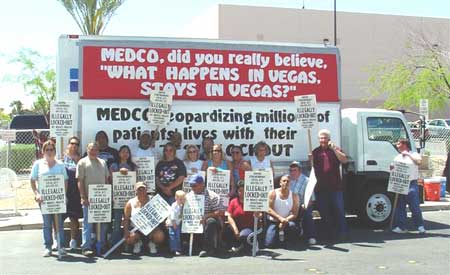
Update: Wednesday, April 5, 2006,12:34 p.m. PDT — Lockout at Las Vegas Medco pharmacy
UPDATE: 5-13-2007
Lawmakers consider benefits for locked-out workers
"The bill stems from a six-week-long lockout early last year involving about 650 workers at a Merck drug distribution facility in Henderson, said Danny Thompson, head of the Nevada (State) AFL-CIO."
[Editor's note: Either AP got the name wrong, or MEDCO is part of Merck. Stay tuned.](UPDATED May 21, 2006, 6:03 a.m. PDT — Tentative settlement, see below.)
To: All Affiliates
From: Danny L. Thompson
RE: Union Lockout — Medco Health Solutions
Date: April 5, 2006Medco Health Solutions, an Rx mail pharmacy, located at 6225 Annie Oakley Drive in Las Vegas, Nevada, locked out its workers at 12:01 am on Wednesday 4/5/06. Medco employees are members of the United Steelworkers Union Local 675. The lockout will affect approximately 600 of our union brothers and sisters.
The National Labor Relations Board has issued two complaints against the company, one being the illegal implementation of benefit changes, including changes to the Medical Insurance Plan. These complaints issued by the National Labor Relations Board will, in effect, make the company’s lockout illegal. The members are united and determined to negotiate the fair contract they deserve.
Any assistance to their efforts will be appreciated. If you have any questions, please call me at the office 702-459-1414 or contact Deb Berko by e-mail or phone 702-413-4519.Danny L. Thompson
Executive Secretary Treasurer
Nevada State AFL-CIO
United Steelworkers Las Vegas Medco website
(Link is now stale.)UPDATE 5-21-2006 — Tentative agreement reached between Steelworkers and Medco Health Solutions,
Inc,. in Las Vegas
Illegal lockout to end if members ratify new contract
Medco Health Solutions, Inc. (NYSE:MHS) has reached a tentative agreement with the United Steelworkers International (USW) union and its Local 675 that covers its members in Las Vegas. The local negotiating committee will unanimously recommend the agreement to the membership. Details of the tentative agreement will be announced only after Local 675 members receive a contract summary and participate in a contract ratification meeting on Tuesday, May 23.
"Public pressure against the company for its illegal lockout affected our negotiations," said Pia Tillis, USW unit chair for the Las Vegas Medco facility. "Unions across the country denounced Medco and threatened to change prescription providers in a deluge of letters, phone calls and emails."
If Medco had not agreed to end the illegal lockout, it would have placed at risk over 25 percent of its total business. Over 6 million union members and their families have coverage under Medco's prescription drug plans.
The USW represents over 5,100 workers at Medco facilities in Las Vegas, Nev., Tampa, Fla., Willingboro, N.J., Columbus, Ohio, North Versailles, Pa., Fort Worth & Irving, Texas and Liberty Lake (Spokane), Wash.UPDATE 4-29-2006 — 500 Las Vegas members of the United Steelworkers remain illegally locked out of their workplace over health insurance costs. Please forward this information to everyone you know. If your prescriptions are filled through mail service with Medco, I highly recommend that you use retail service until union workers are back in the plant to fill your Rx. This will support the group’s efforts and it’s for your own safety
.In Solidarity,
Debra A. Berko
Regional Benefits Coordinator
Union Privilege
Nevada State AFL-CIO
Update: Wednesday, April 5, 2006, 2:38 a.m. PDT — ON THIS DATE in 1951, Julius and Ethel Rosenberg were sentenced to death for conspiring to commit espionage for the Soviet Union. (New York Times e-headlines)
ON April 5, 1208, Quetzalcoatl died [EDITOR'S NOTE: The name literally means "hummingbird wizard," the top gun god of the ancient Aztecs. One of the reasons they rolled over for Cortez and his crusaders lay in the Aztec superstition that Quetzalcoatl would someday return, and eight limbed critters in shining armor — mounted conquistadores — sure looked godly to the natives.]; in 1890, the Silver State reported on northern Nevada flooding: "Several dams up the river have been washed out. In some instances the water has cut a new channel, leaving the dam high and dry"; in 1907, the ferry across the Carson River at Brunswick was completed and put into use; in 1911, U.S. Rep. Victor Berger of Wisconsin demanded the withdrawal of U.S. troops from Mexico, where they were interfering in the revolution; in 1923, a Michigan jury in the prosecution of communist and labor leader William Z. Foster for criminal syndicalism was declared hung after it took eighteen ballots in 31 hours and they all came out six to six; in 1923, Arthur Conan Doyle, author of The Lost World and the Sherlock Holmes stories who was in the U.S. to lecture on spiritualism, opined that archeologist Howard Carter had died on March 2 because of "an evil elemental" loosed by Egyptian occultism or the spirit of Tutankhamen; in 1927, the San Francisco Chamber of Commerce's committee on expositions held a meeting to plan for business exhibits at the Transcontinental Highways Exposition in Reno; in 1934, Lithuania, Estonia, Latvia and Russia renewed their non-aggression treaties for another ten years; in 1934, federal agents were investigating whether the congressional frank had been used by U.S Representative Louis McFadden of Pennsylvania to send out his tract attacking Jewish bankers (it is still circulated today, now on the internet); in 1934, California regulators received a petition from J.P. Thomas asking that he be allowed to abandon the telephone exchange at Kenny in Humboldt County because (1) a fire 13 years earlier had destroyed all the line leading to the exchange, (2) all the equipment was stolen after the fire, (3) no one lived in Kenny anymore; in 1934, Reno's beautiful Overland Hotel, recently repossessed by Reno National Bank, was purchased by Washoe County rancher Nick Sorge for $70,000; in 1956, after he wrote columns critical of mob influence in labor unions, columnist Victor Riesel was blinded by acid thrown in his face by an unknown attacker [EDITOR'S NOTE: The hardassed Mr. Riesel continued to write tough, uncompromising stuff. His column appeared in the Las Vegas Sun for many years afterward until his death.]; in 1963, Olympic skier Sonja McCaskie was raped, strangled, and dismembered in her Reno home (her reputation was dismembered in succeeding days by Reno journalists); in 1965, former Las Vegan Robert Johnson was arrested for allegedly selling defense secrets to the Soviet Union; in 1965, Gov. Grant Sawyer said he would commission state district judge David Zenoff to fill in for disabled Nevada Supreme Court Justice Frank McNamee; in 1976, billionaire recluse Howard Hughes died, quickly setting off a Nevada court battle over the Melvin Dummar will; in 1988, Arizona Secretary of State Rose Mofford became governor after Gov. Evan Mecham was impeached, tried, convicted and removed from office. [EDITOR'S NOTE: No journalist will ever forget Mecham's angry screed to what he considered an untrustworthy reporter: "Don't ever ask me for a true statement again."]
[[EDITOR'S NOTE: Unless otherwise noted, historical items appear courtesy of longtime Nevada reporter Dennis Myers' Poor Denny's Almanac. Items highlighted in blue are of particular interest to labor.]]
Update: Tuesday, April 4, 2006, 3:12 a.m. PDT — ON THIS DATE in 1507, Martin Luther was ordained a Catholic priest in Erfurt, Germany; in 1687, King James II of England issued a "declaration of indulgence" that ended requirements for religious oaths for public or military office, allowed worship in faiths other than the Church of England, and allowed worship in private homes or chapels, a significant step toward freedom of worship and separation of church from state; in 1840, Comanches and residents of San Antonio exchanged prisoners; in 1841, John Tyler became the first vice president to succeed a dead president, and asserted the right to become president instead of acting president (no one could lay their hands on the constitutional debates at the time, but years later the debates surfaced and proved Tyler wrong); in 1860, U.S. Representative Daniel Gooch of Massachusetts gave a speech on Utah polygamy in the House of Representatives; in 1887, the voters of Argonia, Kansas, elected Susannah Salter to be mayor, the first known woman mayor of a U.S. community; in 1907, a document was circulating among Carson City businesspeople in which signers pledged not to hire members of the Industrial Workers of the World; in 1907, a public meeting was held at the county court house in Carson City on selection of a site for the proposed governor's mansion; in 1915, McKinley Morganfield aka Muddy Waters was born in Rolling Fork in the Mississippi Delta; in 1918, Robert Praeger, a U.S. citizen of German descent who tried to enlist in the navy was wrapped and bound in a U.S. flag and lynched by a St. Louis mob (the leaders of the mob were acquitted by a jury); in 1923, in Washington the Interstate Commerce Commission set a valuation of the Nevada Northern Railroad at $3,404,900 compared to the company's own self-valuation of $3,403,479; in 1934, the seven members of Congress who voted against the declaration of war in World War One and were still in office said the results and aftermath of the war reinforced their belief that entry into the war was a mistake (Nevada's congressmember, Edwin Roberts, who voted against war, was no longer in Congress); and also on this day in 1934 former U.S. Representative Jeanette Rankin of Montana, who also voted against war in 1918, testified in Washington for a proposed constitutional amendment requiring a popular vote before U.S. troops could be sent outside the nation to wage a war; in 1934, a year after churches in Germany were (mostly willingly) brought under state control, a group of Christian leaders led by Dietrich Bonhoeffer openly formed a Pastor's Emergency League to oppose the Nazis and the state church, prompting many ministers to resign from the state church (Bonhoffer was hanged in 1945 at Flossenburg concentration camp) and on that same day in 1934, the Reichbishop of the state church issued an order forbidding ministers from discussing the religious dispute in their sermons; in 1934, in Los Angeles, Annie Barnett filed notice of an appeal that she and her husband Jackson Barnett, a Creek tribe member, were proceeding against a federal court ruling invalidating their marriage; in 1934, Naomi Schenck, who as three year old Naomi Pike survived the Donner Party disaster, died in The Dalles, Oregon; in 1934, U.S. Senator Key Pittman of Nevada angrily denied what he called a "malicious rumor" that he would testify on behalf of Reno political/crime bosses William Graham and James McKay in their federal mail fraud trial in New York. Pittman further said "I am shocked beyond words at the disappearance of my friend Roy J. Frisch" (Frisch, former Reno city councilmember who was the chief witness against Graham and McKay vanished on March 23d and was never seen again); in 1934, all the candidates for student president at the University of Nevada dropped out of the race in protest against a fraternity-dominated "combine"; in 1934, at a senate hearing, an FDR nominee for collector of internal revenue in Louisiana responded to a question from U.S. Senator Huey Long by saying "You know you can't prove that, you rotten son of a bitch," and Long ordered that the comment be entered into the record of the hearing; in 1944, the Allies succeeded in taking an aerial photograph of Auschwitz, providing additional data for an Allied bombing run that would have put the death camp out of business, an effort the Allies chose not to undertake; in 1955, the Hotel New Frontier opened in Las Vegas; in 1959, what appeared to be a looming prison riot was prevented when Gov. Grant Sawyer went to the prison and told the inmates he was replacing the warden he fired, A.E. Bernard, with former county sheriff, justice of the peace, and assemblymember Jack Fogliani; in 1960, RCA released Elvis' Stuck On You b/w Fame and Fortune, the first single released in mono and stereo versions; in 1963, a Pony Express sculpture was installed at Harrah's Casino at Stateline, Lake Tahoe; in 1964, My Guy by Mary Wells went onto Billboard's Hot 100 where it stayed for 15 weeks; in 1965, Las Vegas Review Journal columnist Forrest Duke dissed the dramatization of The Green Felt Jungle on NBC's Kraft Suspense Theatre as "laughable" and "almost as big a dud as" the best selling book on which it was based (the network wimped out on naming Las Vegas, calling it "Los Ramos"); in 1965, the Nevada Assembly voted 17 to 13 to lower the voting age to 18, falling seven votes short of the required two thirds for a state constitutional amendment; in 1967, the Rev. Martin Luther King., Jr., spoke against the Vietnam war at Riverside Church in New York City; in 1968, the Rev. Martin Luther King., Jr., was assassinated at age 39 while campaigning in support of striking trash collectors; in 1969, CBS cancelled the Smothers Comedy Brothers Hour, known for iconoclastic, antiwar programming; in 1985, Congress refused to grant support to Nicaraguan contras, but President Reagan provided it secretly and illegally anyway; in 1988, Senate terrorism and narcotics subcommittee chair John Kerry presided over a hearing on 50 to 100 contra flights that carried illegal drugs into the United States in the 1980s; in 1979, former Pakistan prime minister Ali Bhutto, who made Islam the state religion and accomplished socialist reforms while repressing competing political parties, was executed for allegedly ordering the murder of a political opponent; in 1996, Jerry Garcia's ashes were scattered in the Ganges; in 2002, George Bush demanded that Israel halt invasions of Palestinian territory, in response to which Israel increased the incursions.
Robert Kennedy on the death of Martin Luther King Jr.: "Whenever any American's life is taken by another American unnecessarily — whether it is done in the name of the law or in the defiance of the law, by one man or a gang, in cold blood or in passion, in an attack of violence or in response to violence — whenever we tear at the fabric of the life which another man has painfully and clumsily woven for himself and his children, the whole nation is degraded...Too often we honor swagger and bluster and wielders of force; too often we excuse those who are willing to build their own lives on the shattered dreams of others. Some Americans who preach non-violence abroad fail to practice it here at home. Some who accuse others of inciting riots have by their own conduct invited them. Some look for scapegoats, others look for conspiracies, but this much is clear: violence breeds violence, repression brings retaliation, and only a cleansing of our whole society can remove this sickness from our soul. For there is another kind of violence, slower but just as deadly destructive as the shot or the bomb in the night. This is the violence of institutions; indifference and inaction and slow decay. This is the violence that afflicts the poor, that poisons relations between men because their skin has different colors. This is the slow destruction of a child by hunger, and schools without books and homes without heat in the winter. This is the breaking of a man's spirit by denying him the chance to stand as a father and as a man among other men. And this too afflicts us all."
Update: Monday, April 3, 2006, 1:05 a.m. PDT — ON THIS DATE in 1968, the Rev. Martin Luther King., Jr., foreshadowed his own death: Like anybody, I would like to live a long life. Longevity has its place. But I'm not concerned about that now. I just want to do God's will. And He's allowed me to go up to the mountain. And I've looked over. And I've seen the promised land. I may not get there with you. But I want you to know tonight that we, as a people, will get to the promised land. And I'm happy, tonight. I'm not worried about anything. I'm not fearing any man. Mine eyes have seen the glory of the coming of the Lord.
ON THIS DATE in 1860, the short-lived Pony Express began operation between Sacramento and St. Joseph, Missouri; in 1861, an article entitled The Las Vegas Silver Mines in the Desert News reported that more than 100 miners were working in Las Vegas; in 1862, Jesse James was murdered in St. Joseph; in 1906, John Alexander Dowie, founder of the Christian Catholic Church of Zion, Illinois, was deposed as head of the church; in 1906, the Reno Evening Gazette reported that a copper strike which "will rival Butte and Ely" had been made near Pyramid Lake; in 1923, in Augusta, President Harding's staff said he would undertake a western tour during which he would talk about the World Court, a tour from which he would not return alive; in 1923, the lumber town of Loyalton was seeking to take the county seat of California's Sierra County from the gold camp of Downieville; in 1934, in Indiana, a deputy sheriff and a jail worker were indicted and a judge was criticized by the Lake County grand jury as a result of John Dillinger's wooden gun escape from the Crown Point jail (the judge then held the grand jurors in contempt of court); in 1941, the El Rancho Hotel Casino opened on Highway 91 south of Las Vegas, the start of the "Strip"; in 1948, President Truman signed the Marshall Plan, which allocated more than $5 billion in aid for 16 European countries (New York Times e-headlines); in 1954, eight Republican and Democratic congressional leaders, summoned to the Pentagon, were briefed by Secretary of State John Foster Dulles and Joint Chiefs of Staff chair Arthur Radford on a plan for a massive conventional and nuclear U.S. intervention into the Indochina war on the side of the French, but after two hours of sharp and skeptical questioning by the congressmembers that failed to answer questions about preparations and implications of military action, Dulles was told by all eight congressmembers that he would have no support unless he could line up other nations to back the action (after three weeks, the Eisenhower administration was unable to find allied support, and so war was, for the time being, averted); in 1959, the U.S. House UnAmerican Activities Committee claimed that it had evidence that the communists were planning a major push in southern California among labor groups, Mexicans, Jews, and blacks; in 1960, at a dusk to dawn Nashville recording session a month after his army discharge, Elvis recorded some of his best songs (Reconsider Baby, Such a Night) and his worst (It's Now Or Never). [ITALIAN EDITOR'S NOTE: It's Now Or Never was much better than some versions of O Sole Mio inflicted upon unsuspecting little Italian kids.]; in 1962, six people died in the fire that destroyed Reno's Golden Hotel; in 1965, the Nevada Senate defeated a casino entertainment tax on a 10 to 7 vote and later in the day reversed itself and voted for the tax on a 9 to 8 vote; in 1965, Wooly Bully by Sam the Sham and the Pharoahs was released; in 1965, Governor Grant Sawyer said legislators who refused to reapportion the Nevada Legislature in hopes that a U.S. constitutional amendment would overturn federal one person/one vote court decisions had made a "very bad gamble" since the local federal district court had continued a redistricting lawsuit in order to give state legislators time to do the job; in 1965, Governor Sawyer signed legislation outlawing adult publications; in 1968, at Mason Temple in Memphis on the eve of his death, Martin Luther King spoke powerfully of his willingness to die (http://www.afscme.org/about/kingspch.htm), foreshadowing his assassination the next day; in 1969, after repeatedly censoring the antiwar content of the Smothers Comedy Brothers Hour, CBS canceled it altogether in violation of contract (the network claimed the brothers had failed to deliver a show by deadline, but there was no deadline and the brothers won the ensuing lawsuit), and replaced it with Hee Haw; in 1974, California Lt. Gov. Ed Reinecke was indicted for lying to the U.S. Senate Judiciary Committee in the Nixon/ITT scandal (he was convicted but the conviction was overturned when a court ruled there was not a quorum of the committee present for Reinecke to lie to); in 1980, the U.S. government reinstated federal recognition of the Utah Paiutes that had been dropped 26 years earlier (no word on whether the Paiutes returned the favor); in 1990, Sarah Vaughn died; in 2000, the North Las Vegas Airport broke ground for a new control tower, runway, and taxiway extension; in 2000, Microsoft was found guilty of violating antitrust law; in 2002, former U.S. Senator Richard Bryan, representing the group Preserve Nevada and speaking on the steps of the old Las Vegas High School building, announced a list of the 11 most endangered historic sites in Nevada; in 2002, NBC's West Wing aired an episode about a transportation accident involving nuclear waste which displeased nuclear power industry lobbyists and pleased Nevada officials trying to fight the establishment of a dump for nuclear wastes at Yucca Mountain in Nye County (U.S. Senator John Ensign of Nevada: "This could be very helpful.")
[[EDITOR'S NOTE: Unless otherwise noted, historical items appear courtesy of longtime Nevada reporter Dennis Myers' Poor Denny's Almanac. Items highlighted in blue are of particular interest to labor.]]
Update: Sunday, April 2, 2006, 12:16 a.m. PST — ON THIS DATE in 1513, according to anglocentric history, Ponce de Leon "discovered" Florida (it was right where its inhabitants thought it was all along); in 1870, Victoria Woodhull became the first women nominated for the presidency of the United States ; in 1886, a ball was held in Reno to honor the anti-Chinese movement and to celebrate the opening of the Reno Steam Laundry Association building; in 1896, the New York Sun reported that the District of Columbia Typographical Union was investigating whether U.S. Senator William Stewart of Nevada headquartered his Silver Knight newspaper (which had editorial offices in New York and carried a Washington dateline) in Virginia to avoid union rules; in 1902, the first exclusively movie theatre opened in Los Angeles; in 1917, Jeannette Rankin of Montana was sworn into office as a member of the U.S. House of Representatives [EDITOR'S NOTE; She became the only member of Congress to vote against both world wars]; in 1917, President Woodrow Wilson asked Congress for a declaration of war against Germany, stating that "The world must be made safe for democracy." [EDITOR'S NOTE: Apparently, we failed and continue to do so.] (Congress debated for four days before voting); in 1934, Max Baer, training for the fight against Primo Carnera in which he would win the heavyweight championship, decided to leave his training camp at Globin's at Lake Tahoe and find a warmer location; in 1947, Emmylou Harris was born in Birmingham, Alabama; in 1951, University of Nevada President Malcolm Love was in Las Vegas for a round of public appearances during which he was expected to talk about plans to start college classes in Las Vegas during the fall semester; in 1959, after lawmakers carved $1.5 million out of Governor Sawyer's budget but still faced pleas from cities and counties, Clark County Senator Mahlon Brown, D, said that because of casino opposition to any increase in gambling taxes he was looking at tax increases on beer and cigarettes to aid the municipalities; in 1959, furniture store owner Oran Gragson was rumored to be considering a run for mayor of Las Vegas; in 1965, the Nevada State Archives was created; in 1965, author Ken Kesey was arrested for marijuana use; in 1968, presidential candidate Eugene McCarthy won his first presidential primary, in Wisconsin; in 1971, Ringo Starr's It Don't Come Easy was released; in 1971, on his fifth nomination, Jack Lemmon won his second Oscar for Save the Tiger; in 1982, Argentina reclaimed the Malvinas [Falkland] Islands; in 2002, Israeli tanks invaded Bethlehem and Palestinians sought refuge in the Church of the Nativity, barricading themselves inside and holding the church during a long siege.
Update: Saturday, April 1, 2006, 3:23 a.m. PST — ON THIS DATE in 1869, White Pine County was created with Hamilton as its county seat; in 1881, Ed Vesey gave up his lease on Reno's Lake House, possibly to move to Sierra Valley, and Myron Lake took over operation of the property again; in 1886, the Nevada State Journal reported "The Carson Appeal says a private letter from Washington states that Nevada will have some trouble getting the appropriate for her Indian School from the face that the appropriation has been exhausted for this year. The Department stated that the money for this purpose lay there for years, but none of the Nevada Representatives asked for it and of course it was not tendered. It could at any time have been had for the asking but nobody cared enough about it to ask, so of course we wait another year."; in 1895, the Nevada Assembly amended a bill prohibiting the use of "ardent spirits" in the capitol building to make it take effect after the legislature went home for the year; in 1896, the Nevada State Journal reported that Mrs. M.C. Lake would move into the Lake house; in 1904, Truckee Carson Project (Newlands Project) engineer L.H. Taylor said the project would reclaim (irrigate and farm) 235,000 acres (it never reached 100,000); in 1907, mining labor leaders Joseph Smith and Morris Preston, being held on charges of killing a restaurant owner in Goldfield, arrived in Carson City after being removed from the Hawthorne jail to be taken to the state prison to await trial; in 1913, Washoe County District Attorney William Woodburn was asked for a legal opinion on whether the new state glove contests law required the $100 be paid for a day's fights or for each individual fight, and whether the law limited the number of rounds; in 1945, American forces invaded Okinawa during World War II (New York Times e-headlines); in 1952, officials of the Calaveras County Fair came up with a grisly publicity stunt — to prove or disprove stories that frogs had emerged alive from stonemasonry after being inside for years, the fair would entomb a frog in a wall for a year; in 1952, there was growing criticism of a Reno Chamber of Commerce plan to change the name of Slide Mountain to Mount Reno, with snow surveyor James Church and members of the Nevada Historical Society opposing the change; in 1957, Bye Bye Love by the Everly Brothers was released on Cadence; in 1964, Nevada casinos changed the rules of blackjack to defeat a successful system for beating the house that was then in use; in 1965, on a 17-18 vote, the Nevada Assembly voted down a required redistricting plan, hoping that a federal constitutional amendment overturning U.S. Supreme Court one-person/one-vote decisions would be approved so the reapportionment would never have to be done; in 1970, U.S. Army Sp. 4 Peter Lemon was involved in an action in which he stood off Vietnamese troops with three machine guns and some hand grenades while being wounded three times and rescuing a fellow soldier, actions for which he received the Medal of Honor (he later credited his alertness in the action to the fact that he was stoned on marijuana at the time); in 1971, U.S. Representative Walter Baring, D-Nev., sent a letter to President Nixon seeking a pardon for mass murderer William Calley: "I make this request in behalf of my constituents, myself, and every former, current and future American soldier. This miscarriage of justice has hurt the cause of American patriotism and troop morale and surely will not assist you in developing a professional army, volunteer or draft." [EDITOR'S NOTE: Baring was ousted in the Democratic primary the following year.]; in 1971, the Nevada Senate voted to kill a public vote on whether to make abortion legal; in 1971, the Riverside Hotel in Reno reopened under the ownership of Jessie Beck; in 1975, NLF and Hanoi forces were sweeping through Vietnam toward Saigon and Cam Ranh, with two province capitals falling without a shot being fired; in 2003, U.S. forces invaded an Iraqi hospital at Nasiriyah to seize Private Jessica Lynch (earlier the Iraqis, who saved Lynch's life, had tried to turn her over to U.S. forces who refused to accept her).
Update: Friday, March 31, 2006, 2:26 a.m. PST — ON THIS DATE in 1968, President Johnson stunned the country by announcing he would not run for another term of office. (New York Times e-headlines)
ON MARCH 31, 1492, in Granada's Alhambra Palace, Ferdinand and Isabella of Spain signed an "edict of expulsion" ordering all Spanish Jews to leave the nation and giving them three months to dispose of their homes, property and assets (usually at a fraction of their value (Isabella said it was not their decision, it was God's); on this date in 1845, the autobiography Narrative of the Life of Frederick Douglass was published; in 1870, Thomas Peterson Mundy of Perth Amboy became the first African American to vote under the 15th amendment to the U.S. Constitution, which had been ratified the previous day; in 1877, Virginia City's magnificent International Hotel opened; in 1878, future world heavyweight champion Jack Johnson was born in Galveston; in 1879 ,a Carson Reform Club was formed in Carson City to open a club room for local boys in order to keep them out of saloons; in 1917, the United States took ownership from Denmark (for $25,000,000) of the Danish West Indies, 50 Caribbean Sea islands in the Lesser Antilles, changed their name to the Virgin Islands and turned them over to the Navy to run (a decision that was a fiasco); in 1927, César Chávez was born near Yuma, Arizona; in 1932, police in Redwood City, California were holding (on an assault charge) a man named Joe Cramer who had escaped from the Nevada State Prison eleven years earlier; in 1932, there was a party and dance in the Washoe County Library to show off improvements made to it; in 1933, the Civilian Conservation Corps was created to train and aid youth during the Depression; in 1934, law enforcement officers surrounded the Lincoln Court Apartments in an exclusive section of St. Paul, trapping John Dillinger in his apartment, but Dillinger, his companion Billie Frechette, and gangster Homer Van Meter escaped in a gun battle; in 1943, Rodgers and Hammerstein's Oklahoma! opened on Broadway; in 1944, Adolf Eichmann promised Jewish leaders in Hungary that German/Jewish relations would return to normal after Germany won the war; in 1949, the latest battle in the dairy lobby's war against oleomargarine was being fought in Congress over whether to continue the special federal fees the dairies had succeeded in imposing on oleo and on whether to prohibit yellow oleo from interstate commerce; in 1949, attorney Madison Graves filed charges against Las Vegas police officers after a teenager was beaten in the city jail and then given no medical attention to head injuries for four hours; in 1951, housing units in the Valley Park addition that were brought to Carson City in 1946 were turned over to the Carson City housing authority by the federal government after repairs (the city would rent them out with the rents to go into the city treasury); in 1957, the first and only musical written by Richard Rodgers and Oscar Hammerstein II for television, Cinderella, was broadcast (performed live!) and introduced the United States to a new performer until then seen only on Broadway — Julie Andrews ("Just before I went on, a very kind soul pointed out to me that more people probably would see me in that single telecast than all the full houses of My Fair Lady for 100 years"), a program not broadcast again until Dec. 9 2004; in 1958, Chuck Berry's Johnny B. Goode was released; in 1965, a massive airborne offensive began in Vietnam, with a hundred U.S. planes pouring tons of napalm, phosphorus bombs, and fuel oil on a 19,000-acre section of Vietnam; in 1968, Lyndon Johnson agreed to negotiations with the Vietnamese, ordered a partial bombing halt in Vietnam, and withdrew from the presidential race; in 1971, a court martial board sentenced Lt. William Calley to life at hard labor for murdering 22 Vietnamese civilians at My Lai; in 1971, the Nevada Assembly voted to reduce the residency requirement for Nevada divorces to three weeks; in 1982, a massive avalanche hit Alpine Meadows ski resort, killing seven and entombing chairlift operator Anna Conrad, trapped under a bank of lockers buried in ten feet of snow (she was found alive in a hollowed-out ice cave five days later); in 1995, Latina star Selena was shot and killed in Corpus Christi; in 2005, the U.S. Equal Employment Opportunity Commission charged Caesars Palace in Las Vegas with a workplace climate that allowed repeated, severe, and gross sexual harassment, such as a supervisor trying to have forced sex with a worker who was four months pregnant and another supervisor grabbing a worker by the hair and forcing her to perform fellatio and other supervisors exposing themselves to female workers.
[[EDITOR'S NOTE: Unless otherwise noted, historical items appear courtesy of longtime Nevada reporter Dennis Myers' Poor Denny's Almanac. Items highlighted in blue are of particular interest to labor.]]
Update: Thursday, March 30, 2006, 4:52 a.m. PST — Labor and business leader Roland Christensen dies at 80. Funeral Saturday in Reno.
Update: Thursday, March 30, 2006, 4:45 a.m. PST — ON THIS DATE in 1981, President Reagan was shot and seriously injured outside a Washington, D.C., hotel by John W. Hinckley, Jr. Also wounded were White House news secretary James Brady, a Secret Service agent and a District of Columbia police officer. (New York Times e-headlines) [EDITOR'S NOTE: Why does no one ever seem to mention the names of the latter two men? Didn't they bleed enough? The Secret Service agent was Timothy McCarthy, the DC Police officer was Thomas Delanty.]
[[EDITOR'S NOTE: Unless otherwise noted, historical items appear courtesy of longtime Nevada reporter Dennis Myers' Poor Denny's Almanac. Items highlighted in blue are of particular interest to labor.]]
ON MARCH 30, 1870, five years after the end of the civil war, slavery became illegal in the United States with ratification of the Fifteenth Amendment and celebrations were planned throughout the nation, including at Elko (where it was the occasion for demands for integrated local schools) and Virginia City; on this date in 1899, the Virginia City Chronicle charged that the Southern Pacific Railroad had rewarded Assemblymember Willard Gillespie of Gold Hill for absenting himself during the legislative vote on appointed a new United States senator by appointing him ticket agent at Oakland Mole, the westernmost train station from which transcontinental passengers were ferried across San Francisco Bay from their arriving trains; in 1899, Reno postmaster H.P. Kraus reported that with nine days to go before the end of the postal year, he had sold $10,606.24 in stamps and estimated he would sell another $200 during the nine days, making an increase of eight percent over the previous year; in 1920, Danes were rebelling and demanding a republican government after King Christian dismissed the government of Prime Minister Carl Theodor Zahle after Zahle refused to force Central Schleswig to become a part of Denmark following the region's vote to remain with Germany (this precipitated the Easter Crisis of 1920 that ended with a threat to Christian's reign and his retreat to a latent role in governance); in 1920, officials estimated that U.S. citizens were spending a billion dollars annually (about $10.7 billion in 2005 dollars) in Mexican border towns like Mexicali, Nogales, Juarez, and Tijuana where alcohol was legal; in 1920, Sunset magazine editor Charles Field spoke at Eagles Hall at a meeting to organize a Reno Hoover for President Club; in 1932, the New York Renaissance, an African American team, defeated the Boston Celtics, a mostly white team, to win the national basketball championship; in 1934, a committee of local businesspeople mapped out a plan to change Reno to a city manager form of government; in 1934, the town of Derby was being moved to make way for highway construction; in 1945, just days before the Ravensbruck women's death camp was liberated, a group of women attacked their guards as they were being led to the gas chambers (nine escaped but were recaptured and killed); in 1947, plans for the Tucker automobile were announced; in 1948, President Truman suggested that his rival Henry Wallace relocate to Russia, Wallace testified against Truma'‚s defense plan in Congress, anti-Truman Democrats refused to accept General Eisenhower's disavowal of presidential ambitions, and Republican presidential candidates Dewey and Taft were planning a joint stop-Stassen effort; in 1948, on the eve of state takeover of the Basic Magnesium industrial complex in Henderson from the federal government, Gov. Vail Pittman and other officials sought to reassure residents of the company town that they would not have to pay higher rates now that the state was operating their power company; in 1963, aeronautical engineer Ed Dwight, an African American air force test pilot, was admitted to U.S. astronaut training, where — after full public relations mileage was obtained from him — he was harrassed and threatened into quitting two years later (he is now a renowned sculptor); in 1969, 20 year- old Charles Lynn Hodge of Reno, Nevada, died in Tay Ninh province, Vietnam (panel 28w, row 91 of the Vietnam wall); in 1972, at a meeting in Key Biscayne, Nixon campaign manager John Mitchell allegedly approved the break-in at Democratic National headquarters in the Watergate office complex; in 1989, Gladys Knight performed without the Pips for the first time, at a casino in Las Vegas.
Update: Wednesday, March 29, 2006, 2:38 a.m. PST — ON THIS DATE in 1516, to placate Catholic authorities, the city government of Venice ordered all the city's Jews into Europe's first Jewish ghetto where they continued to live in misery until 1797 when Napoleon 3d conquered the city and liberated the ghetto; in 1806, Congress provided money for work on the Cumberland Road, the first federal highway; in 1915, Gov. Emmet Boyle vetoed a measure providing for a bounty on "noxious animals" on the ground that the counties already paid a $1 bounty for coyotes and he saw no reason for the state to get involved; in 1923, in the new issue of Fascisti Review Gerarchia, Italian Premier Benito Mussolini said liberalism was a remnant of the 19th Century and that "men nowadays are tired of liberty"; in 1923, Oklahoma Speaker Murray Gibbons discovered a case of illegal whiskey in a hearing room of the legislature; in 1932, there was an uproar in the U.S. House of Representatives hall when U.S. Representative Charles Martin of Oregon (a right wing Democrat) called New York Representative Fiorello LaGuardia (a liberal Republican) a socialist, whereupon a dozen members were on their feet shouting for recognition and using colorful language not normally heard in the hall; in 1932, in Arizona, a three story limestone pueblo was being excavated near the Verde River; in 1934, Renoites lined the Truckee River watching to see if a new island formed in the river between Virginia and Center after the construction of the Center Street Bridge would withstand heavy flows driven by upstream rains; in 1957, a report on the causes of a Feb. 5 explosion and fire in downtown Reno was released; in 1962, in Bonn, Germany, NPR reporter Carol Cizauskas was a one-day-old newsbabe; in 1967, the Beatles recorded With A Little Help From My Friends (lead vocal: Ringo), the second track of Sgt. Pepper; in 1971, Lt. William Calley was convicted of murdering 22 Vietnamese civilians, the only responsible official ever brought to justice for the My Lai massacre; in 1973, the United States withdrew ground forces from Vietnam but kept bombing the devil out of the country*; in 1973, Dr. Hook and the Medicine Show, who had a hit with Cover of the Rolling Stone, appeared on the cover of Rolling Stone; in 1992, President Bill Clinton admitted to an inability to correctly operate a doobie: "I didn't inhale and I didn't try it again."
* IRATE EDITOR'S NOTE: In today's e-headline, the New York Times related the same Vietnam item thusly: "On March 29, 1973, the last United States troops left South Vietnam, ending America's direct military involvement in the Vietnam War."
BULL! As Mr. Myers notes, above, our involvement did not end then and has never ended. Just ask any old soldier suffering from the after effects of Dioxyin/Agent Orange, the favorite war cocktail of the late apostle of jungle defoliation, General and Senator Barry Goldwater, R-Ariz.
Update: Tuesday, March 28, 2006, 3:44 a.m. PST — ON THIS DATE in 1862, the civil war battle at La Glorietta Pass in New Mexico was fought, known as the "Gettysburg of the West"; in 1915, for the first time in the United States people were told publicly how to use a contaceptive, in remarks by Emma Goldman before a crowd of 600 at New York's Sunrise Club, resulting in her conviction for "inflammatory speech" and a sentence of 15 days in the workhouse, the first of many such court actions (a woman journalist wrote in the Little Review that "Goldman was sent to prison for advocating that women need not always keep their mouths shut and their wombs open"); in 1923, California Secretary of State Frank Jordan announced that author Upton Sinclair had failed to qualify to the ballot in an off year election to fill the seat of a recently deceased congressmember; in 1923, distressed by the behavior of men in the capitol, young women in Washington, D.C. formed an Anti-Flirting Club; in 1929, Joe Dini, later speaker of the Nevada Assembly, was born in Yerington; in 1934, the search for vanished former Reno city councilmember Roy Frisch, chief prosecution witness against Reno gangsters in a federal fraud trial, widened to San Francisco; in 1934, former Nevada boss George Wingfield sold a Las Vegas lot at the corner of Second and Fremont streets that he purchased for $5,000 five years earlier to Ed Von Tobel for $15,750; in 1942, attorney Minoru Yasui, a U.S. citizen who had quit a job at a Japanese consulate because of Pearl Harbor, walked the streets of Portland after a curfew imposed only on citizens of Japanese descent in order to provoke his arrest and a court test of the law (the U.S. Supreme Court upheld the conviction); in 1953, the greatest U.S. athlete of the 20th century, Jim Thorpe, AKA Bright Path of the Sac and Fox Native American Nation, died in Philadelphia (when his native Oklahoma was indifferent to providing him with a resting place, the tiny towns of Mauch Chunk and East Mauch Chunk in Pennsylvania merged and changed their name to Jim Thorpe, all by public vote, and he was buried there in 1954); in 1964, the University of Nevada Board of Regents accepted from the Nevada State Prison warden a donation to the university library a collection of copies of various issues of the inmate newspaper Sagebrush; in 1967, bids were opened for construction of Reno's new Hug High School; in 1997, former Nevada Assemblymember Arthur Espinoza died (Espinoza lost his 1970 reelection although he won the initial vote count; when the 1971 legislature examined one of the voting machines, it registered votes for Espinoza when they were actually cast for his opponent Hal Smith, so Smith was seated in the Assembly); in 2000, Lord of the Rings: The Fellowship of the Ring movie director Peter Jackson told New Zealand's Wellington Evening Post that the Beatles once had plans for production of the Rings trilogy, with John Lennon slated to play Gollum, Paul McCartney to play Frodo, George Harrison to play Gandalf and Ringo Starr to play Sam, but the project was personally vetoed by J.R.R. Tolkien.
Update: Tuesday, March 28, 2006, 12:46 a.m. PST — [HOMER SIMPSON, CALL YOUR OFFICE!] ON THIS DATE in 1979, America's worst commercial nuclear accident occurred inside the Unit Two reactor at the Three Mile Island plant near Middletown, Pa. (New York Times e-headlines)
Update: Monday, March 27, 2006, 8:19 p.m. PST — ON THIS DATE in 1625, King James,, who commissioned the Bible translation that bears his name in order to have a Bible "as consonant as can be to the original Hebrew and Greek," died; in 1879, the Reno Evening Gazette endorsed incorporation of the town: "There is a disposition among some of our taxpayers to shirk the responsibility. They are afraid that it will make taxes too high, and that the town government will be too cumbersome. This is nonsense. The cost of a town government, such as is proposed, will not add appreciably to the present rate of taxation. It will be both cheap and simple, and its effectiveness will be beyond question. Life and prosperity would have a security heretofore unknown; the sanitary condition of the town vastly improved, and contagious diseases kept at bay."; in 1923, San Francisco supervisors named the Hetch Hetchy Dam after city engineer M.M. O'Shaughnessy; in 1934, the Reno city council joined the Washoe county commission in offering a thousand dollar reward in the disappearance of former city councilmember Roy Frisch, the chief witness in a federal fraud trial of Reno's crime bosses William Graham and James "Cinch" MacKay; in 1939, a two-day silver conference called by Nevada Governor Ted Carville, D, of eleven western governors, mining figures, and U.S. Senator Patrick McCarran, D, began at the Reno civic auditorium; in 1956, the University of Nevada withdrew the expulsions of six students for participating in a demonstration against campus president Minard Stout; in 1977, 582 people died when two 747s collided (on Tenerife) in the Canary Islands; in 2000, ABC began broadcasting reports by Diane Sawyer in which she made Elian Gonzalez relive the loss of his mother and rolled around on the floor with him, drawing harsh criticism from fellow journalists and psychiatrists for exploitation and child abuse (and the right wing criticized her for censoring a comment by the boy in which he said he did not want to go back to Cuba).
Update: Monday, March 27, 2006, 1:13 a.m. PST — ON THIS DATE in 1958, Nikita Khrushchev became Soviet premier in addition to First Secretary of the Communist Party. (New York Times e-headlines)
[[EDITOR'S NOTE: Unless otherwise noted, historical items appear courtesy of longtime Nevada reporter Dennis Myers' Poor Denny's Almanac. Items highlighted in blue are of particular interest to labor.]]
Update: Sunday, March 26, 2006, 12:17 a.m. PST — ON THIS DATE in 752, Pope Stephen II died three days after his election to the papacy; in 1780, England's first Sunday newspaper, the British Gazette and Sunday Monitor began publication; in 1804, Congress approved legislation providing to the President "a sum not exceeding fifteen thousand dollars...for the purpose of extinguishing Indian claims..."; in 1861, the Wilmington Daily Journal in North Carolina reported the creation of the Territory of Nevada by printing on page 3 the entire congressional act establishing the territory (the act was signed by President Buchanan on March 2d in his final week in office); in 1881, the Reno Evening Gazette reported that "(Nevada's U.S. Senator William) Sharon is the only U.S. Senator whose pay was ever docked on account of absence. He got no pay for the extra session of 1879, not showing himself in Washington during the entire session. (Four years to the day earlier, after Sharon had spent most of the first two years of his term far from Washington, the Gazette had claimed that Sharon had "worn out two pairs of pants in his seat in Congress, an exhibition of heroism which fills us with awe."); in 1885, Eastman manufactured the first motion picture film, which could only be viewed on individual viewers like nickelodeons, because not until the same date in 1895 was the first motion picture projector patented by Charles Francis Jenkins, a resident of Indiana; in 1923, Reno city councilmember Roy Frisch proposed creation of a park in a rock quarry at Stewart and Wheeler streets; in 1942, Assistant U.S. Attorney General Thurman Arnold testified that Standard Oil of New Jersey had developed a synthetic rubber before the war, turned it over to the Third Reich, but failed to make it available in the U.S; in 1942, newspapers carried a photo of a long line of dozens of vehicles crossing the desert near Lone Pine, California, transporting a thousand U.S. citizens from Los Angeles to an internment camp in the Owens Valley; in 1942, the books of Nevada treasurer Dan Franks and controller Henry Schmidt did not agree on Boulder Dam revenue, the difference being $60,000 (about $753,000 in 2005 dollars); in 1942, responding to Army and Navy bluenoses who wanted Nevada "vice" removed so it could not tempt soldiers and sailors stationed in the state, Governor Ted Carville pledged his cooperation but said most legal authority over such things was in the hands of municipal officials; in 1942, attorneys George Vargas and former acting governor Morley Griswold filed for a writ of habeas corpus in an effort to free resident Japanese alien Harano Fujii, who was being held on a charge of possessing a gun; in 1955, The Ballad of Davy Crockett became number one on the hit parade; in 1956, the U.S. Information Agency denounced equality in the Soviet Union, describing jobs to which U.S. women would seek entry fifteen years later: "True to their principle of 'equality,' women labor in steel mills, lumber camps and mines, and on railroads, hod carriers on construction jobs, as street cleaners, loggers, stokers, machinists, truck drivers, carpenters, and so on."; in 1960, under a threat of protest marches organized by Dr. James McMillan, casinos in Clark County, Nevada, desegregated their facilities (EDITOR'S NOTE: Las Vegas is in Clark County); in 1960, Elvis taped an appearance with Frank Sinatra at the Fontainbleu Hotel in Miami for later broadcast, helping Sinatra finally break his losing streak as a television ratings performer; in 1964, at the Scala Theatre, the Beatles shot the final concert scene for A Hard Days Night; in 1968, 24 year-old Larry Earl Barger of Las Vegas, Nevada, died in Binh Dinh province, Vietnam (panel 46e, row 28); in 1969, 28 year-old Carlos Wilson Rucker of Las Vegas, Nevada, died in Khanh Hoa province, Vietnam (panel 28w, row 52); in 1979, the Camp David peace treaty was signed by Israeli Prime Minister Menachem Begin and Egyptian President Anwar Sadat at the White House (New York Times e-headlines); in 1982, ground was broken for the Vietnam veterans memorial wall.
Update: Saturday, March 25, 2006, 10:15 p.m. PST — ON THIS DATE in 1855, Beadle's New York Dime Library released Flash Dan, the Nabob or, The Blades of Bowie Bar — A Story of the Gold Lands by Howard Holmes, a dime novel set in northern California and near Carson City, Nevada in 1869; in 1894, Jacob Coxey's army of unemployed workers began marching from Ohio to Washington, D.C. to demand help from the federal government; in 1911, a fire broke out in New York's Triangle Shirtwaist Factory, killing 146, 132 of them girls (the lack of safety exits and fire escapes and the condition of the building galvanized the union movement and led to legal reforms in working conditons and the conviction on manslaughter charges of the owners); in 1927, U.S. Senator Tasker Oddie, R-Nev., was throwing a fit after learning that U.S. Interior Secretary Hubert Work had arranged the acquisition of land in Secret Valley in California's Lassen County for a site in competition with Nevada's Hawthorne for a Army ammunition depot; in 1939, Hitler sent a message of solidarity to Mussolini to celebrate 20 years of fascism in Italy; in 1939, with war talk common, the Nevada Bureau of Mines was doing a study of the prospects for development of strategic war minerals in the state; in 1947, President Truman issued executive order 9835, creating a program to adjudge the "loyalty" of civil service employees and empowering the U.S. attorney general to compile a "list of subversive organizations"; in 1955, customs inspectors seized a shipment of copies of Allan Ginsberg's Howl as they were brought into the U.S. (Lawrence Ferlinghetti's City Lights Bookstore in San Francisco responded by publishing the book in the U.S.); in 1958, John Ensign, now U.S. senator from Nevada, was born in Roseville, California; in 1961, Elvis performed at Pearl Harbor to raise money for the U.S.S. Arizona memorial (it was his last public performance for nine years); in 1966, the fab four posed for the "butcher cover" of their Yesterday and Today album; in 1970, Crosby, Stills, Nash, and Young's only album, the magnificent Deja Vu, went gold; in 1975, Sparks city councilmember Pete Lemberes, who was being investigated by a county grand jury, read a public statement in which he criticized the grand jury, Sparks city attorney Paul Freitag, two of his fellow councilmembers, and Sparks Nugget owner John Ascuaga; in 1975, in a Nevada Assembly judiciary committee hearing on a measure to hike the penalties for marijuana possession, ACLU of Nevada lobbyist Richard Siegel pointed out that jail time for possession in Nevada was already six times longer than the maximum sentence possible for conspiracy to murder (the committee responded by ordering a bill draft to make jail time for conspiracy to murder equal to that for marijuana possession); in 1976, Jackson Browne's wife Phyllis took her own life; in 1992, Cosmonaut Sergei Krikalev returned to a changed world after ten months on the Mir space station (his nation, the Soviet Union, no longer existed).
[[EDITOR'S NOTE: Unless otherwise noted, historical items appear courtesy of longtime Nevada reporter Dennis Myers' Poor Denny's Almanac. Items highlighted in blue are of particular interest to labor.]]Update: Saturday, March 25, 2006, 12:42 a.m. PST — ON THIS DATE in 1965, the Rev. Martin Luther King, Jr., led 25,000 marchers to the state capitol in Montgomery, Ala., to protest the denial of voting rights to blacks. (New York Times e-headlines)
Update: Monday, April 24, 2006, 4:36 p.m. PDT — Nevada Cement Update
New contract ratified, ending threat of regional strike.
Update: Tuesday, April 4, 2006, 3:07 a.m. PDT —
Pension issues remain. More talks have been scheduled for Monday, April 24, 2006.
Fernley Leader-Courier 4-4-2006Update: Thursday, March 30, 2006, 2:04 p.m. PST — Negotiations scheduled for today have been postponed until Friday morning, March 31 — which just happens to be César Chávez's birthday, which will be celebrated in Reno Friday afternoon. Si se puede.
Nevada Cement plans major expansion of Fernley plant (Reno Gazette-Journal 3-30-2006)
Update: Wednesday, March 29, 2006, 3:17 a.m. PST — Fernley Leader-Courier (RGJ subsidiary) contrasts union and management positions, 3-29-2006Update: Monday, March 27, 2006, 6:19 p.m. PST — On KOLO TV-8's 5:00 p.m. newscast, Ed Pearce reported that today's negotiating session ended about 4:30 p.m. Laborers' Union Local 169 Business Manager Richard "Skip" Daly noted that the major remaining sticking points involve health insurance and pension benefits. Pearce's story noted the concerns of the construction industry should a strike inhibit the flow of concrete at the start of the spring construction season. More talks are scheduled for Thursday morning, March 30.
[[EDITOR'S NOTE: Without modification of the current company proposal calling for open-ended health care cost increases deductible without notice from workers' bi-weekly paychecks, employees could conceivably owe the boss money at the end of a pay period. Shades of the old company store.]]
Update: Monday, March 27, 2006, 3:09 p.m. PST, FERNLEY, NEVADA — Union and company negotiators are meeting at Nevada Cement in Fernley at this hour.
At the beginning of today's meeting, Teamsters Local 533 Secretary-Treasurer Mark Tracy addressed all those at the bargaining table.
He brought with him Teamsters Union business agents in charge of truck and rail transportation as well as Nevada Cement.
"The Teamsters will support our committee and if the committee decides that a strike is necessary, the Teamsters will shut down every truck and train coming into Nevada Cement," Tracy told negotiators.
"I sincerely hope you can reach agreement and the next time we meet, I would like to greet everyone with a handshake and a contract instead of a picket," Tracy added, "but we'll do it if we have to."
Updates at NevadaLabor.com as matters develop.Update: Friday, March 24, 2006, 1:23 p.m. PST — Strike at major cement manufacturer could cripple regional construction
Strike vote tonight in Fernley
UPDATE 8:36 P.M. PDT 4-24-2006 — New contract ratified, ending threat of regional strike.
UPDATE 4:38 p.m. PST 3-26-2006 — Unions and management to meet Monday, March 27.
Reno Gazette-Journal 3-26-2006UPDATE: 9:13 p.m. PST 3-24-2006 —The company contract was not ratified. Workers have not walked out as of tonight. Tomorrow has not yet arrived. [On its late newscast, KOLO TV-8 reported that a strike will not happen until Monday at the earliest.]
FERNLEY, NEVADA (March 24, 1:23 p.m. PST) — Friday evening, union negotiators representing workers at Nevada Cement in Fernley will present the company's final contract but will not recommend ratification. If the workers reject the offer, a strike vote will be taken.
The existing contract with Laborers' Union Local 169 and Teamsters Local 533 expires at midnight after having been extended several times in attempting to reach agreement. Nevada Cement is the region's major supplier of the most critical of all construction materials.
"The unions went the final yard by offering to send the matter to binding arbitration in order to avert a potential strike, but the company rejected the offer," stated Local 169 Business Manager Richard "Skip" Daly.
"A decision by a neutral arbitrator would be final, but the company has left the workers with only two options: accept a deficient economic package for the next five years, or strike," he added."Nevada Cement wants to continue a blank check policy that allows the company to charge employees up to 100 percent of the cost of employee and dependent health insurance and deduct it from paychecks. Increases could happen at any time at the company's sole discretion, leaving workers unsure of receiving any raise under the economic package," Daly noted.
"Employees don't have a raise if an 84-cent per hour increase is offset by a $1.00 per hour health insurance hike, for example.
"Nevada Cement has offered, in our view, next to nothing for pensions. As the plan now stands, a worker with 20 years of service qualifies for a modest $1,000 per month at retirement. Under the Nevada Cement proposal, that worker would only receive an extra $50 per month," Daly said.
"In order to increase the pension benefit, the unions even offered to defer negotiated pay raises, but the company also rejected that proposal," he noted.
"Nevada Cement's final offer was just not in line with those of comparable economic packages for workers in similar employment in this area," stated Teamsters Local 533 Secretary-Treasurer Mark Tracy.
"The pension package is well below what a family can survive on. We are only about 46 cents an hour apart on an average wage increase over five years, but Nevada Cement is set in cement in that area too," Tracy said.
The unions together represent about 90 workers in the joint bargaining unit, all of whom are covered under the union contract.
Nevada Cement has been signatory to the unions' joint contract since 1973. Laborers' Local 169 represents about 1,800 workers engaged in northern Nevada skilled construction. Teamsters Local 533 represents about 2,200 employees in many fields in addition to drivers throughout northern Nevada and northeastern California.________
Watch NevadaLabor.com for breaking news and updates. Get out your walking shoes and picket signs.
[[EDITOR'S NOTE: Unless otherwise noted, historical items appear courtesy of longtime Nevada reporter Dennis Myers' Poor Denny's Almanac. Items highlighted in blue are of particular interest to labor.]]
Update: Friday, March 24, 2006, 12:01 a.m. PST — ON THIS DATE in 1886, the Reese River Reveille said that lobbyists were costing the state of Nevada thousands of 1886 dollars: "If such a thing were possible there are at least half a dozen men in Nevada who should be quarantined for sixty days every two years."; in 1906, the Reno Evening Gazette suggested that U.S. Representative Clarence Van Duzer — who had been absent from the House for long periods because of a railroad accident — was lying about his injuries and he was actually malingering; in 1925, the Reno chamber of commerce sent a wire to U.S. Senator Tasker Oddie, R-Nev., protesting plans to close the Reno office of the Bureau of Indian Affairs; in 1934, a drama was unfolding in the Mediterranean: Illinois transit and utility executive Samuel Insull, whose companies had collapsed in the Depression, who became a repository for much of the public's ill feeling toward the financial community, and who had retired to Greece to live, was indicted back in the U.S. for bankruptcy, embezzlement and mail fraud; extradition was refused by Greece so he left the country when his visa expired and tried to reach Romania on his steamer Maiotis; in 1934, in Lima, Ohio, Russell Clark was convicted of murdering Sheriff Jess Sarber while breaking John Dillinger out of jail; in 1955, Cat On A Hot Tin Roof opened on Broadway; in 1956, U.S. Navy officials confronted Lt. Thomas Dooley with the results of an investigation into his sexuality and forced him to resign his commission; in 1956, in Columbus, Georgia a woman who sued McCall's magazine for claiming she ran a baby-selling racket in Phenix City won her case and was awarded a cent by the jurors; in 1959, The Drifters' There Goes My Baby was released; in 1963, Patti Homer of Bijou Pines, California, who was a dealer at a Stateline, Nevada casino, appeared on the television show What's My Line?; in 1964, four months after the assassination, the first Kennedy half dollars were released to the public (so many of them were hoarded that the half dollar declined as a commonly used coin); in 1965, with the support of 200 professors and over the opposition of Gov. George Romney and the Michigan Senate, the first Vietnam teach-in was held at the University of Michigan, an action that spread across the nation (Michigan Supreme Court Justice Paul Adams attended, calling the teach-in "a vital service...in promoting debate on the question of U.S. policy in Vietnam"); in 1977, on the anniversary of the coup that brought the military dictatorship to power, Argentine investigative journalist Rodolfo Walsh published Open Letter From A Writer To The Military Junta on the torture, disappearance and murder of thousands of Argentinians, and was assassinated the next day; in 1980, ABC News, which had promised to keep airing its late night news program America Held Hostage until the Iran hostages were freed, changed the name of the program to Nightline; in 1989, the nation's worst oil spill occurred as the supertanker Exxon Valdez ran aground on a reef in Alaska's Prince William Sound and began leaking 11 million gallons of crude (New York Times e-headlines); in 2002, Halle Berry and Denzel Washington won the best acting Oscars.
Update: Thursday, March 23, 2006, 12:01 a.m. PST — ON THIS DATE in 1842, Whig U.S. Rep. Joshua Giddings of Ohio was censured for mentioning slavery in violation of the House's "Gag Rule" (he defended slave mutineers on board the Creole, an incident similar to the Amistad case), after which he resigned and was then reelected; in 1874, President Grant signed an executive order reserving land in the Pyramid Lake region "for the Pah-Ute and other Indians residing thereon"; in 1918, Lithuania's independence was recognized by German emperor Wilhelm II; in 1918, trial began of 101 labor leaders indicted for "espionage" for opposing U.S. participation in World War One (among them was Big Bill Haywood, who at age 15 worked in a mine in Nevada's Humboldt County); in 1919, at a meeting at the Milan Industrial and Commercial Alliance attended by about a hundred people, Benito Mussolini started the political group Fasci di Combattimento ("fraternities of combat"); in 1921, the War Resisters League International was founded in the Netherlands; in 1922, in Belfast, Ulster police sledgehammered open the door to a family home, lined up a Catholic father, his five sons and a boarder, and opened fire, killing all but one child in retaliation for the killings of two police auxiliaries; in 1923, Albert Einstein resigned from a League of Nations panel because he had concluded the league was powerless and "as a convinced pacifist it does not seem well to me to have any relation with the league whatever"; in 1923, at the request of alcohol prohibition enforcement agents, a judge ordered the Alturas Buffet at Lake and Second streets in Reno shut down for eight months even though there had been no criminal conviction; in 1923, in Utah, a posse that had been pursuing a group of Paiutes for several days was reported to have killed one of the Indians; in 1933, the Reichstag enacted the Ermächtigungagesetz, making Adolf Hitler a dictator; in 1942, the U.S. began interning U.S. citizens in camps around the west, eventually imprisoning citizens of Japanese, German, Italians, Bulgarian, Hungarian, Romanian, and Czech descent; in 1943, 29 Jewish children from the La Rose Orphanage in France, and their adult caretaker, were gassed at Sobibor death camp; in 1950, All the King's Men won the best picture Oscar; in 1954, Hollywood movie star/singer Dick Haymes, accused under the New McCarran/Walter Immigration Act of entering the U.S. illegally by returning from courting Rita Hayworth (his future wife) in the Territory of Hawaii, said he would appeal the attempt to deport him to his native Argentina; in 1954, former cowboy actor Rex Bell of Las Vegas, who lost a congressional race in 1944, announced that he would oppose Reno Mayor Francis "Tank" Smith and White Pine County Assemblymember George Hawes in the Republican primary for lieutenant governor; in 1963, Surfin' U.S.A. by the Beach Boys was released; in 1964, John Lennon's In His Own Write was published; in 1965, America's first two-person space flight began as Gemini 3 blasted off from Cape Kennedy with astronauts Virgil I. "Gus" Grissom and John W. Young aboard (New York Times e-headlines); in 1966, the Archbishop of Canterbury, Michael Ramsey, met with Pope Paul VI, the first such meeting of the heads of the Anglican and Catholic churches since Henry VIII; in 1976, former Chilean Ambassador to the U.S. Orlando Letelier was assassinated in Washington, D.C., by two Cuban exiles hired by the regime of Chilean dictator Augusto Pinochet [EDITOR'S NOTE: The correct date is 21 Sept 1976. Letelier's American aide, Ronni Karpen Moffitt, also died in the explosion of a bomb placed in Letelier's auto. Her husband still mourns, as do we all the assassination of an American citizen on American soil by a dictator put into power by President Richard the Rotten and his secretary of state, Dr. Strangelove. Damn them.]; in 1983, President Reagan proposed a "star wars" defense system (his biographer Lou Cannon — a former Nevada reporter — notes that Reagan starred in the 1940 movie Murder in the Air, playing agent "Brass Bancroft" who prevents the theft of an "inertial projector" ray that can take down enemy airplanes); in 2001, author Robert Laxalt died in Reno; in 2002, Rex Daniels, who took the first master's degree in journalism from the University of Nevada, died in Reno; in 2003, Donald John Cline, Jr., of Sparks, Nevada, and Frederick Pokorney, Jr., of Nye County, Nevada, and Michael Williams of Yuma, who was born in Reno, died in Nasiriyah, Iraq.
Update: Wednesday, March 22, 2006, 1:02 a.m. PST — ON THIS DATE in 1972, Congress sent the proposed Equal Rights Amendment to the Constitution to the states for ratification. It fell short of the three-fourths approval needed. (New York Times e-headlines.) [Editor's note: The Nevada State Legislature defeated the ERA in 1977 when Nevada State Senate Majority Leader James Gibson, D-Henderson, cut a deal with uberlobbyist Jim Joyce to reverse eight already-committed votes in the lower house in return for passing some legislation desired by Joyce's clients. Right wing discriminators were shocked when the ERA moved through the senate as a result of brilliant parliamentary procedure engineered by Sen. Joe Neal, D-North Las Vegas. The late Sen. Gibson was a prominent member of the Mormon Church, which opposes equal rights for women. The fabled "Eight Who Lied" included Speaker Joe Dini, D-Yerington; Speaker Pro-Tem Harley Harmon, Jr., and Majority Leader Danny Demers, both D-Las Vegas. The defeat dealt a mortal blow to the amendment, to which congress had attached a questionably constitutional deadline for passage. Some antiques needing a few more states for ratification remain alive after two centuries. But hey, the ERA only involves equal rights for 53 percent of the population, so who cares?]
MARCH 22, 1775: "I do not know the method of drawing up an indictment against a whole people. The natural rights of mankind are indeed sacred things, and if any public measure is proved mischievously to affect them, the objection ought to be fatal to that measure, even if no charter at all could be set up against it. Only a sovereign reason, paramount to all forms of legislation and administration, should dictate." — Edmund Burke/speech supporting the appeasement of America [Provided by Dennis Myers' Poor Denny's Almanac.]
ON MARCH 22, 1638, Anne Hutchinson was exiled from Massachusetts Bay Colony for heresy (church and state were so tightly bound that her questioning of doctrine was seen as questioning the authority of the state) and she, her husband, and her allies went south where they helped found Rhode Island as a refuge from religious power and from civil enforcement of religious views (her heresy conviction was posthumously reversed in 1987 by Massachusetts Gov. Michael Dukakis); in 1861, President Lincoln appointed James Nye of New York as governor of the new Territory of Nevada, and Orion Clemens of Iowa as territorial secretary; in 1882, there was an Anti-Chinese Watchmakers Club in San Francisco, organized against pawnbrokers who employed Chinese watchmakers (reportedly, there were 40 Chinese watchmakers in San Francisco); in 1912, in Washington, U.S. Representative George Bartlett of Nevada announced that he would seek the Democratic nomination for the Nevada supreme court justice seat being vacated by James Sweeney (Bartlett ended up running, and losing, as an independent); in 1912, with the bunk house in the Southern Pacific railroad preserve in Sparks abolished, Sparks boarding houses were gaining new customers and some workers were living in Reno and riding the train to Sparks; in 1922, alcohol prohibition busts were made of two ranches near Dayton and a dugout cellar in Gold Hill; in 1934, amid indications that the federal judgeship appointment of Nevada's Frank Norcross was in trouble, U.S. Sen. Key Pittman of Nevada denied reports that he might accept the appointment; in 1946, a grand opening was held for the reopening under new management of the Nevada Club in Reno; in 1947, long before Sen. Joseph McCarthy came on the scene, President Truman ordered loyalty investigations of every federal worker in the United States; in 1949, Louis Martini was buried in Sparks four years after his May 9, 1945, death in the invasion of Okinawa; in 1951, a committee of the Argentine Congress created to take over and investigate the newspaper La Prensa said officials had been unable to locate and jail its editor, Alberto Gainza Paz, and declared him a fugitive from justice. (Gainza Paz was in Uruguay and was not able to reclaim his newspaper until the overthrow of Juan Peron in 1955; on April 16 1957, NBC's Armstrong Circle Theatre presented a docudrama, Slow Assassination/Peron vs. La Prensa); in 1951, Carson City March of Dimes chair Paul Laxalt reported that a house to house solicitation had produced $849.53 for the anti-polio campaign; in 1954, the headline on the cover of the new issue of Newsweek (postdated March 29) asked in the wake of See It Now's McCarthy broadcast, "Should television take sides?"; in 1954, syndicated columnist Westbrook Pegler, using material from the Senate Judiciary Committee chaired by U.S. Sen. Patrick McCarran, D-Nev., ran an innuendo-filled column attacking Edward R. Murrow; in 1961, a tobacco industry scientific advisory board announced that after six years of work it had found no evidence of a link between smoking and lung cancer; in 1961, a Clark County grand jury convened to investigate local police was dismissed after filing a report calling officers "burglars behind badges" but also saying that the police department was making progress in reforming itself [EDITOR'S NOTE: We don't need no stinking badges?]; in 1961, Please Please Me, the first Beatles album, was released in Britain; in 1968, in France the March 22d Movement began, with students striking against soulless and bureaucratic campuses and for the rights of financially hard-pressed blue collar workers, a unique student/worker movement that spread across France and won the support of the middle class; in 1971, the captain commanding 53 armored cavalry troopers who refused to obey orders to protect a damaged helicopter and their commanding officer's vehicle at Khe Sanh was relieved of his command but Gen. John Hill said he would take no action against the other men; in 1971, Gov. Mike O'Callaghan said he would comply with a federal court order reinstating welfare recipients who had been thrown off the welfare rolls by his administration; in 1971, in an opinion drafted by deputy Larry Struve, Washoe County District Attorney Robert Rose said the Tahoe Regional Planning Agency and its zoning authority were constitutional; in 1975, Reno, Washoe Valley and Carson City were snowbound with all roads in and out closed; in 1975, Nevada district judge Paul Goldman ruled that the 55 mile an hour speed limit, imposed on Nevada during the 1973 energy crisis by the federal government through a threat of a loss of federal highway funds, was invalid because it was enacted by the state highway board instead of the legislature; in 1980, Pink Floyd's Dark Side of the Moon broke the record of Carole King's Tapestry for longest stay on the Billboard top 100 album chart; in 2004, using a missile, Israel assassinated Sheik Ahmed Yassin and seven other people standing near his wheelchair.
[[EDITOR'S NOTE: Historical items appear courtesy of longtime Nevada reporter Dennis Myers' Poor Denny's Almanac. Items highlighted in blue are of particular interest to labor.]]
Update: Tuesday, March 21, 2006, 9:16 a.m. PST — ON THIS DATE in 1556, Archbishop Thomas Cranmer was burned at the stake by Queen Anne; in 1685, Johann Sebastian Bach was born in Eisenach, Germany; in 1806, in the village of San Pablo Guelato, Oaxaca, future Mexican President Benito Juarez was born; in 1851, the anarchist cooperative colony Modern Times was started in New York; in 1857, Australian journalist, trade union activist, and anti-imperialist Alice Henry, who started Chicago's Women's Trade Union League, was born in Richmond, Tasmania; in 1864, President Lincoln approved "An Act to enable the people of Nevada to form a Constitution and State Government, and for the admission of such State into the Union on an equal footing with the original States."; in 1879, former Nevada Governor Lewis Bradley, narrowly defeated for election to a third term in 1878 after vetoing a bill that (if approved) would have forgiven massive unpaid taxes for major corporate tax scofflaws, died in Elko; in 1904, U.S. Representative Clarence Van Duzer of Nevada, a Silver-Democrat, spoke in support of William Randolph Hearst's presidential candidacy at Boston's Faneuil Hall; in 1907, the United States attacked Honduras, one of at least seven U.S. invasions of that nation; in 1923, the first charges (against two men arrested in a Taylor Street home in Reno) were filed under Nevada's state alcohol prohibition law, setting the stage for a court test of the law, which state Attorney General Michael Diskin contended was unconstitutional; in 1930, President Hoover nominated racist John J. Parker to the U.S. Supreme Court, drawing NAACP opposition (the nomination was rejected by the Senate); in 1934, Nevada Gov. Fred Balzar died at the governor's mansion in Carson City and Lieutenant Governor Morley Griswold became acting governor; in 1935, the Nevada Senate approved an Assembly bill to hire one staff person to care for the untended Nevada Historical Society collection in the basement of the State Building in Reno; in 1939, Billie Holliday recorded Long Gone Blues on the Columbia label; in 1947, Lieutenant Governor Cliff Jones told the story of Las Vegas' history to the Carson City Rotary Club; in 1950, after being acquitted of all fraud charges brought against him by federal prosecutors, car manufacturer Preston Tucker filed suit against the prosecutors; in 1953, President Eisenhower endorsed construction of the Glen Canyon Dam, which obliterated a river canyon some considered another Grand Canyon (an effort is now underway to remove the dam and restore the canyon); in 1954, Dr. Hans Helmut Gros was arrested in Reno for failing to register as an agent of the former Nazi government of Germany while allegedly preparing to slip out of the country en route to South America; in 1960 at Sharpeville, South African officers raked a crowd of protesters with machine gun fire, killing 69 people and provoking young attorney Nelson Mandela's abandonment of nonviolence; in 1961, the Beatles appeared in the Cavern Club for the first time; in 1963, the last inmates departed Alcatraz after Attorney General Kennedy ordered the shutdown of the island prison; in 1965, voting rights marchers escorted by federal troops (and led by the Rev. Martin Luther, King, Jr.) finally made it across Edmund Pettus Bridge near Selma, Ala., on the third attempt in a month; in 1985, at a march in Langa, South Africa, to commemorate the 25th anniversary of the Sharpeville massacre, police again opened fire on protesters, killing at least 21; in 1994, the Grateful Dead played in concert for the last time with Jerry Garcia; in 2001, the United States Supreme Court heard verbal arguments in Nevada vs. Hicks, in which the State of Nevada claimed immunity from being sued in Paiute/Shoshone Tribal Court. (Items about Benito Juarez and Martin Luther King, Jr., added by the editor.)
[[EDITOR'S NOTE: Historical items appear courtesy of longtime Nevada reporter Dennis Myers' Poor Denny's Almanac. Items highlighted in blue are of particular interest to labor.]]
Update: Monday, March 20, 2006, 2:03 p.m. PST — ON THIS DATE in 1841, the detective story came into existence with the publication of Poe's The Murders in the Rue Morgue; in 1852, Uncle Tom's Cabin, written by Harriet Beecher Stowe in protest against the fugitive slave laws, was published, spreading anti-slavery sentiment (in the novel, Tom is an African American who is portrayed as a noble, courageous, and self sacrificing figure, so when white playwrights got ahold of the story they changed the character into a groveling, submissive figure); in 1896, the United States attacked Nicaragua, one of many U.S. invasions of that nation; in 1898, thirteen wagonloads of Latter Day Saints settlers from Moroni, Utah, arrived in White Pine County, Nevada, where they established the hamlet of Preston; in 1903, the Reno Evening Gazette commented "J. Pierpont Morgan was in Washington the other day. He visited the President and also saw Senator Gorman and Senator Hanna. We will now hear that the trusts have ordered the removal of the capitol to Wall Street."; in 1903, the Washoe County library board advertised for architects to submit plans for the county's first library at a cost of no more than $15,000; in 1903, Carson City's Ormsby House was sold and the new owners planned to renovate the hotel; in 1909, the U.S. Department of Agriculture released its farmers bulletin no. 352 The Nevada Mouse Plague of 1907-08 by Stanley E. Piper; in 1916, African pygmy Ota Benga, who was brought to the U.S. for a world's fair and then put on exhibit in a monkey house at the Bronx Zoo, committed suicide; in 1923, Secretary of Commerce Herbert Hoover convened a conference on ways to voluntarily clear radio congestion after Congress defeated radio regulation legislation; in 1926, when longtime rumors that the James Gang had buried $65,000 in gold in a glen east of Arkansas City, Arkansas, were confirmed by an elderly resident in a published interview, people started arriving and reached an agreement with the owner of the glen for excavation; in 1926, supporters of former Nevada supreme court justice Frank Norcross for an appointment to the U.S. Court of Appeals for the Ninth Circuit were gathering endorsements for him to be put before President Coolidge; in 1928, the installation of dial telephones began in Reno, though they were not yet functional for dial calls; in 1933, Dachau concentration camp began operating with a capacity of 5,000 prisoners; in 1939, President Frankin Roosevelt nominated William O. Douglas to the U.S. Supreme Court; in 1939, Vice President John Nance Garner, trying to telegraph his disagreements with President Roosevelt without actually saying so, was directing reporters to his 1932 acceptance of the vice presidential nomination for guidance on his stand on current issues (1932 Garner letter accepting the nomination: "Had it not been for the steady encroachment of federal government on the rights and duties reserved for the states we perhaps would not have the present spectacle of the people rushing to Washington to set right whatever goes wrong. The gravitation of power to Washington has builded a structure of administration vast beyond the imagination of the builders of the constitution."); in 1939, the German reich was in negotiations with Lithuania over the fate of Memel, which had been administered by France under a League of Nations mandate since the end of the world war; in 1940, University of Nevada freshman halfback Marion Motley killed an elderly Japanese man in a car accident and was charged with negligent homicide; in 1949, Gentleman's Agreement, an indictment of anti-Semitism in the U.S., won the Academy Award for best picture of the year; in 1952, Nevada Regent Sam Arentz Jr., son of former U.S. representative and mining executive Samuel Arentz, was named manager of Nevada mining operations of Combined Metals Reduction Co.; in 1953, in New Orleans, T Bone Walker recorded Long Distance Blues; in 1954, official Washington coped with a shocking turn of events, the apparent victory of the Vietnamese over the French at Dien Bien Phu, as French General Paul Ely arrived to seek U.S. help (the chair of the U.S. joint chiefs would propose using nuclear weapons against the Vietnamese); in 1969, John and Yoko were married in Gibraltar; in 1992, President Bush the Elder vetoed a tax cut for middle income taxpayers; in 1994, Italian journalists Ilaria Lapi and Miran Hrovatin, who reportedly were digging into gun running by the Italian military in Somalia, were mysteriously murdered by a Land Rover full of gunmen in Mogadishu as Italian troops were leaving Somalia; in 1999, Las Vegas civil rights pioneer James McMillan died.
[[EDITOR'S NOTE: Historical items appear courtesy of longtime Nevada reporter Dennis Myers' Poor Denny's Almanac. Items highlighted in blue are of particular interest to labor.]]
Update: Sunday, March 19, 2006, 1:41 a.m. PST — ON THIS DATE in 624, Muhammed proclaimed the Day of Deliverance; in 1799, Napoleon laid seige to Acre, Palestine; in 1860, William Jennings Bryan, U.S. congressmember, three time Democratic presidential nominee, and U.S. secretary of state who resigned in protest against the Wilson administration's belligerence that led to entry in World War I, was born in Salem, Illinois; in 1874, President Grant signed an executive order reserving land in the region of Walker Lake, Nevada, "for the use of the Pah-Ute Indians residing thereon"; in 1907, Chattanooga African American Ed Johnson was lynched just hours after the U.S. Supreme Court stayed his execution and granted him an appeal hearing, leading to a remarkable federal intervention — the Secret Service investigated the lynching and filed a report implicating 21 members of the mob and local officials including Sheriff Joseph Shipp, who were hailed before the Supreme Court in Washington for a two day hearing with the officials found guilty of contempt of court and slapped with jail sentences; in 1925, Angelo Roncalli, later Pope John XXIII, was made a bishop; in 1928, Hans Kung, a Swiss Catholic priest and theologian who is a critic of the doctrine of papal infallibility and so was stripped in 1979 of his authority to teach Catholic theology, and who wrote the "Declaration of the Religions for a Global Ethic" that was adopted by the Parliament of the World's Religions in 1993, was born in Sursee, Canton of Lucerne; in 1928, a judge in Independence, California, threw out charges against six Owens Valley men accused of bombing the aqueduct built to carry water out of the Owens Valley to Los Angeles; in 1928, U.S. court watermaster Harry Dukes filed a report with the federal court in Carson City on the division of waters from natural storage and artificial storage in Lake Tahoe; in 1931, gambling was made legal again in Nevada; in 1934, utility and transit magnate Samuel Insull, who left the United States an hour ahead of the posse and was wanted for trial on fraud charges, was sailing around the Mediterranean on the tramp steamer Majotis trying to find a nation willing to take him in while (rumor had it) alleged gangsters on board were reportedly planning to capture him and hold him in Cretan caves for ransom; in 1934, it was announced that a new book by George Lyman, A History of Virginia City and the Comstock Lode, would be published in April (when the book came out, the actual title was The Saga of the Comstock Lode); in 1939, Langston Hughes established the New Negro Theatre in Los Angeles; in 1949, after several oil companies took out leases on the public's land in the Newark, Railroad, and Long valleys, people in Ely threw together their own companies and took out leases of their own on adjoining parcels, hoping that their "nuisance value" would get them bought out; in 1960, during campaigning in the Wisconsin presidential primary, which was being contested by senators John Kennedy, D-Mass., and Hubert Humphrey, D-MInn., an estimated 5,000 anti-Catholic letters were mailed around the state from a post office in Hutchinson, Minnesota; in 1960, actor William Talman, who had been arrested a few days earlier on drug charges, threatened legal action against CBS for using a "morals" clause in his contract to fire him from his role as the district attorney on Perry Mason. (Talman was later cleared of the drug charges and his fellow cast members demanded that CBS rehire him, which it did); in 1960, bids were being sought for prep work on the site of the proposed Prosser Dam west of Reno (the first component of the Washoe Project, which was intended to regulate upstream runoff for flood control, fishery use, and power generation); in 1960, Joseph and Victor Saturno of Reno, who gave Bank of America shares of stock to every resident of impoverished San Marco, Italy, were planning a trip to the town to attend the unveiling of sculptures of the two mens' parents; in 1968, a group of "wise men" presidential advisors convened by President Johnson, many of whom supported getting into Vietnam, advised Johnson to get out of Vietnam; in 1991, Phoenix, Ariz., lost the right to host the 1993 Super Bowl because of the behavior of state political leaders in denigrating Martin Luther King Jr.; in 1996, a new Beatles song, Real Love (created by adding the voices of George, Ringo and Paul to a recording made by John), was released as part of The Beatles Anthology; in 1997, President Clinton named George Tenet as CIA director.
Update: Saturday, March 18, 2006, 5:14 p.m. PST — ON THIS DATE in 1832, several British citizens were sentenced to seven years in the Australia penal colony for trade union organizing; in 1849, on his first day at sea after sailing from Massachusetts for the California gold fields, nineteen year old Alf Doten began the diary that he would keep all his life (including his years as a Nevada editor), that would eventually fill 79 volumes, and that would be edited by Walter Van Tilburg Clark and published in three mammoth volumes by the University of Nevada Press 70 years after his death; in 1877, Frederick Douglass was appointed a U.S. marshal; in 1881, with the construction of an insane asylum in Washoe County impending, the Reno Evening Gazette reprinted an essay from the Eureka Leader calling for decent treatment for the mentally disabled; in 1881, Reno's Congregational Church raised $98 with a social; in 1897, a day after their heavyweight championship fight in Carson City, new champion Robert "Ruby Bob" Fitzsimmons was still in the Nevada capital and former champ James "Gentleman Jim" Corbett was in San Francisco getting a tooth repaired and showing himself in the streets to quash a rumor that he was dead; in 1907, during flooding in western Nevada, dozens of buildings in Reno were destroyed, 200 yards of railroad track at Floriston was swept away, Reno's Chinatown was underwater, the Verdi steel bridge went under, the Floriston dam was blown up to save the paper mills, sending logs into the river where they destroyed the Mayberry Bridge, and the Reno Evening Gazette got out a one-sheet edition; in 1913, retailers in the state were reportedly still handing out S&H Green Stamps after they were outlawed by the Nevada Legislature; in 1913, Reno's Grand Theatre showed films of President Wilson's inauguration; in 1914, members of "Kelley's Army," a group that intended to join Coxey's Army, were passing through Nevada (Coxey's Army was a "living petition" of the unemployed walking to the District of Columbia to petiton the government for help); in 1922, the Cinderella state champion basketball team of Fallon was invited to participate in an interscholastic basketball tournament in Chicago against 40 other states and an intermountain tourney in Salt Lake City, but could not attend either because of the expense [[EDITOR'S NOTE: Apparently March Madness existed even back then.]]; in 1936, in Ocala, Florida, an unemployed worker named George Timmerman was found nailed to a cross, his lips sewn shut with twine; in 1936, as Boulder Lake behind Hoover Dam slowly spread, filling valleys and canyons, a National Geographic Society bulletin said "Originally planned for power, irrigation, and flood control, Boulder Lake also is developing into a scenic gem of first rank."; in 1942, an internment program was established to imprison U.S. citizens in camps throughout the west (eventually, citizens of Japanese, German, Italian and Romanian descent were interned); in 1954, former Las Vegas Review- Journal reporter Constance Heehn was interviewed by her former newspaper on her efforts to save Utah death row inmate Don Neal from a firing squad; in 1967, Penny Lane by the Beatles hit number one; in 1969, Richard Nixon secretly ordered the bombing of neutral Cambodia; in 1970, in Worcester, Massachusetts, Country Joe McDonald was fined $500 for obscenity for leading a concert audience in his famous "Gimme an F!" cheer.
Sen. Robert F. Kennedy, D-NY/University of Kansas/Lawrence, Kansas/March 18, 1968: Too much and too long, we seem to have surrendered community excellence and community values in the mere accumulation of material things. Our gross national product ... if we should judge America by that — counts air pollution and cigarette advertising, and ambulances to clear our highways of carnage. It counts special locks for our doors and the jails for those who break them. It counts the destruction of our redwoods and the loss of our natural wonder in chaotic sprawl. It counts napalm and the cost of a nuclear warhead, and armored cars for police who fight riots in our streets. It counts Whitman's rifle and Speck's knife, and the television programs which glorify violence in order to sell toys to our children. Yet the gross national product does not allow for the health of our children, the quality of their education, or the joy of their play. It does not include the beauty of our poetry or the strength of our marriages; the intelligence of our public debate or the integrity of our public officials. It measures neither our wit nor our courage; neither our wisdom nor our learning; neither our compassion nor our devotion to our country; it measures everything, in short, except that which makes life worthwhile...
Sen. Robert F. Kennedy/Kansas State University/March 18, 1968: I am concerned — as I believe most Americans are concerned — that our present course will not bring victory; will not bring peace; will not stop the bloodshed; and will not advance the interests of the United States or the cause of peace in the world. I am concerned that, at the end of it all, there will only be more Americans killed; more of our treasure spilled out; and because of the bitterness and hatred on every side of this war, more hundreds of thousands of Vietnamese slaughtered; so that they may say, as Tacitus said of Rome: "They made a desert, and called it peace." And I do not think that is what the American spirit is really all about.[[EDITOR'S NOTE: Historical items appear courtesy of longtime Nevada reporter Dennis Myers' Poor Denny's Almanac. Items highlighted in blue are of particular interest to labor.]]
Update: Friday, March 17, 2006, 12:01 p.m. PST — ON THIS DATE in 1876, in a search for Crazy Horse, the U.S. Army accidentally attacked the wrong Lakota village in South Dakota; in 1897, after the Nevada Legislature hastily made boxing legal, a heavyweight title fight between "Ruby" Bob Fitzsimmons and "Gentleman" Jim Corbett was held in Carson City (as late as 1999 the film of the fight still received a vote in a Village Voice poll of film critics as the best film of its decade); in 1913, women's rights leaders met with President Wilson at the White House in an effort to get him to give up his stance of leaving suffrage to the states; in 1917, the first known women's bowling tournament got underway in St. Louis; in 1922, on the first St. Patrick's Day since part of Ireland was liberated from English rule, green neckties were worn in the new republic and the tricolor was raised and blessed at Marlborough Hall, which had been transferred from crown forces to the Irish Republican Army; on the same day in 1922 in Washington green ties worn on the floor of the House of Representatives created such a sensation that the house was temporarily adjourned; on the same day in 1922, a New York city parade celebrated marked the liberation of most of Ireland but one sign carried by a women's society read "We know no south, we know no north, we know only Ireland"; in 1923, the Associated Press reported that France was considering turning the French West Indies over to the U.S. in payment of war debts; in 1923, Gov. James Scrugham vetoed senate bill 148, which designated the Lincoln Highway as the primary highway route across the state, a veto that had been urged by the Humboldt County Chamber of Commerce; in 1923, Nevada U.S. Attorney George Springmeyer announced that federal agents would begin arresting purchasers as well as sellers of bootleg liquor; in 1928, Knights of Columbus official Joseph Becker said in Salt Lake City that being raised by mothers and being taught in school and church by female teachers were making boys effeminate; in 1928, federal prohibition agents interrupted and dispersed a high school fraternity dance at Moana Springs; in 1937, a special election was held in Nevada to repeal a portion of the Nevada Constitution in order to allow the state to take part in a federal old age assistance program (the measure was enacted, but it is unclear if the program was ever used in the state); in 1939, the Nevada Legislature was trying to wrap up business for the year, though the clock had been stopped at midnight on March 16; in 1954, Arizona's Navajos, one of the poorest tribes in the U.S., was reported to have found uranium and entered into an agreement with the Atomic Energy Commission; in 1955, Dick Graves opened the Sparks Nugget; in 1957, President Magsaysay of the Phillippines died in a plane crash; in 1959, the Dalai Lama fled Tibet for India; in 1960, the Eisenhower administration formed an anti-Castro paramilitary unit in preparation for an illegal invasion of Cuba; in 1965, the Beatles announced that the title of their next movie would be Eight Arms To Hold You (it was released as Help!); in 1966, farm workers led by César Chávez began a march from Delano to Sacramento; in 1970, U.S. postal workers struck; in 1970, Sen. Roman Hruska, R-Neb., defended President Nixon's right to appoint mediocre judges to the U.S. Supreme Court, arguing that "there are a lot of mediocre judges and people and lawyers [and] they are entitled to a little representation, aren't they...?"; in 1999, former Nevada assemblymember and senator James Bailey died.
Update: Thursday, March 16, 2006, 8:14 p.m. PST — ON THIS DATE in 1875, Nevada District Judge Henry Rives charged a Eureka County grand jury to take special note of those trying to buy elections because such practices put the public "at the mercy of men whose means and lack of conscience, and fearlessness of the laws, shall enable them to control the election of men to office who will be their tools and minions, ending in overthrowing republican government and erecting in its stead an incompetent and wicked monarchy, presided over by these alleged corruptionists"; in 1892, the Nevada State Journal reprinted a melancholy report from the fading mining camp of Pioche: "The furnaces were shut down Monday, February 29th, at 5:30, and the employes at the smelter and upon the Pioche and Jack Rabbit railroad were given their time. About fifty men altogether were laid off from the smelter and railroad. They are making arrangements to leave camp. Our streets are nearly deserted now. Thus doth our glory fade."; in 1907, mine owners in Goldfield issued a joint announcement saying that they had all agreed not to hire members of the Industrial Workers of the World; in 1910 ,Reno's African Methodist Episcopal Church received a permit to build a church on 220 Bell Street [[EDITOR'S NOTE: The church still stands.]; in 1912, former U.S. first lady Patricia Ryan (Nixon) was born in White Pine County, Nevada; in 1936, the New Deal project of constructing Rye Patch Dam in Pershing County, Nevada, was hit with a fire that destroyed a machine shop; in 1939, in Oklahoma City, Mary Hill filed for divorce from her husband, who abandoned her in 1911; in 1939, the Nevada Assembly defeated a last ditch attempt to approve a state constitutional amendment legalizing a lottery that had already been approved by the 1937 legislature and the Nevada Senate in 1939; in 1940, a group of movie stars including Errol Flynn, Alan Hale, Humphrey Bogart, Jane Wyman, and Ronald Reagan arrived in Reno on the train for the premiere in Virginia City and Reno of the movie Virginia City (which played simultaneously in Reno on opening night at the Majestic, Granada, and Wigwam theatres); in 1942, Fats Waller recorded Jitterbug Waltz for Bluebird Records; in 1942, more than 1,800 Jews from Pochep, Russia were massacred; in 1953, the Nevada Assembly killed a civil rights bill not by a straight vote but by 'indefinite postponement'; in 1954, in Los Angeles, a jury was deliberating on the case against Jimmy "The Weasel" Frattianno, Dominic Raspona, and James Modica, accused of threatening the lives of Terry Oil Company executives (including Nevada Lieutenant Governor Cliff Jones); in 1954, funeral services were held in Reno for former Nevada first lady Julia Scrugham; in 1963, the Peter, Paul, and Mary song Puff the Magic Dragon was released (a rumor attributed by PP&M to Time magazine claimed it was a drug song); in 1964, with Beatlemania still in full throat, Can't Buy Me Love (Capitol 5150) went straight to gold the instant it was released on the strength of a million and a half advance orders; in 1967, Pink Floyd began work on Piper at the Gates of Dawn at Abbey Road studios; in 1968, over a period of four hours, 400 Vietnamese were murdered in two sections (including My Lai 4) of Son My village in Quang Ngai province (the Pentagon asked journalists to discontinue the use of the term "massacre" in favor of "incident" and many journalists have complied); on that same day in 1968, U.S. Senator Robert Kennedy, D-NY, announced his candidacy for president; in 1972, Yoko and John were served with deportation papers by the Nixon administration; in 1997, Nevada's first professional historian, Russell Elliott, died after a distinguished career that produced a half dozen books on Nevada, including the standard History of Nevada (Elliott was hired on September 1, 1949, by the University of Nevada as an assistant professor of history and political science at a salary of $3,600 a year); in 1984, Jesse Jackson won the Mississippi Democratic caucuses, the first instance in U.S. history of an African American candidate winning a presidential preference contest.
[[EDITOR'S NOTE: Historical items appear courtesy of longtime Nevada reporter Dennis Myers' Poor Denny's Almanac. Items highlighted in blue are of particular interest to labor.]]
Update: Wednesday, March 15, 2006, 2:25 a.m. PST — ON THIS DATE in 44 BC, Roman dictator Julius Caesar was assassinated; in 1493, Christopher Columbus wrote a letter describing Native Americans as "men of great deference and kindness" (which did not prevent him from cutting off their arms if they failed to mine enough gold to meet his quota); in 1915, sixteen cartons of ore specimens were ready for shipment to the St. Louis world‚s fair as part of Nevada's exhibit; in 1927, the Nevada Senate voted in the morning to reject without consideration a bill already passed by the Assembly allowing wide open gambling in the state, then voted in the afternoon to give the bill a hearing; in 1939, Jim Thorpe of the Sac and Fox tribe, 1912 Olympic decathlon and pentathlon winner, football great and professional baseball player who also excelled in hockey, basketball, golf , lacrosse, baseball, swimming, rowing, and boxing, and is generally considered the athlete of the century, spoke to an assembly at Sparks High School "in full Indian regalia"; in 1939, the Third House, a satirical show about Nevada legislators staged by legislative attaches, was held for the 1939 session with only the Assembly participating; in 1954, the Chords (one of the "hallway groups" that harmonized in school, on streetcorners, or in the subway) recorded Sh-boom as the B side of a 78 record on the Cat label, setting off the doo-wop era. (Unfortunately, a white group called the Crew Cuts covered the Chords version, draining away the Chords' earnings and their hit); in 1954, the NAACP launched a boycott of Las Vegas after African American delegates to the convention of the American Public Welfare Association were denied lodging in the city's large hotels; in 1955, Elvis unfortunately took on Tom Parker as his manager; in 1956, My Fair Lady opened on Broadway; in 1957, the Atomic Energy Commission revealed that an atomic reactor at Los Alamos had exploded on February 12, but gave no explanation for the delay in the announcement; in 1957, a one-day delay in delivery of a gambling regulation bill to Governor Russell six days before the end of the 1957 legislature raised questions of whether the governor had to act on it before the end of the session or could wait until after the lawmakers went home, which would determine whether the '57 or '59 legislature would vote on overriding a veto; in 1962, reporters and photographers laid siege to the Washoe County court house, but Mary Rockefeller, wife of the New York governor, failed to appear for her divorce; in 1963, the University of Nevada in Reno took possession, after removal of graves, of a former cemetery parcel, now the site of the Nye Hall dormitory (approximate date) [[EDITORS'S NOTE: Shades of what's happening today with the old Reno cemetery which still remains near the university.]]; in 1971, CBS canceled The Ed Sullivan Show; in 1988, a four-day battle began in the area of Halabja on the Iran/Iraq border during which the city was gassed by what the Reagan administration said was an Iranian attack (14 years later, the second Bush administration changed that story as part of its campaign for war, claiming the attack was launched by Saddam Hussein's forces, then charging that "he gassed his own people"). [[EDITOR'S NOTE: In the runup to Gulf War I, in January, 1991, The San Francisco Chronicle reported that deaths attributed to the most infamous 1988 "Saddam gassing," that of a Kurdish village, were not caused by poison gas. The source: The prestigious U.S. Army War College. The national media ignored it. The Daily Sparks Tribune did not.]]
Update: Tuesday, March 14, 2006, 10:58 a.m. PST — ON THIS DATE in 1928, Oklahoma's Quapaw tribe, pulled into the Teapot Dome scandal, was in court trying to recover their lead and zinc mines from which they earned $2,000,000 a year until President Harding's interior secretary Albert Fall transferred them to the Eagle Picher Corporation; in 1936, a federal prosecutor in New York denied that he was considering dropping changes against Reno gangsters William Graham and James McKay after two hung juries, and said a third trial would begin on an undetermined date; in 1939, U.S. Senators Key Pittman and Patrick McCarran, both D, of Nevada sharply criticized Secretary of the Interior Harold Ickes for setting up a socially restricted "company town" (Boulder City), as a federal reservation "in opposition" to existing communities in Nevada; in 1943, Aaron Copland's Fanfare for the Common Man debuted at the Cincinnati Symphony, conducted by Eugene Goossens, who commissioned the piece as a tribute to U.S. servicepeople. (Copland: "The challenge was to compose a traditional fanfare, direct and powerful, yet with a contemporary sound. I think Goosens was rather puzzled by the title I chose. He [Goossens] wrote, 'Its title is as original as its music, and I think it deserves a special occasion for its performance. If it is agreeable to you, we will premiere it March 14, 1943, at income tax time.' [Income taxes were filed earlier then.] I was all for honoring the common man at income tax time."; in 1954, United Press reported that there was danger of a negotiated settlement between France and Indochina, which the news service called "an unsure peace of appeasement in Indochina"; in 1960, Martin and Lewis reunited in Las Vegas and did some on-stage routines, but press reports said the reconciliation was temporary since the two men were making more money separately than they did as a team; in 1961, the Reno city council sold the town's brick clock tower city hall to First National Bank for a parking garage, generating outrage in the community; in 1962, the last court cases growing out of the Reno new year's eve riot of 1961-62 were disposed of in municipal court; in 1963, President Kennedy released $200,000 in flood relief funds for Nevada, the first cash to reach the state since the January floods; in 1964, the Beatles performed in Washington, D.C., a concert carried by closed circuit to sold out houses and stadiums in Cleveland, El Monte, and Oak Park, Illinois; in 1964, Washoe County District Attorney William Raggio secured indictments against a lawyer and his client for a false claim of Nevada residency in a divorce case; in 1980, international liberal leader, former U.S. representative and organizer of the successful Democratic Party "Dump Johnson" movement, Allard Lowenstein was murdered by civil rights activist Dennis Sweeney; in 1989, Edward Abbey, the Thoreau of the desert who worked to redefine the west and especially the desert from a movie stereotype to a besieged region victimized by corporate greed and government exploitation, died in Arizona; in 1998, beat generation poet, painter, publisher, and co-founder of the legendary independent City Lights book store Lawrence Ferlinghetti spoke at the 3d Annual Anarchist Book Fair in San Francisco. [[Courtesy of longtime Nevada reporter Dennis Myers' Poor Denny's Almanac. Items highlighted in blue are of particular interest to labor.]]
Update: Monday, March 13, 2006, 5:18 a.m. PST — Using God to convince union members to vote against themselves
"In his new book, The Left Hand of God: Taking Back Our Country from the Religious Right (Harper San Francisco, 2006), (Rabbi Michael) Lerner sets out to explain how some religious leaders convinced working-class people to vote against what he sees as their own economic self-interest by supporting conservative Republicans. For Lerner, the culture war isn't about abortion or homosexuality, it's driven by a culture that prizes possessions, power and status over family, community, and compassion for the needy.
"Lerner, who edits Tikkun magazine — a bi-monthly spiritual and political journal — draws on hundreds of interviews conducted through focus groups with union workers. He describes a nation paralyzed by a spiritual crisis, where working-class citizens who've been alienated by a culture of materialism turn to fundamentalist religious leaders and support politicians who espouse 'faith-based' platforms.
"Lerner spoke recently with The Miami Herald:
"Q: How did you research this book?
"A: 'We started with groups that were formed primarily out of a labor movement, people who were referred to us from unions. . . . We started this process just trying to talk about stress in the workplace and stress in family life. As we sat and listened to people, we were astounded to find that these people who worked for unions were turning to the right.'...Read the complete Lerner interview with Miami Herald religion writer Alexandra Alter.
also published in the 3-12-2006 Reno Gazette-JournalRead Alter's review of Lerner's book and another on the same subject, THE HIJACKING OF JESUS: How the Religious Right Distorts Christianity and Promotes Prejudices and Hate by Dan Wakefield.
EDITOR'S NOTE: Poor Denny's Almanac items highlighted in blue are of particular interest to labor.
Update: Monday, March 13, 2006, 2:33 a.m. PST — ON THIS DATE in 1804, the House of Representatives approved a committee report recommending the impeachment of U.S. Supreme Court Justice Samuel Chase and appointed a committee to draft articles of impeachment; in 1868, the impeachment trial of President Andrew Johnson began in the U.S. Senate; in 1897, the gloves to be used in the Fitzsimmons/Corbett heavyweight championship fight in Carson City on St. Patricks Day were delivered, weighed, and accepted, and a bell that previously was used in a Virginia City mine to signal raising and lowering the hoist was installed as the fight bell; in 1903, the Nevada Assembly approved an amended version of Assemblymember H.R. Cooke's Reno incorporation bill, already passed by the senate; in 1906, Susan B. Anthony died; in 1913, a California state senator introduced a resolution declaring Lake Tahoe to be a California asset, objecting to federal reclamation drainage of the lake for Nevada farming, and instructing the state attorney general to sue Nevada to determine rights to the lake's water, prompting Nevada state legislators to table a resolution providing $100,000 for the Panama Pacific Exposition in San Francisco; in 1924, a day after Nevada U.S. senators Key Pittman and Tasker Oddie told a federal reclamation fact finding commission that the Newlands project had been neglected, Oddie met with President Coolidge to lobby for plans to turn the Spanish Springs Valley north of Sparks into a reservoir; in 1924, an attempt to broadcast a radio program around the world from London was made (it could not be picked up in Reno);in 1925, the Tennessee Legislature outlawed teaching evolution; in 1936, the Civilian Conservation Corps boys at Camp Reno held a dance for themselves and the people of the town before they ended their work and returned to their homes in the east; in 1939, Ellen Holmsen, who had earlier been barred from a Reno courtroom and thrown out of a restaurant in Reno for wearing pants, was "deported" from her New Jersey home town for the same reason; in 1957, the Georgia General Assembly adopted a resolution calling for the impeachment of U.S. Supreme Court justices Earl Warren, Hugo Black, William O. Douglas, Thomas Clark, Felix Frankfurter and Stanley Reed; in 1961, Nevada state highway engineer Otis Wright announced that the construction of the Third Street route of the Interstate 80 freeway through Reno (which would never be built) would begin June 30 in spite of U.S. Representative Walter Baring's objections to the route; in 1964, outside her apartment on Austin Street in Long Island, Catherine "Kitty" Genovese was attacked and knifed in view of a cumulative total of at least 38 neighbors who failed to intervene to save her even though the murderer returned to the scene twice and killed her the third time, setting off debates about a society of people indifferent to each other; in 1965, a rally organized by religious leaders was held in front of Nevada capitol building in support of civil rights legislation (the measure won final legislative approval on March 30); in 1965, the Kinks‚ So Tired of Waiting For You was released; in 1971, a National Welfare Rights Organization organizer said plans were being laid for the second welfare rights march on the Las Vegas strip of entering the Sands casino and sitting in on the casino floor; in 1980, the Ford Motor Company was acquitted of murder in its intentionally faulty manufacture of the Pinto; in 2001, U.S. Rep. Scott McInnis of Colorado introduced legislation "To provide permanent appropriations to the Radiation Exposure Compensation Trust Fund" to compensate without more delay victims of U.S. nuclear testing in Nevada. [[Courtesy of longtime Nevada reporter Dennis Myers' Poor Denny's Almanac. Items highlighted in blue are of particular interest to labor.]]ON MARCH 12 — 1873, President Grant signed an executive order reserving land in the Moapa Valley "for the Indians of that locality"; 1928, during the day Los Angeles water czar William Mulholland inspected the Saint Francis Dam and pronounced it sound and in the evening the dam gave way, the water behind it destroying numerous communities on its way to the sea (the Los Angeles water department tried to buy up all photographs of the disaster to prevent any loss of confidence in dam building); 1928, a joint army/navy board recommended to Congress that a munitions depot be established at Hawthorne, Nevada; in 1930, Gandhi and almost 80 satyagrahis (nonviolent fighters) started walking on the 240 mile "Salt March" to protest the British monopoly on salt and the salt tax, encouraging the illegal manufacture of salt, giving millions a sense of empowerment and taking a major step toward Indian independence; in 1963, Bob Dylan cancelled an appearance on the Ed Sullivan Show after CBS censors refused to let him sing his song Talkin' John Birch Society Blues; in 1971, 19 year-old Joseph James Gomez of Las Vegas, Nevada, died in Dinh Tuong province, Vietnam (panel 30w, row 87).
Update: Saturday, March 11, 2006, 10:07 p.m. PST — ON THIS DATE in 1810, a Louisiana court ruled in Adelle vs. Beauregard that a person "of color" is assumed to be free unless a slaveowner could prove otherwise, but it also distinguished between persons of African heritage and other persons of color; in 1811, Ned Ludd led workers who were being thrown out of work by mechanization in breaking the textile machines that were costing them jobs, a movement that was spread across England by "Luddites." Speaking of man-made monsters, in 1818, Frankenstein or the Modern Prometheus by Mary Wollstonecraft Shelley was published (the story was written on a remarkable overnight ghost story-writing contest proposed by Lord Byron at Lake Geneva in 1816, which produced both Frankenstein and John Polidori's pioneering The Vampyre, the first modern vampire story); all portents and parallels to the characteristics of modern corporations will be most welcome; in 1880, the Reno Evening Gazette published a selection of editorials from the San Francisco newspapers on how to deal with the "Sand Lots" movement in that city, in which private militia were being drilled at night in private, marched in daylight in public, and held meetings in vacant lots at which speakers condemned leading San Francisco figures to death by name; in 1880, as Adolph Sutro, his tunnel completed (the water level in Comstock mines fell by a hundred feet), quietly sold his stock in the tunnel company through New York broker Edward Adams, the Reno Evening Gazette reported "Adolph Sutro has purchased a $150,000 house near McAllister street, San Francisco, where he will reside in the future. He is also said to have purchased a handsome country seat on the Hudson river, N.Y."; in 1880, the Reno Gazette reported "A pioneer tom-cat died at Winnemucca the other day, and over his grave a monument has been erected. The deceased had resided continuously in Humboldt county for over 18 years, and was a model of all the feline virtues.";
ON MARCH 11, 1907, Nevada newspapers declared that miners in Goldfield were withdrawing from the Industrial Workers of the World, which wasn't true, and were pointing an editorial finger at labor leader Joseph Smith in the street killing of Goldfield restaurant owner John Silva though Smith was nowhere near the shooting; in 1919, the Wilson administration, which conducted the "red raids" and other oppression of radicals after the world war, claimed to have found evidence of IWW plots against the U.S. (most of the "evidence" consisted of publicly displayed posters and leaflets arguing leftist causes); in 1927, Alameda County (California) District Attorney Earl Warren was conducting a campaign to wipe out a "love cult" called the "Sacred School of the White Brotherhood" to which he said a hundred men and women belonged; in 1927, an old fashioned mining rush was on to the gold camp of Weepah, Nevada, with a new fashioned twist — newsreel and movie studio cameras on hand to record it or use it as a dramatic setting; in 1933, German minister Hermann Goring announced that large Jewish businesses did not enjoy police protection: "I will ruthlessly set the police at work whenever harm is being done to the German people. But I refuse to make the police the guardians of Jewish department stores."; in 1939, the Nevada Senate, deciding that Native Americans should have the same right to alcohol as other citizens, gave final legislative approval to a measure sponsored by Assemblymember H.E. Springer of Mineral County repealing the ban on liquor sales to Indians (the federal ban on such sales remained in place); in 1946, President Truman's new interior secretary J.A. Krug took office just as U.S. Representative Berkeley Bunker, D-Nev., was pushing a resolution calling for an investigation of federal handling of public lands and in the midst of a battle between the House and Senate on whether grazing fees for public lands should be raised; in 1946, Margaret Gale Ferris Dangberg, who came west with her parents in a covered wagon in 1864 (her father planted trees all over Carson City and her brother invented the Ferris wheel introduced at the 1893 Columbian Exposition) and married the founder of the Dangberg Land and Livestock Company, died in Berkeley;
ON MARCH 11, 1953, an atomic bomb accidentally dropped on South Carolina by a U.S. bomber failed to explode, although it was a close call — five out of six safety catches on the device opened; in 1959, A Raisin in the Sun, the first Broadway play written by an African American (Lorraine Hansberry) and the first directed by an African American (Lloyd Richards) opened at the Barrymore; in 1960, California Governor Edmund G. Pat Brown, D, , whose term of office had been wracked by public tumult over the death sentence imposed on convicted killer Caryl Chessman and who had given Chessman a reprieve while he unsuccessfully asked the legislature to abolish the death penalty, said his involvement in the case was at an end (the Vatican made a plea for Chessman's life the same day); in 1960, Nevada Lt. Governor Rex Bell, R, said Republican state chair Emery Graunke was out of line when he criticized Democratic Gov. Grant Sawyer's use of Nevada air guard planes, saying that GOP Governor Charles Russell and state lawmakers of both parties did the same thing; in 1960, John Howard Griffin's turn as a black man in New Orleans was attracting news coverage. [[EDITOR'S NOTE: the late Mr. Griffin's landmark book, Black Like Me, is still in print. Read it.]]; in 1968, a gold record was posthumously awarded to Otis Redding for "Dock of the Bay"; in 1969, Levi's started selling bell bottoms; in 1985, following the death of Konstantin Chernenko, Mikhail Gorbachev became the new general secretary of the Soviet Communist Party, leading the Soviet Union through six remarkable years of reform; in 2002, two powerful blue beams of light were sent into the sky in New York City from the site of the missing World Trade Center towers; in 2005, Donald Griffith Jr. of North Las Vegas died in Tal Afar. [[Courtesy of longtime Nevada reporter Dennis Myers' Poor Denny's Almanac. Items highlighted in blue are of particular interest to labor.]]
Update: Saturday, March 11, 2006, 5:54 a.m. PST — The Nevada State AFL-CIO will host a forum on immigration reform at 1:00 p.m. Saturday, March 18, at the Boyd School of Law at the University of Nevada-Las Vegas. Confirmed speakers include Frank Sharry, Executive Director of the National Immigration Forum; Judith Golub, Executive Director Immigrant Legal Resources Center; the U.S. Chamber of Commerce's Randy Johnson (most probably not the Big Unit from the Big Apple) and Tracy Hong, Director of the Immigration Program of the Asian-American Justice Center. Attendees are being invited from across the community representing business, labor, government, religion, education and social service organizations. For more information, contact Peter Ashman at (702) 735-1112, Pilar Weiss at (702) 386-5130 or Ireri Rivas at (775) 348-7557.
EDITOR'S NOTE: Poor Denny's Almanac items highlighted in blue are of particular interest to labor.
Update: Friday, March 10, 2006, 2:09 a.m. PST — ON THIS DATE in 1848, the United States Senate ratified the Treaty of Guadaloupe Hidalgo, ending the war of conquest against Mexico, and bringing the territory that became Nevada into the union (the treaty was signed February 2 and was "formally proclaimed" on July 4); in 1867, after the legislature adjourned for the year, Nevada Governor Henry Blasdel vetoed a bill making gambling legal (the next legislature approved a new bill and passed it over Blasdel's veto); in 1968, Robert Kennedy and César Chávez met in Delano, California, for the breaking of Chávez's anti-violence fast. (Chávez's physicians had contacted Kennedy to ask for his help in convincing Chávez to end his fast before it did more damage to his health.) [[Courtesy of longtime Nevada reporter Dennis Myers' Poor Denny's Almanac]]
Update: Thursday, March 9, 2006, 3:23 a.m. PST — ON THIS DATE in 1866, a Nevada state law was approved "establishing and maintaining a Mining School and Creat[ing] the Office of State Mineralogist," an elective statewide office; in 1866, a new Nevada law restricted election to statewide offices to those 25 years of age and older, a provision still in effect that has been criticized in a United Nations human rights report because it overrides the Nevada Constitution (which does not contain the restriction); in 1877, Central Pacific Railroad engineer Jack Sovan of Nevada was reported to have invented a locomotive headlight "which is destined to mark a new era in the history of railroading and place the name of its inventor in the front rank of men revered by the world for their genius"; in 1912, a man named John Maher began serving a one year prison sentence in the Nevada State Prison for running a gambling game in Elko; in 1912, the Reno chapter of the International Concatenated Order of Hoo Hoo (I'm not making this up) initiated twenty new members; in 1933, a letter from U.S. Senator Key Pittman to Nevada Lieutenant Governor Maurice Sullivan was made public, and it denounced U.S. Secretary of the Interior Harold Ickes' administration of the Hoover Dam area as dictatorial; in 1940, the governor of Oklahoma was trying to halt the construction of a $54,000,000 federal dam (which he called unconstitutional) after oil was discovered in the site of a reservoir to be created by the dam; in 1940, the Works Progress Administration, a New Deal agency, provided $24,578 for street improvements throughout Tonopah; in 1940, Reno police got new seven-pointed badges; in 1954, Edward R. Murrow jumped on the growing anti-McCarthy bandwagon with a See It Now program attacking U.S. Senator Joseph McCarthy, R-Wisconsin; in 1964, the epic battle in the U.S. Senate began over the 1964 civil rights bill, leading to a filibuster that lasted 57 days (including six Saturdays); in 1964, the first Ford Mustang was manufactured; in 1969, 19 year-old Rodney Lane Crane of McGill, Nevada, died in Binh Duong province, Vietnam (panel 30w line 86 of the Vietnam wall) and 20 year-old Ronald Eugene Dedman of Wells, Nevada, died in Quang Ngai province, Vietnam (panel 30w, row 87); in 1969, CBS cancelled the antiwar Smothers Comedy Brothers Hour (that's not a misprint); in 2005, a statue of author and Native American leader Sarah Winnemucca was unveiled in Statuary Hall in the United States Capitol. [[Courtesy of longtime Nevada reporter Dennis Myers' Poor Denny's Almanac]]
Sorenson elected secretary-treasurer of the Northern Nevada Central Labor Council/AFL-CIO
Update: Wednesday, March 8, 2006, 9:57 p.m. PST — Liz Sorenson was unanimously elected secretary-treasurer of the Northern Nevada Central Labor Council/AFL-CIO at the venerable labor organization's monthly meeting Wednesday evening at the Northern Nevada Labor Temple in Sparks.
Sorenson, a longtime member and former vice-president of Communications Workers of America Local 9413/AFL-CIO, succeeds former CWA 9413 president Barbara Welling in the post. As her nomination was moved and seconded, Sorenson was praised for her organizational ability, legislative and political experience.
The Northern Nevada Central Labor Council is one of three CLC's in the state and is comprised of a wide range of construction, service and public employee unions as well as affiliated organizations such as the Gail Bishop Chapter of the Alliance for Retired Americans.
The NNCLC went into operation in 1902. The combined AFL-CIO issued its current charter in 1958.
Rich Houts of Laborers' International Union of North America Local 169 serves as NNCLC president and administered the oath of office immediately after Sister Sorenson's election.
Congratulations! Be well. Raise hell.
Update: Wednesday, March 8, 2006, 5:19 a.m. PST — ON THIS DATE in 1939, the AFL and the CIO held the first session of a peace conference in hopes of ending their war, but the AFL rejected John L. Lewis' proposal for combining all major labor groups into one big union; in 1946, W.E. Travis, who was once a stagecoach driver, became chairman of the board of the Pacific Greyhound Bus Lines (he died six years later and left a will that provided money to the University of Nevada for construction of a student union); in 1957, former Nevada surveyor general Wayne "Red" McLeod testified before a Nevada Legislature committee investigating whether Surveyor General Louis Ferrari should be impeached for corrupt land dealings; in 1961, a joint hearing of the budget committees of the Nevada Assembly and Senate on whether the state could provide more funding to county school districts erupted in snapping and snarling between Assemblymember Ray Knisley of Pershing County and Clark County Commissioner Harley Harmon, who also pounded his fist on the table; in 1968 20 year- old Danny Lee Smothers of Carson City, Nevada, died in Quang Tri province, Vietnam (panel 43e, row 61 of the Vietnam wall); in 1969, 20 year-old Larry Donald Brown of Caliente, Nevada, died in Kien Hoa province, Vietnam (panel 30w, row 72); in 1970, 21 year-old William Robert Rogne of Fallon, Nevada died in Quang Duc province, Vietnam (panel 13w, row 98); in 1992, the New York Times created the Whitewater "scandal" with a story by Jeff Gerth that used emotionally loaded language and withheld exculpatory information, setting off almost a decade of prosecutorial and journalistic tail-chasing. [[Courtesy of longtime Nevada reporter Dennis Myers' Poor Denny's Almanac]]
Update: Tuesday, March 7, 2006 — ON THIS DATE in 1932, in freezing weather, Ford Motor Company goon squads used fire hoses on protesters in a "march on hunger" at Ford's River Rouge plant; in 1939, the Nevada Assembly approved and sent to the governor a women‚s wage act setting an eighteen dollar weekly minimum wage for women and providing that split shifts worked by women could not extend over more than twelve hours; in 1939, Clark Gable received a divorce in Las Vegas from Ria Langham; in 1939, members of the U.S. House Judiciary Committee were trying to decide how to drop an impeachment action against Secretary of Labor (first-ever cabinet-level woman) Frances Perkins (her critics faulted her for failing to deport longshoreman's union leader Harry Bridges); in 1943, in Radoszkowice, Byelorussia, a Jewish community established in the 16th century was liquidated; in 1944, Anne Frank wrote that "he who has courage and faith will never perish in misery!"; in 1949, University of Pennsylvania radiology "expert" Eugene Pendergras said the notion of danger in the area where an atomic bomb is exploded was "thoroughly disproved"; in 1949, the U.S. House Armed Services Committee was busily processing a secret bill giving U.S. intelligence agents new powers, and committee chair Carl Vinson said no details of the bill would be given to Congress, no record of the committee hearing was kept, debate on the bill would be limited, amendments would not be permitted, and little time would be provided on the floor for questions before the vote; in 1955, the flash from an atomic bomb detonation in Nevada was seen in Idaho, Washington, New Mexico, and Missouri; in 1962, Nevada Attorney General Roger Foley informed Governor Grant Sawyer that he would not represent state gambling regulators in court in their effort to desegregate casinos (Foley went on to become a U.S. District judge.); in 1962 in Alabama, Montgomery black leader Uriah Fields (a former aide to Martin King) called on NASA director James Webb to put an African-American on the list of astronauts; in 1962, the Reno Evening Gazette reported "Lawyer Thomas Cooke hesitatingly confirmed today that the planned marriage of Barbara (Bobo) Rockefeller and Reno hotelman Charles Mapes had been postponed in New York. ("Perhaps I shouldn't have said that," said Cooke shortly after returning from New York. "I'm not in a position to say anything at all. I'm not a public relations man."; in 1968, 19 year- old Sterling Price Johnson of Carlin, Nevada, died in Quang Tri province, Vietnam (panel 43e, row 45); in 1969, 21 year-old John Ira Aleck of Reno, Nevada, died in Quang Nam province, Vietnam (panel 30w, row 62); in 1968, Robert Kennedy made his last comments in the U.S. Senate on Vietnam.
"Are we like the God of the Old Testament that we can decide in Washington, D.C., what cities, what towns, what hamlets in Vietnam are to be destroyed? Is it because we think it may possibly protect the people of Thailand, the people of Malaysia, the people of Hawaii, or keep certain people out of Texas or California or Massachusetts or New York? Or do we have that authority to kill tens and tens of thousands of people because we say we have a commitment to the South Vietnamese people? But have they been consulted, in Hue, in Ben Tre, or in the other [south Vietnamese] towns that have been destroyed? Do we have that authority? As to our own interests in Vietnam, could not the Germans have argued the same thing before the beginning of World War Two -- that they had the right to go into Poland, into Estonia, into Latvia, into Lithuania, because they needed them as a buffer? I question whether we have that right in this country...What we have been doing is not the answer, it is not suitable, and it is immoral and intolerable to continue it." [[Courtesy of longtime Nevada reporter Dennis Myers' Poor Denny's Almanac.]]
Update: Monday, March 6, 2006, 12:53 a.m. PST — ON THIS DATE in 1930, 100,000 people demonstrated in New York City, demanding jobs; also in 1930, in France, Emma Goldman was served with an order telling her to leave the country, which she successfully contested and overturned; in 1939, a federal project was launched to aid Native Americans who had been relocated from fertile land to less arable land by Los Angeles' successful effort to remove water from the Owens Valley in California; in 1939, the U.S. Court of Appeals in New York upheld the mail fraud convictions of Reno political/crime bosses William Graham and James McKay; in 1946, France recognized the Democratic Republic of Vietnam as a state within the French union with Ho Chi Minh as its chief of state (the French violated the agreement twelve weeks later); in 1951, the Nevada Legislature ratified the 22d amendment (limiting presidents to two terms) to the U.S. Constitution; in 1961, Reno labor union leaders were furious with U.S. Representative Walter Baring, D-Nevada, for trying to divert what would become the Interstate 80 freeway route from downtown Reno to a bypass route north of town, thus interfering with construction of some housing developments; [NEVADALABOR.COM EDITOR'S NOTE: Baring's actions to preserve a small neighborhood delayed construction of I-80 through Reno for more than another decade. Residual anger over that issue was a contributing factor in Baring's defeat in the 1972 Democratic primary.]; in 1964, former vice president Richard Nixon said on the Today Show that he would accept the Republican nomination for vice president were it offered; also in 1964, the Civil Aeronautics Board fined Riddle Airlines for providing a free flight for 30 people to Las Vegas for a fund raiser for U.S. Senator Howard Cannon, D-Nevada (but the fine was only $750); in 1967, Muhammad Ali's 1-A draft classification was upheld and he was ordered inducted into the military; in 1968, 21 year-old Jere Douglas Farnow of Las Vegas, Nevada, died in action in Quang Tin province, Vietnam (panel 43e, row 18); also in 1968, 21 year-old James Herbert Smith Jr. of Las Vegas, Nevada, died in Quang Tri province, Vietnam panel 43e, row 35). [[Courtesy of longtime Nevada reporter Dennis Myers' Poor Denny's Almanac.]]
Update: Sunday, March 5, 2006, 4:39 p.m. PST — ON THIS DATE in 1901, U.S. Rep. George White of North Carolina, a minister, former slave, and opponent of Jim Crow (and author of A Brief Account of the Life, Experience, Travels, and Gospel Labours of George White, an African), ended his congressional service, the last African-American to serve in Congress for 20 years; in 1910, during a strike on the Tonopah and Goldfield Railroad, railroad officials were arrested for posing as law officers, a strikebreaker was rotten-egged by citizens as he left a barber shop, and a performance of The Gingerbread Man at the Majestic Theatre in Reno was cancelled when the troup of performers were delayed by the interruption in rail service; in 1924, President Coolidge declared an amnesty for all U.S. deserters in the world war who had deserted after the armistice and before the formal end of the war, about a hundred men (those who deserted before the armistice had been amnestied by President Harding); also in 1924, in response to a plea from the Philippine legislature, President Coolidge said he did not believe the time for independence of the Philippines, seized by the U.S. in a bloody 1899-1902 war, had come: "The government of the United States would not feel that it had performed its full duty by the Filipino people or discharged all of its obligations to civilization if it would yield at this time to your aspiration for national independence."; in 1960, Elvis was discharged from the Army at Fort Dix; in 1963, singers Patsy Cline, Cowboy Copas and Hawkshaw Hawkins died in a plane crash; in 1968, 18 year- old David Louis Bidart of Reno, Nevada, died in Phuoc Long province, Vietnam (panel 43e, row 3 of the Vietnam wall); in 1981, President Reagan called for an end to legal aid for the poor. [[Courtesy of longtime Nevada reporter Dennis Myers' Poor Denny's Almanac.]]
Update: Friday, March 3, 2006, 3:18 p.m. PST — We don't need no stinking wages!
Nevada Supreme Court tries to gut state prevailing wage law. Read it and weep.
Barbwire special Internet edition: How the court blew its own decision. The court's ruling against labor actually sides with labor. Welcome to Legal LaLaLand. Praise the Lord, pass the ammunition and rig for backlash and backfire.
Be well. Raise hell.
Update: Friday, Feb. 24, 2006, 3:47 p.m. PST — Northern Nevada labor leader Bob Curtis dies. Memorial service scheduled for Saturday in Fernley.
SEEDING THE FUTURE (7-12-1995) — Plasterers and Cement Masons Business Manager Bob Curtis, second from left, and Nevada State AFL-CIO Executive Secretary-Treasurer Claude S. "Blackie" Evans, second from right, present a $2,000 AFL-CIO/Jim Arnold, Sr., Scholarship check to the parents of Giselle Zagari (Reed High School '95), who went on to medical school at the University of Nevada-Reno. John Zagari is a longtime member of Plasterers & Cement Masons Local 241 / AFL-CIO. The award was presented at a Northern Nevada Central Labor Council meeting on July 12, 1995. Marie Zagari stands at right. (Dr. Giselle Zagari graduated from the UNR med school.) Robert K. Curtis left this world on Tuesday, Feb. 21, due to natural causes. Brother Curtis, 67, served as business manager of Plasterers and Cement Masons Local 241/AFL-CIO from 1993 until his retirement in 1999. He had recently been hospitalized at St. Mary's Regional Medical Center in Reno after contracting viral encephalitis. While recovering, he broke his hip and became a victim of double pneumonia, an especially virulent strain of which has recently been plaguing the region.
Before his election as Local 241 business manager, Brother Curtis labored many years for I. Christianson and Harker and Harker Construction. He was instrumental in the acquisition of the building which became the Northern Nevada Labor Temple at 1819 Hymer Avenue in Sparks. Local 241 and Painters & Allied Trades Local 567/AFL-CIO purchased the building in 1998. Communications Workers of America Local 9413/AFL-CIO and Sheet Metal Workers Local 26/AFL-CIO later joined the consortium and are also housed at the temple, as are the Northern Nevada Central Labor and Building & Construction Trades councils.
Viewing will take place from 9:00 to 11:00 a.m. on Saturday, Feb. 25, with a memorial service immediately thereafter at the Church of Jesus Christ of Latter Day Saints, 155 Highway 95 Alternate, in Fernley, Nevada about 30 miles east of Reno on Interstate 80. (Highway 95 intersects Main Street in Fernley and heads due south toward Silver Springs.) Interment will take place at 10:00 a.m. on Monday, Feb. 27, 2006, at the Veterans Administration Cemetery, 14 Veterans Way, Fernley.
Robert K. Curtis was born on Dec. 4, 1937, to Kenneth C. Curtis (deceased) and Merle Chapple Curtis in Payson, Utah. He served proudly in the U.S. Marine Corps and loved serving his family, friends and community. He is survived by his wife, Doris Ann Curtis; five children, Kenneth F. Curtis (Chris), Nannette Petersen (Rick), Kyle L. Curtis (Robyn), John D. Hansen (Patti), and Bobbiann Fair (Lance); 17 grandchildren and one great granddaughter.
Bob Curtis will be remembered as a feisty guy of strong principle. Political leaders feared his wrath when he saw workers being abused through inaction by public officials. Perhaps his favorite phrase was gleaned from the defensive stands of a former Nevada attorney general.
"What's the matter, isn't this egregious enough to warrant your attention?" Curtis often asked. He enjoyed satirizing the egregious lawyerly use of imposing words.
Rest in peace, brother. You fought and worked hard for it.
Friends may visit the family guest book at http://www.rossburkeknobel.com
(Information courtesy of Danny Thompson, Executive Secretary Treasurer, Nevada State AFL-CIO; Plasterers and Cement Masons Local 241/AFL-CIO; Painters and Allied Trades Local 567/DC-16/AFL-CIO, and a paid family obituary in the Reno Gazette-Journal.)
Update: Friday, Feb. 24, 2006, 12:14 p.m. PST — ON THIS DATE in 1208, 26-year-old Francis of Assisi decided to become a priest; in 1866 the Nevada state seal, designed in 1864, was adopted by the state legislature; in 1912, Elizabeth Gurley Flynn led 20,000 textile workers in the "Bread and Roses" strike (opposed by the AFL) in Lowell, Massachusetts; in 1917, President Woodrow Wilson made public the decoded Zimmerman telegram sent from the German foreign secretary to the German ambassador in Mexico, offering Mexico restoration of its land lost to the U.S. in the Mexican war if Mexico entered the First World War on Germany's side; in 1933, Senator Albert Henderson of Clark County introduced legislation requiring businesses to pay of workers in money and not in scrip redeemable only at the company store, a measure to address abuses on the Hoover Dam project; in 1958 the original coin press used in the Carson City branch of the U.S. Mint in the 1800s was returned to the Nevada State Museum (the former mint building) after being rescued from being sold for scrap by the San Francisco branch mint; in 1965 District 1199 Health Care Workers in Wisconsin became the first known labor union to oppose the war in Vietnam (1199 came out against the Iraq war on October 22d 2002); in 1966, Seattle residents David Miller and Russel Wills refused induction into the U.S. armed services; in 1969, in the wake of a Mardi Gras that included 33 parades and 200 arrests, New Orleans leaders were asking if the celebration had become too big; in 1969, United Press International ran a story asking "Is smoking so grave a health hazard that the government should take drastic steps to discourage it?"; in 1969, a survey of Detroit police officers said the officers see members of the African American community as overprivileged and not as victims of discrimination; in 1969, after being hit with a $22 a month rent hike, two hundred tenants on the west side in Las Vegas signed up to pay their rents into a trust fund until their landlord did something about poor maintenance and faulty construction of their rental units; in 1982, John (posthumously) and Yoko received the album of the year Grammy for Double Fantasy; in 1983, the Reagan administration announced that it had classified three Canadian environmental documentaries (including the Oscar-winning If You Love This Planet) as "political propaganda" whose distribution in the United States would be "monitored" by the Justice Department; in 1988, the U.S. Supreme Court ruled that ridiculing public figures is protected speech, overturning a $200,000 jury award to Jerry Falwell against Hustler magazine; in 1988, Alice Cooper announced he was running for governor of Arizona (he was not elected); in 2003, John Darren Smith, of an undisclosed Nevada community, died in Kuwait; in 2003, during a live interview with Dan Rather, Saddam Hussein challenged George Bush to a televised debate. [[Courtesy of longtime Nevada reporter Dennis Myers' Poor Denny's Almanac.]]
Update: Tuesday, Feb. 21, 2006, 2:38 a.m. PST — ON THIS DATE in 2005, labor leader Tom Stoneburner died at Washoe Medical Center.
Update: Update: Friday, Feb. 17, 2006, 1:50 p.m. PST — ON THIS DATE: in 1906, labor leaders "Big Bill" Haywood, George Pettibone and Charles Moyer were kidnapped in Colorado by Pinkerton detectives and Idaho officials and put on a train for Idaho to stand trial on charges of murdering a former Idaho governor, an arrangement tolerated by the federal courts (the men were found not guilty); in 1906 U.S. Rep. Nicholas Longworth married President Roosevelt's daughter Alice ("If you can't say something nice about someone, come sit by me") in a White House ceremony; in 1933, the end of alcohol prohibition set off the most precipitous decline in the crime rate in recorded history, including a dramatic free fall in the homicide rate; in 1937, ten construction workers helping build the Golden Gate Bridge died when scaffolding gave way; in 1976, after receiving an award from Harvard's Hasty Pudding Club, Bette Midler said "This award characterizes what the American male wants in a woman — brains, talents and gorgeous tits." [[Courtesy of longtime Nevada reporter Dennis Myers' Poor Denny's Almanac.]]; in 2006, the Hasty Pudding Club made this year's award winner, Halle Berry, write "I will not make Catwoman II" on a blackboard four t imes.
Update: Update: Friday, Feb. 17, 2006, 1:49 p.m. PST —
Man burned in explosion at Sparks business
Reno Gazette-Journal 2-16-2005UPDATED Friday, Dec. 8, 2006, 12:57 A.M. PDT: NEWS FLASH — Contractor Involved In Fatal Trench Accident In Somersett Loses License (From KRNV.com, Dec. 7, 2006, 6:17 p.m. PST) — The construction company involved in a Reno trench accident in February went before the State Contractors Board on Thursday. The board ruled that contractor John Winfield must surrender his contractor's license and cannot re-apply for another license in Nevada for at least five years. The board also ruled that Winfield must pay several fines to the board and OSHA because of the accident. Two men died and a third person was hurt when a trench they were working in near the Somersett golf course collapsed. [BACK TO CURRENT NEWS BULLETINS. BACK TO HOME PAGE.]
Families say trench collapse warrants charges, Reno Gazette-Journal 7-12-2006
Second fatality from Reno trench collapse [EDITOR'S NOTE: Deja vu all over again circa 1899]
Update: Monday, Feb. 20, 2006, 5:31 a.m. PST —
BARBWIRE BY BARBANO: You're worth $100k dead Sparks Tribune 2-19-2006, Updated 2-24-2006
20 year-old who died in Reno trench was a together man with goals and achievements
Father says he saw no shoring of trench/tomb
Reno Gazette-Journal 2-19-2006Second trench worker dies
Reno Gazette-Journal 2-18-2006Update: Saturday, Feb. 18, 2006, 4:23 p.m. PST — Family keeps vigil as father is disconnected from life support; employer had been cited by state contractors board; statistics show more trench deaths than mining deaths. Reno Gazette-Journal 2-18-2006
Update: Friday, Feb. 17, 2006, 1:48 p.m. PST —
Experts say trench tragedy avoidable
Reno Gazette-Journal 2-17-2006Officials investigate deadly trench collapse
Reno Gazette-Journal 2-16-2006Update: Wednesday, Feb. 15, 2006, 3:13 a.m. PST — Worker killed as trench collapses at golf course: Reno Gazette-Journal morning edition followup of the Tuesday stories, below.
Update: Tuesday, Feb. 14, 2006, 7:31 p.m. PST — On its 6:30 p.m. newscast, KOLO TV-8 reported that the trapped worker has been free, is responsive and has been transported to Washoe Medical Center. Journalist James Steiner stated that a recovery operation to retrieve the body of the worker who died is now underway.
Update: Tuesday, Feb. 14, 2006, 6:01 p.m. PST — KRNV TV-4 has reported that one worker remains buried up to his chest in a trench collapse on the second hole of the Somersett Golf Course in northwest Reno. His foot is trapped under a pipe, but he is responsive. Another worker was taken to Washoe Medical Center about 3:30 p.m. PST. KRNV described his condition as critical when transported but his current prognosis remains unknown. The body of the one man confirmed dead remains entombed at the irrigation ditch construction site.
Update: Tuesday, Feb. 14, 2006, 5:34 p.m. PST — KOLO TV-8 reported this afternoon that one worker has been killed and two remain trapped in a trenching project at the Somersett Development in northwest Reno. Rescue crews are now onsite in a sloping area that appears to be part of a golf course. The trench collapse happened just after 2:30 p.m. PST. The three workers are employees of a company called Western States Equipment, a subcontractor not listed in the Reno White Pages. Q&D Construction, which is not involved in the project, heard the alarm and immediately dispatched heavy equipment to assist. Firefighters have brought in a vacuum to pump water from the saturated ground. One worker's foot is trapped by a pipe. No word on the other. A cold westerly wind is blowing and the temperature is dropping quickly as a storm front moves in. Stay tuned and say a prayer.
Update: Saturday, Feb. 11, 2006, 2:26 a.m. PST — Heavy equipment operator killed in accident on U.S. 395 extension in Pleasant Valley south of Reno
Update: Thursday, Feb. 9, 2006, 4:29 p.m. PST —
UNION TAKES C.C. COMMUNICATIONS EXPENSE REPORTS TO INTERNAL REVENUE SERVICE THIS FRIDAY, FEB. 10
PRESS CONFERENCE IN FRONT OF RENO IRS OFFICE AT 1:45 P.M.
RENO — Union representatives of Churchill County Communications workers will meet with the Internal Revenue Service this Friday afternoon. A press conference is scheduled for 1:45 p.m. in front of the Reno IRS office at 200 S. Virginia Street.
"Our members have raised the issue of credit card expenses incurred by executives employed by CC Communications," stated Communications Workers of America representative John Doran.
"The company has asserted that 'tax dollars' are not involved in its operations, but CC Communications is owned by the taxpayers of Churchill County," Doran added.
"We are going to ask the Internal Revenue Service about the tax status of CC Communications, the returns it must file and about accounting of expenditures," he noted.Update: Monday, Jan. 30, 2006, 12:42 p.m. PST —
LAMBDA LEGAL NEWS RELEASE, January 30, 2006
Contact: Mark Roy: 212-809-8585 ext.267; cell 347-512-3358
NevadaLabor.com
EXCLUSIVEThe complete Jespersen file from day one, including Harrah's infamous "You have to look 25 forever" Personal Best photos
Lambda Legal Launches Multimedia Blitz Focusing on Harrah's Firing of a Veteran Bartender Who Refused to Wear Mandatory Make-up
"The thousands of signatures on this petition show employers that fair-minded people know that it is wrong to fire a good employee just because she won't make herself up like a doll for work."
Reno, NV ( January 30, 2006) — Lambda Legal today announced a multimedia campaign blitz — targeting gamblers, the lesbian, gay, bisexual and transgender (LGBT) community and the general public — to draw attention to a federal lawsuit against Harrah's Casino for firing a 21-year bartender, Darlene Jespersen, because she refused to make up her face every day to match a photo given to her by Harrah's.
Lambda Legal's "Shame on You Harrah's" campaign already has collected more than 6,000 signatures of people protesting the firing of Jespersen. Strategically placed on-line banner ads about the campaign are targeting gamblers and the LGBT community. The banner ads provide information about the case and encourage viewers to sign Lambda Legal's online petition. Banner ads have been placed on LGBT websites like www.365gay.com and www.outinamerica.com. Gamblers will see the ad on www.totalaction.com.To view the petition, visit http://ga4.org/campaign/BlowtheWhistle_Jespersen. In addition, Lambda Legal has sent an action alert to its members urging them to sign the petition and gather friends and family to do so as well.
The campaign will include an advertisement in the Sunday, February 5 edition of the Reno Gazette-Journal with thousands of signatures decrying Harrah's discriminatory action. Jespersen worked at Harrah's in Reno, Nevada, and is a resident of Reno.
"So far the response to the campaign has been outstanding," said Michael Adams, Director of Education and Public Affairs at Lambda Legal. "The thousands of signatures on this petition show employers that fair-minded people know that it is wrong to fire a good employee just because she won't make herself up like a doll for work."
Lambda Legal represents Darlene Jespersen in a federal lawsuit against Harrah's Casino. Jespersen was a dedicated, top-performing bartender for Harrah's in Reno, Nevada for 21 years. Jespersen refused to comply with a new dress code that required women to wear a full regimen of makeup (foundation or powder, blush, mascara and lipstick at all times), applied precisely the same way every day to match a photo provided by Harrah's. A decision in the case is currently pending before the U.S. Court of Appeals for the Ninth Circuit.
The "Shame on You Harrah's" campaign is part of Lambda Legal's program to "Blow the Whistle on Workplace Discrimination." Earlier this month Lambda Legal launched its Blow the Whistle website at www.lambdalegal.org/btw.
The lawsuit, Jespersen v. Harrah's Casino, is being handled by Jennifer C. Pizer, Senior Counsel in Lambda Legal's Western Regional Office in Los Angeles. She is joined by cooperating attorney Ken McKenna in Reno, Nevada.
___
Lambda Legal is a national organization committed to achieving full recognition of the civil rights of lesbians, gay men, bisexuals, transgender people and those with HIV through impact litigation, education and public policy work.
Plumbers
and Pipefitters Local 350 Centennial Dinner 10-13-2006
Complete info on Centennial
Commemorative Book
Reserve
your table and your ad today. All historical items welcome.
 |
U-News Breaking News/Bulletins/Almanac May 24-July 31, 2006
U-News Breaking News/Bulletins/Almanac May 12-May 23, 2006
U-News Breaking News/Bulletins/Almanac April 11-May 11, 2006
U-News
Breaking News/Bulletins 1999-2005 Archive
Plus
selected excerpts from Poor Denny's Almanac beginning with the 8-11-2004 installment.
Top of Page
|
|
NevadaLabor.com
Front Page
| U-News Archives 1996-2005 Español | Annual César Chávez CelebrationWar
Rooms: Cable
TV, Cancer Kids, Energy,
Starbucks, Wal-Mart
Labor
Links | Nevada Writers | About the Editor | Deciding Factors
|
|
Site
composed & maintained by Deciding
Factors (CWA 9413 signatory)
Comments and
suggestions appreciated. Ask for mailing list inclusion.